





 Portuguese
  English
  Spanish
  4 min of reading
  5 comments




New Lidar With 1-Centimeter Resolution Can Detect Individual Photons and Generate Images 100 to 1,000 Times Sharper, Reveals Structural Differences at the Top of Clouds and Points to Limitations in Atmospheric Models Used to Predict Precipitation and Earth’s Energy Balance
Researchers at Brookhaven National Laboratory have developed a new lidar capable of analyzing the tops of clouds with a resolution of approximately 1 centimeter, making measurements 100 to 1,000 times sharper and revealing unprecedented structural differences in the clouds.
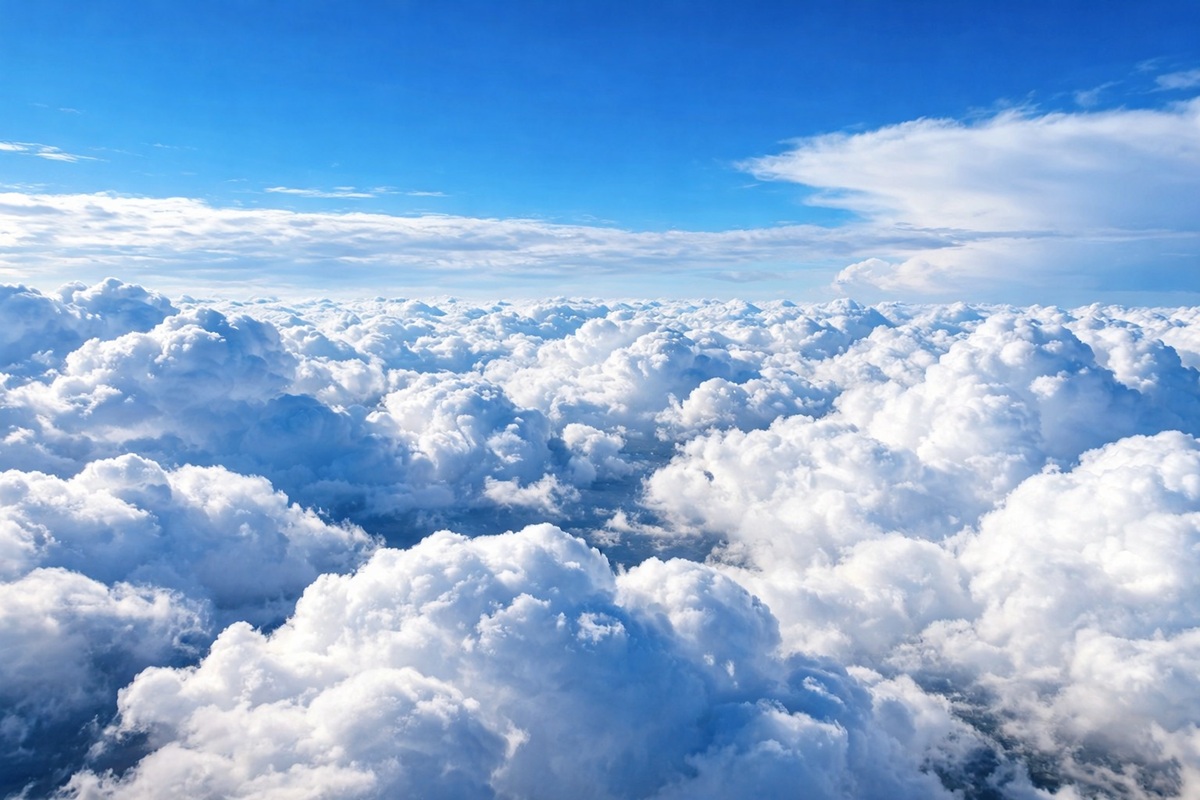
Clouds, seen from above as white and fluffy formations with bluish-gray patches, have always intrigued scientists regarding the physics governing their tops. Now, a new type of lidar has allowed unprecedented observation of these structures.
The equipment was developed at the facilities of Brookhaven National Laboratory in Long Island, New York. It is a laser remote sensing device that captures minute details of cloud structures on a centimeter scale.
-
Motorola launched the Signature with a gold seal from DxOMark, tying with the iPhone 17 Pro in camera performance, Snapdragon 8 Gen 5 that surpassed 3 million in benchmarks, and a zoom that impresses even at night.

-
Satellites reveal beneath the Sahara a giant river buried for thousands of kilometers: study shows that the largest hot desert on the planet was once traversed by a river system comparable to the largest on Earth.

-
Scientists have captured something never seen in space: newly born stars are creating gigantic rings of light a thousand times larger than the distance between the Earth and the Sun, and this changes everything we knew about stellar birth.

-
Geologists find traces of a continent that disappeared 155 million years ago after separating from Australia and reveal that it did not sink, but broke into fragments scattered across Southeast Asia.
The lidar achieves a resolution of approximately 1 centimeter, equivalent to 0.4 inches. This makes it 100 to 1,000 times sharper than traditional instruments used to study clouds.
The study was published in the Proceedings of the National Academy of Sciences. In it, Brookhaven and collaborators combined the new lidar with experiments conducted in controlled atmospheric chambers.
Clouds Under Ultra-High Resolution
According to the researchers, the new lidar provides ultra-high-resolution images of cloud dynamics. The system detects and counts individual photons, massless particles that carry light, emitted after ultrafast laser pulses hit the cloud.
A custom data sampling algorithm converts the signals from the photons into a detailed profile of the cloud structure. The device has been described as essentially a microscope for clouds by the study’s lead author, Fan Yang, a Brookhaven researcher.
The team used the equipment in a cloud chamber in Michigan. In this controlled environment, it was possible to generate clouds artificially under specific temperature and humidity conditions chosen by the researchers.
This allowed for precise documentation of how droplets are distributed throughout the cloud. A video captured by a camera above the chamber shows the boundary where air meets the top of the cloud.
At the top of the image, swirling air and descending currents of external air visibly alter the upper structure of the cloud compared to its interior.
Differences Between the Top and Interior of Clouds
The research resulted in the first experimental description capable of distinguishing the water structures at the top and inside clouds. These characteristics determine how clouds evolve, form precipitation, and affect Earth’s energy balance.
The measurements revealed a large variation in the distribution of droplets at the top of the cloud. In the rest of the cloud, the distribution was more uniform.
The researchers found that existing models were insufficient to describe the physics of clouds. The discrepancy was especially evident in the upper layer, where the observed patterns differ from traditional predictions.
This structural variation helps explain why simplified representations may fail to accurately simulate cloud behavior in atmospheric models.
Drift and Sedimentation in Clouds
Scientists attribute the differences to two main processes: drift and sedimentation. Drift pulls clean, dry air from above the cloud downward, generating irregular droplet distribution in the highest layer.
Sedimentation automatically separates droplets according to size. Heavier droplets fall more quickly within the clouds, while lighter ones remain suspended longer.
In the dense interior of the cloud, turbulence is often strong. This promotes immediate mixing and more uniform droplet distribution.
At the tops of clouds, however, turbulence is weaker. As a result, only relatively small droplets remain suspended in this region.
Yang explained that many atmospheric models completely neglect the sedimentation of droplets or represent different sizes with a single falling speed. This simplification is considered reasonable in the central region of the cloud.
However, he noted that this approach fails to work near the top of the cloud, where turbulence is weaker and the effects become more complex.
Implications for Models and Predictions
The findings have significant implications for atmospheric science. Inaccurate representations of the physics at the tops of clouds can introduce substantial uncertainties in predictions about how clouds reflect solar light and trigger rain.
The researchers argue that a better understanding of these structures is essential for improving models that assess Earth’s energy balance.
The future goal is to use the lidar to directly measure clouds in real atmosphere. This would allow for comparison between laboratory results and natural conditions.
Scientists acknowledge that a cloud chamber does not perfectly represent the dynamics of real clouds. Nevertheless, they assert that technological advancements have brought them very close to this reality.
By revealing that clouds are stranger at the top than previously imagined, the new lidar paves the way for revisions in existing models and more accurate measurements of atmospheric physics.








E muito peso sobre nossas cabeças.
Desde quando meteorologia e segurança de vôo é cultura inutil? Claro que poderiam ilustrar com fotos, mas o assunto é mais do que relevante para a pesquisa metereológica e aeroespacial.
Alguém chamou essa informação de lixo, mas não é, ela “informação” só espoe o quanto somos limitado.