





 Portuguese
  English
  Spanish
  4 min of reading
  1 comment


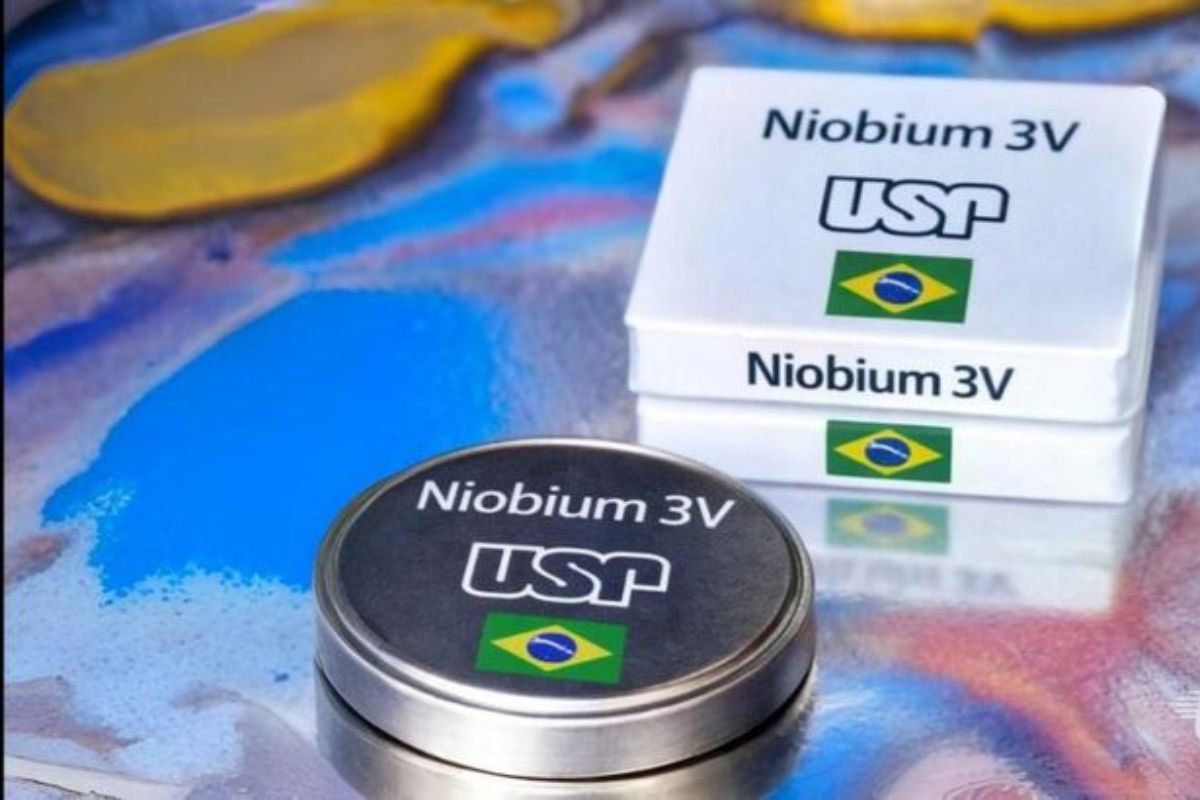


With Patent Already Filed, Scientists from São Carlos Developed a System That Stabilizes Niobium in Reversible Operation, Reaching About 3 Volts and Reducing Dependence on Lithium, Cobalt, and Nickel, While Opening a Brazilian Route to Transform Electrochemical Research into Lasting Technological, Industrial, and Geopolitical Advantage on a Future Scale.
The scientists from the Institute of Chemistry of São Carlos, at USP, presented an unprecedented battery that places niobium at the center of electrochemical storage, overcoming a historical limitation: the instability of the metal in conventional environments. The breakthrough was not to “force” the material, but to control the chemical surroundings in which it operates.
With a patent already filed, the technology proposes high energy density, reversible operation, and reduced dependence on lithium, cobalt, and nickel. The advancement comes from a Brazilian laboratory and enters a decisive phase: proving performance, durability, and safety on a larger scale, without losing national control of intellectual property.
Why Niobium Did Not Advance as a Main Element
For many years, niobium was treated as an additive in lithium batteries, not as a protagonist. The reason was chemical: under traditional conditions, the metal reacts intensely, oxidizes uncontrollably, and forms passive layers that hinder electron flow. In practice, this undermined system predictability and blocked the expected energy gain.
-
Motorola launched the Signature with a gold seal from DxOMark, tying with the iPhone 17 Pro in camera performance, Snapdragon 8 Gen 5 that surpassed 3 million in benchmarks, and a zoom that impresses even at night.

-
Satellites reveal beneath the Sahara a giant river buried for thousands of kilometers: study shows that the largest hot desert on the planet was once traversed by a river system comparable to the largest on Earth.

-
Scientists have captured something never seen in space: newly born stars are creating gigantic rings of light a thousand times larger than the distance between the Earth and the Sun, and this changes everything we knew about stellar birth.

-
Geologists find traces of a continent that disappeared 155 million years ago after separating from Australia and reveal that it did not sink, but broke into fragments scattered across Southeast Asia.

The USP team starts from an objective observation: the historical problem was not just the material itself, but the molecular environment surrounding it. This change in diagnosis alters the development strategy. Instead of abandoning niobium for being “unstable,” the scientists sought to build an architecture that made this reactivity usable and repeatable throughout charge and discharge cycles.
How the Bioinspired Solution Emerged in São Carlos
The research was conducted in the Bioelectrochemistry and Interfaces Group at IQSC, in São Carlos, under the guidance of Professor Frank Crespilho and the participation of Luana Italiano, Graziela Sedenho, and Rafael Colombo. The concept matured from previous experiences in international research environments, observing how biological systems use reactive metals without losing functional stability.
The central technical point was the inspiration from biological microenvironments: molecular structures that regulate chemical coordination, solvent contact, and electron transfer.
In simple terms, it’s like creating “local rules” for the metal to work at the limit without collapsing the system. This design allowed the scientists to convert an old chemical limitation into a controllable mechanism.
NB-RAM and N-MER: The Technical Design of the Unprecedented Battery
According to the project description, the device operates with two complementary layers. The first is the NB-RAM architecture, defined as a “chemical protection box” surrounding niobium, responsible for ordering local coordination and containing uncontrolled oxidations. This layer acts as a stability base for the active material.
The second is the N-MER, an electronic-redox mechanism that regulates how electrons enter, are stored, and leave the system.
The combination of the two fronts allows niobium to transition between oxidation states in a staggered and reversible manner, exploring multiple electrons of the same metal. This is where a key data point of the project appears: voltages in the range of 3 volts in a genuinely niobium-based proposal.
What the Prototypes Already Show and What Still Needs to be Proved
The reported prototypes demonstrated consistent operation in multiple cycles, with high electrochemical reversibility and a potential window above what was expected for niobium in classical systems.
In technical terms, this indicates that the battery does not depend solely on an initial performance peak but on repeatable behavior, a basic requirement for any real application.
At the same time, the current stage requires methodological caution. To move from the laboratory to industry, the scientists still need to expand long-term durability tests, operational safety, and manufacturing standardization.
The strength of the result lies in opening a viable path; the challenge now is to transform scientific viability into industrial robustness.
Economic, Industrial, and Geopolitical Value of Brazilian Niobium
Brazil has an abundance of niobium, and this changes the strategic conversation when the topic is the battery chain. If technology advances, the country can capture value beyond raw material exports, combining research, patents, materials engineering, and manufacturing. In this scenario, the gain is not just energetic: it is also industrial and geopolitical.
The patent filed by USP reinforces a sensitive point in the global technological dispute: those who control intellectual property tend to control margins, licensing, and the pace of adoption.
Therefore, the next move mentioned by the team involves coordinated internationalization of protection, scaling, and validation in advanced prototypes. In other words, the race now is for time, scale, and technological sovereignty.
The USP advancement repositions the battery debate in a broader axis: it is not merely about replacing one metal with another, but about redesigning the chemical environment to unlock performance with stability. The scientists have shown that niobium can stop being a secondary component and compete for space in post-lithium technologies, as long as the industrial stage confirms what the laboratory has already demonstrated.
If this battery reaches the market, in which area do you see the most direct impact on your routine: a cellphone with greater autonomy, an electric car with increased safety, or residential storage for solar energy? And what condition would be indispensable for you to trust this technology developed in Brazil?








Qualquer coisa que o Brasil inventar e ter a patente sempre entra royaltes para novas pesquisas.