





 Portuguese
  English
  Spanish
  3 min of reading
  0 comments


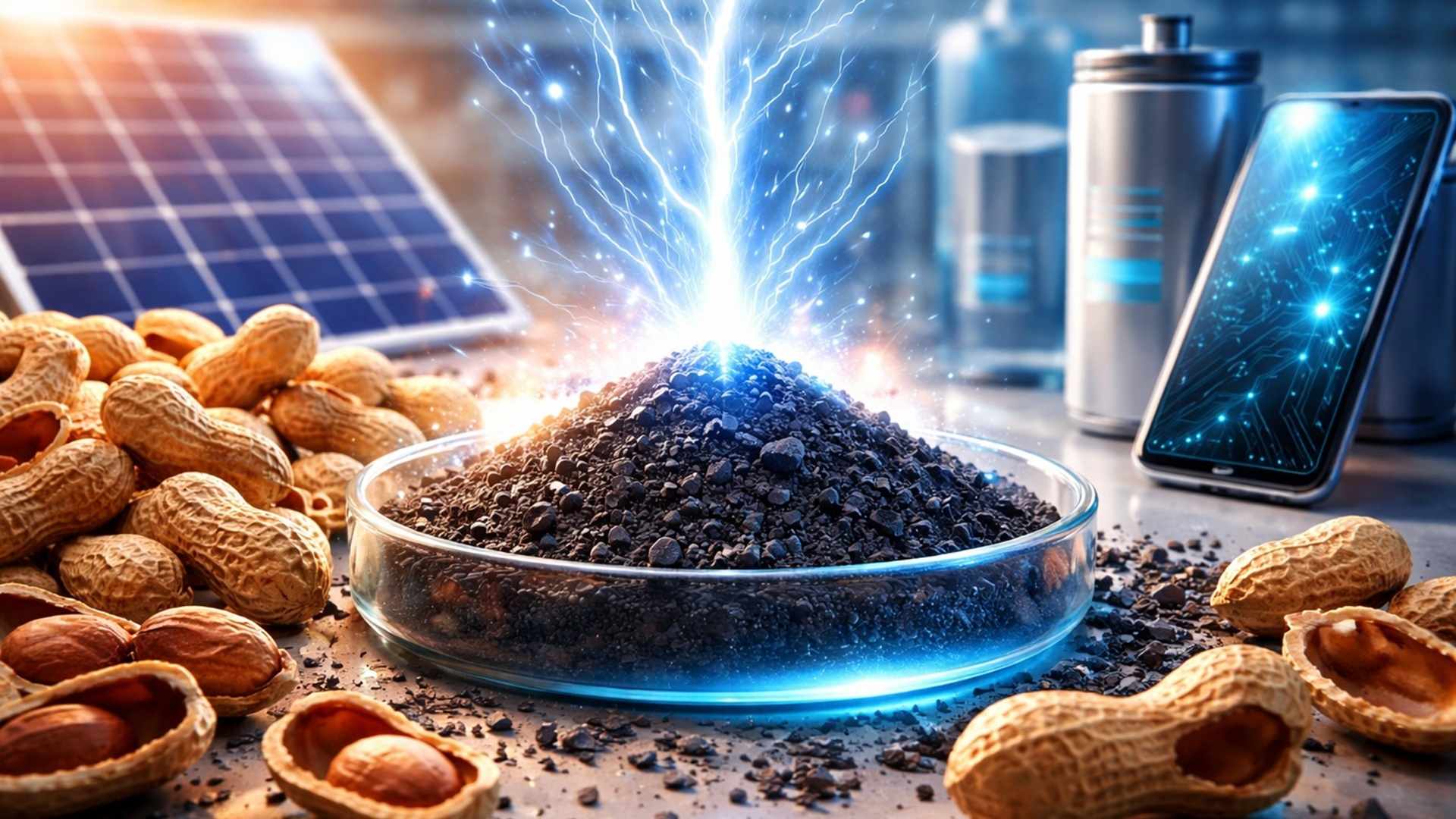
Research Conducted by UNSW Sydney Scientists Demonstrates That Agricultural Waste Generated by the Annual Production of 55 Million Tons of Peanuts Can Be Converted into Monolayer Graphene in Just 10 Minutes Using Thermal Heating and Extreme Electric Pulses Without the Application of Industrial Chemicals
Researchers at UNSW Sydney developed a process capable of converting peanut waste into graphene in about 10 minutes, using thermal heating and extreme electric pulses, without chemicals, opening new possibilities for the utilization of agricultural biomass on a technological scale.
Process Converts Peanut Shells into Graphene Without the Use of Chemical Reagents
The method developed by the scientists uses peanut shells as raw material to produce monolayer graphene.
The plant material is initially crushed and subjected to heating of approximately 500 °C for five minutes.
-
Motorola launched the Signature with a gold seal from DxOMark, tying with the iPhone 17 Pro in camera performance, Snapdragon 8 Gen 5 that surpassed 3 million in benchmarks, and a zoom that impresses even at night.

-
Satellites reveal beneath the Sahara a giant river buried for thousands of kilometers: study shows that the largest hot desert on the planet was once traversed by a river system comparable to the largest on Earth.

-
Scientists have captured something never seen in space: newly born stars are creating gigantic rings of light a thousand times larger than the distance between the Earth and the Sun, and this changes everything we knew about stellar birth.

-
Geologists find traces of a continent that disappeared 155 million years ago after separating from Australia and reveal that it did not sink, but broke into fragments scattered across Southeast Asia.

This treatment removes impurities and generates a carbonaceous material derived directly from the agricultural waste.
The presence of lignin, abundant in peanut shells, provides the carbon-rich base necessary for the structural transformation.
In the next stage, heatingnto occurs by Joule effect. An electric pulse rapidly raises the temperature to about 3,000 °C for milliseconds, rearranging the carbon atoms into virtually defect-free graphene layers.
The entire process takes about 10 minutes and eliminates the need for the addition of chemicals or petroleum-derived raw materials.
Global Peanut Production Reveals Potential of Underutilized Agricultural Wastes
Approximately 55 million tons of peanuts are produced annually worldwide. A large portion of the shells generated from this volume ends up being allocated to low economic value applications or simply discarded.
The researchers identified the lignin present in this waste as an ideal starting point for graphene production.
The plant polymer contains a high concentration of carbon, an essential characteristic for the formation of the material.
The method replaces the traditional use of carbon black, which is normally obtained from fossil fuels. Instead, it uses only the charcoal produced from the peanut biomass itself.
According to the team, the simplicity of the process reduces industrial steps and eliminates the need for additional chemical systems.
Estimated Energy Costs Indicate a New Route for Graphene Production
According to calculations presented by the researchers, producing one kilogram of graphene using this system may require energy equivalent to approximately US$ 1.30 per kilogram.
This value represents an alternative compared to conventional methods, which typically demand high energy consumption and continuous industrial infrastructure.
The speed is also noteworthy. The extreme heating occurs in milliseconds, unlike traditional processes that rely on long periods in continuously operating industrial furnaces.
Despite the progress, the researchers indicate that the quantities produced are still small. Commercial viability will depend on reproducing the quality of graphene at scale and integrating with existing industrial chains.
Industrial Applications Expand Interest in Graphene Obtained from Peanuts
The graphene produced from peanut waste has potential applications in various technological sectors. These include batteries and supercapacitors, with the possibility of improving energy density and charging speed.
The material can also be utilized in lighter and more flexible solar cells, flexible electronics, touch screens, and highly sensitive medical and environmental sensors.
Other applications include ultrafast transistors and systems related to energy storage, data centers, and portable medical devices.
The demand for more efficient technologies continues to grow, driving interest in high-performance conductive materials produced with lower energy impact.
Biomass Beyond Peanuts Expands Possibilities of Lignin-Based Technology
The researchers highlight that the central element of the process is lignin, present in various forms of plant biomass. This allows the method to be adapted to other organic wastes.
Examples cited include coffee grounds, banana peels, and forest by-products. Utilizing these materials expands the concept of utilizing agricultural waste for graphene production.
The technology fits into a scenario of enhancing the circular bioeconomy, focused on converting organic waste into high-value materials.
According to the team, the proposal is not limited to traditional recycling.
The goal is to enable the direct transformation of biomass into technological inputs, connecting agricultural production and the advanced materials industry through the utilization of peanuts and other plant sources.








-

-

-

-

-

13 pessoas reagiram a isso.