





 Portuguese
  English
  Spanish
  4 min of reading
  0 comments


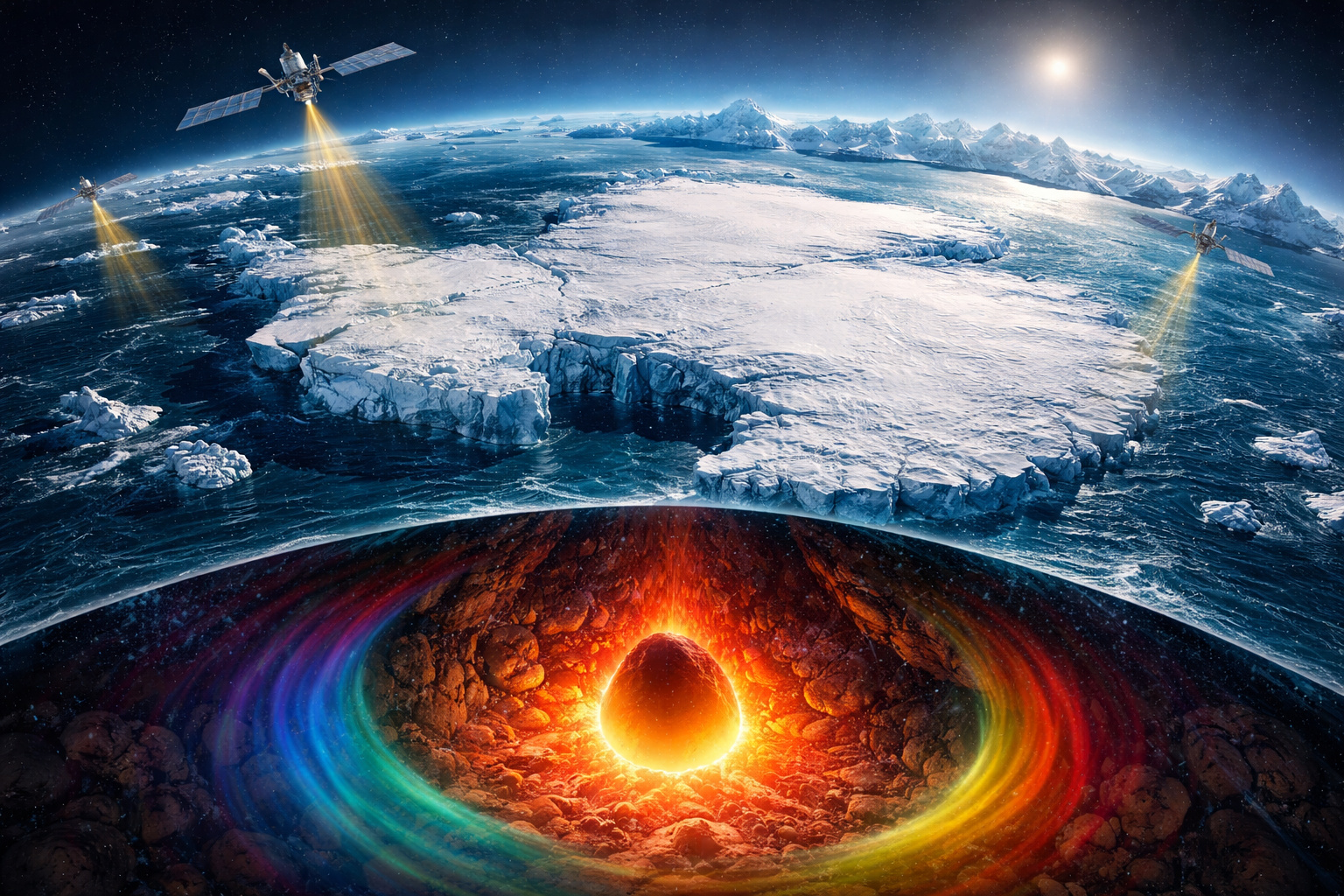
New Model Based on Seismic Data Shows a Gravitational Anomaly in the Called Antarctic Geoid Low, Which Has Intensified in Recent Million Years, Altering Local Gravity and Raising Alerts About Indirect Impacts on Ice and Sea Level
There is an invisible “hole” beneath Antarctica that does not appear in common satellite images. It is neither a tunnel nor a crater. It is a gravitational anomaly so extensive that it challenges classical geophysical models.
And the most intriguing part: it is getting more intense.
Researchers have reconstructed the history of this depression in Earth’s gravitational field and discovered that the phenomenon has existed for at least 70 million years and has gained strength over time. The reason lies thousands of kilometers below our feet.
-
Friends have been building a small “town” for 30 years to grow old together, with compact houses, a common area, nature surrounding it, and a collective life project designed for friendship, coexistence, and simplicity.

-
This small town in Germany created its own currency 24 years ago, today it circulates millions per year, is accepted in over 300 stores, and the German government allowed all of this to happen under one condition.

-
Curitiba is shrinking and is expected to lose 97,000 residents by 2050, while inland cities in Paraná such as Sarandi, Araucária, and Toledo are experiencing accelerated growth that is changing the entire state’s map.

-
Tourists were poisoned on Everest in a million-dollar fraud scheme involving helicopters that diverted over $19 million and shocked international authorities.


The Billion-Dollar Enigma of the Gravitational Field That Turns Earth into an Irregular “Potato”
Earth appears as a perfect sphere when viewed from space. However, when scientists analyze the so-called geoid, the story changes completely.
The geoid represents how gravity is distributed across the planet. Instead of a smooth ball, it resembles a surface full of highs and lows. One of the deepest points of this “gravitational depression” is beneath the Antarctic.
This means that gravity there is slightly weaker. The weight difference for a person would be just a few grams. Almost imperceptible.
But on a planetary scale, the impact is gigantic.
This lowering, known as Antarctic Geoid Low, extends over a continental area. It is as if a gigantic invisible cavity is shaping the ocean surface around the icy continent.
And this changes the game for those studying climate, ice, and sea level.
The Secret Revealed by Earthquakes That Function as an “X-Ray” of Earth’s Natural Engineering
To understand what is happening with this gravitational anomaly, scientists turned to a powerful tool of modern geophysics: seismic waves.
When an earthquake occurs, the waves traverse the interior of the Earth. They change speed as they encounter denser or hotter rocks.
Based on this data, researchers constructed a three-dimensional model of the Earth’s mantle beneath Antarctica. It’s like performing a complete tomography of the planet.
From there, they created a new gravitational map and compared it with data from satellites specialized in measuring gravity. According to experts, the results were compatible with records considered the gold standard.
But the next step was even bolder.
They “rewound” the planet in computational simulations to observe how this anomaly evolved over the past 70 million years.
The Slow Movement of Deep Rocks That Strengthened the Gravitational Anomaly and May Have Influenced Antarctic Ice
Models indicate that large tectonic plates have sunk beneath Antarctica over millions of years. These plates descended deeply into the mantle, altering the mass distribution within the planet.
At the same time, a giant region of hot, less dense material rose slowly.
This combination has thus strengthened the gravitational depression over the past 40 million years.
There is a detail that draws attention.
The intensification of the anomaly occurred during a period close to the beginning of the great glaciation of Antarctica, about 34 million years ago.
Researchers consider this connection a hypothesis. There is still no direct confirmation. But there is a technical point that intrigues the scientific community.
The geoid influences the sea level. When it “sinks,” the ocean surface follows this change.
This means that the gravitational lowering may have reduced sea level around the continent, creating conditions that favored the growth of the ice sheet.
If confirmed, therefore, we are talking about a deep geodynamic gear interfering with the global climate system.
The Domino Effect That Links Earth’s Mantle, Rotation Axis, and Monitoring by High-Precision Satellites
The study also tested whether the model could reproduce a phenomenon called True Polar Wander, which corresponds to real changes in Earth’s rotation axis over geological time.
According to researchers, the simulations thus reached results compatible with historical records of these variations.
This suggests that the same processes which shape the Earth’s interior also influence gravity distribution, the position of the Earth’s axis, and the dynamics of ice masses.
For sectors linked to mineral exploration, energy, and satellite monitoring, understanding these variations is not mere academic curiosity.
Space missions that measure gravity are essential for mapping underground reservoirs, tracking melting, monitoring aquifers, and assessing the stability of large continental masses.
Understanding what is happening beneath Antarctica helps calibrate models used in the geophysical industry and energy sector.
And this is happening now, at a time of global attention to climate and environmental security.
In the end, the so-called “gravitational hole” is not just a scientific eccentricity. It exposes how slow and deep processes continue to shape the planet’s surface and can influence everything from polar ice to sea level that affects coastal cities around the world.
And you, do you believe that such deep movements can alter the future of global climate? Share your opinion in the comments.










-

-

-

-

-

-

48 pessoas reagiram a isso.