





 Portuguese
  English
  Spanish
  7 min of reading
  0 comments


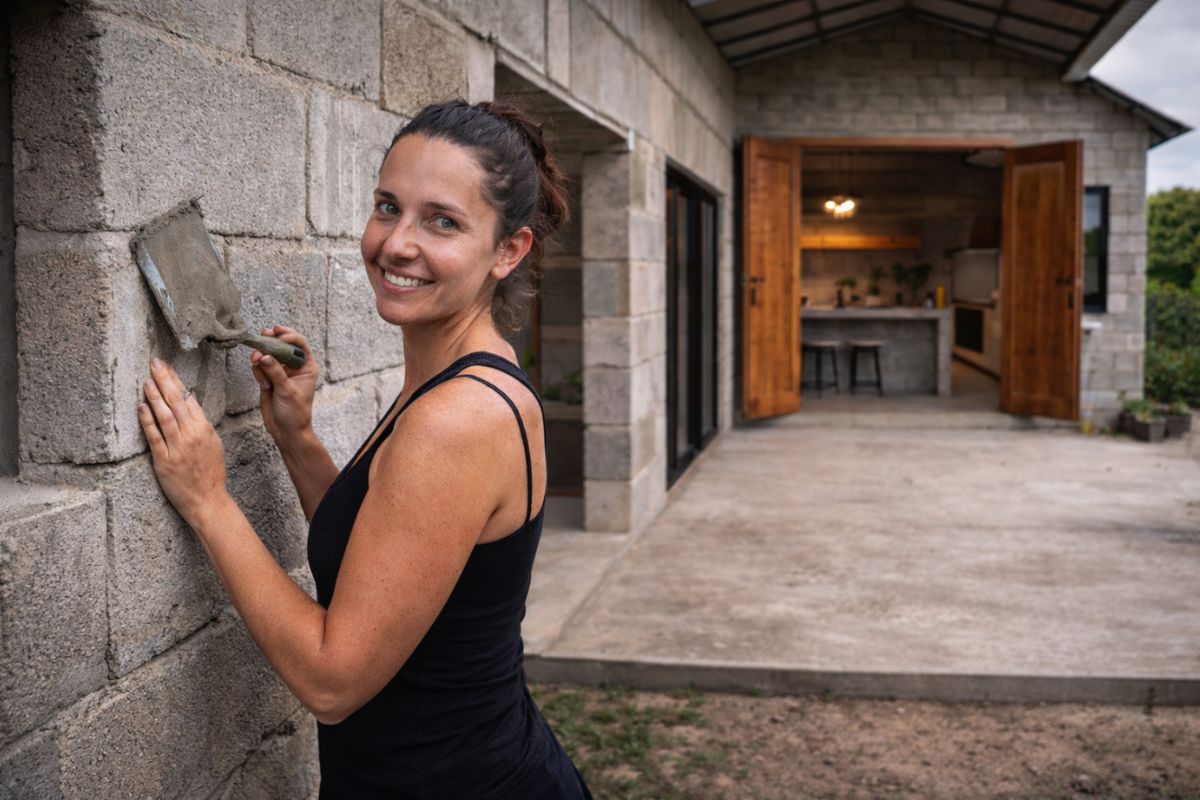
In The Exposed Block House Designed By The Resident Architect And Author Of The Work With Her Husband, The Savings Came From The Combination Of Structural Masonry, Metal Structure And Homemade Manufacturing Of Doors, Counters, Sinks And Furniture, In A Long, Technical Process Full Of Adjustments Throughout The Entire Execution.
The exposed block house originated from an aesthetic and structural decision at the same time. Instead of following a conventional construction with finishes that hide materials, the couple opted for visible solutions, self-execution, and choices that reduced steps, such as the use of structural masonry integrated with the metal structure.
The result draws attention for its industrial visual balanced with wood, vegetation, and natural light, but the most relevant point lies in the method. The savings did not come from an isolated trick, but rather from the sum of project decisions, hands-on work, and technical adaptation during construction and the finishing phase.
The Choice Of The Exposed Block And What It Changes In The Work

The resident, architect and author of the project, started with a long-standing preference for exposed materials and refined the idea until arriving at the exposed block system. In practice, the house was designed with structural masonry, which alters the logic of the work from the outset, as part of the structure is resolved within the blocks themselves, with grouted points and specific reinforcements.
-
Friends have been building a small “town” for 30 years to grow old together, with compact houses, a common area, nature surrounding it, and a collective life project designed for friendship, coexistence, and simplicity.

-
This small town in Germany created its own currency 24 years ago, today it circulates millions per year, is accepted in over 300 stores, and the German government allowed all of this to happen under one condition.

-
Curitiba is shrinking and is expected to lose 97,000 residents by 2050, while inland cities in Paraná such as Sarandi, Araucária, and Toledo are experiencing accelerated growth that is changing the entire state’s map.

-
Tourists were poisoned on Everest in a million-dollar fraud scheme involving helicopters that diverted over $19 million and shocked international authorities.


This changes cost, time, and execution. According to the construction report, there is a reduction in the use of wooden formwork and a gain in rationalization in stages that, in traditional systems, would require more forms, more finishes, and more coverage to hide structural elements. The final aesthetics is born together with the structure, which reduces rework.
At the same time, the solution has technical limits. Large spans and elevated ceilings required supplementation with an exposed metal structure, mainly at openings and large doors. This highlights an important point of the exposed block house: it was not treated as a miracle solution for everything, but rather as part of a hybrid system.
This combination allowed for maintaining the desired design without forcing masonry beyond its capacity. Instead of insisting on a single solution, the project separated what the block could support and what required steel. This adjustment is what gives consistency to the result, because it preserves safety and enables designs with large spans.
Timeline, Pandemic, And The Real Cost Of Time

The initial plan, according to the couple, was to have the structural portion resolved in about six months, with the construction rising and receiving coverage at an accelerated pace. The metal assembly, for instance, appeared as one of the fastest stages, with execution taking a short time after the parts were manufactured.
But the schedule did not follow the original forecast. The pandemic, difficulties in finding professionals, and the need to carry out a significant part of the work with hands-on effort extended the process to approximately a year and a half. This data is essential for understanding the real savings, because saving money often means investing more time.
The hands-on effort became crucial precisely at this point. The couple worked and executed tasks at possible times, advancing in finishing, installations, and piece manufacturing stages. This reduces expenditures on third parties, but requires planning, discipline, and tolerance for mistakes, adjustments, and redoing.
In authorial works, this balance tends to be the greatest challenge. The exposed block house shows that savings can exist, but it does not come without operational cost. The lower price for outsourced services was offset by a workload, study, and continuous execution, including in details that would normally be delegated.
Concrete, Flooring, Sinks, And Finishes Made By The Residents
One of the strongest axes of the house lies in the use of concrete on different scales, from flooring to sinks. The chosen flooring was polished concrete, frequently confused with burnt cement. The distinction is both technical and practical, as polished concrete is applied as a thicker layer and undergoes mechanical polishing, while burnt cement usually has a more manual and superficial application.
After execution, the flooring received resin. This stage was presented as decisive for maintenance and cleaning, in addition to altering the final coloring. Without the resin, the tendency would be for greater marking and a stained appearance, which shows that the initial savings of an exposed finish needs to consider the cost of protection and durability.
The concrete sinks also reinforce this reasoning. Instead of buying ready-made pieces for all environments, the couple produced sinks and countertops, including versions in concrete and white concrete. The financial gain comes along with personalization benefits, but the execution requires formwork, curing control, installation, and the ability to correct when something goes wrong.
And something did go wrong at least in one stage, when a form opened during the pouring of the countertop and the concrete spread, requiring reinforcement and redoing. This is important because it takes the narrative away from idealization. The savings from hands-on work appear even when there is a mistake, as long as the resident has the knowledge and willingness to correct it without compromising the overall project.
Giant Doors, Custom Carpentry, And Made-To-Measure Manufacturing
If there is one element that encapsulates the spirit of the work, it is the set of large metal doors. The main door, about 3 meters tall, was treated as the central piece of the project and required prolonged study, prototypes, learning welding, and tests with pulleys and opening mechanisms until arriving at the correct operation.
The fabrication was carried out by the husband, who did not master welding at the beginning of the process. There was a long period of research, reduced prototypes to test the mechanism, and many adjustments in the field. This was not improvisation, but domestic prototyping with method, something rare in conventional residential work.
This logic was repeated in carpentry and adapted pieces. Furniture was designed, modified, or assembled for different functions, such as sideboards, racks, headboards, support structures, and technical furniture. In some cases, the pieces came cut and without drilling, and the assembly, drilling, fixing, and adjustments were left to the resident.
The result is a house with a strong identity and costs spread over stages. In practice, the savings come from replacing specialized labor with the residents’ work, but also from project decisions that already anticipated this path. When the design is compatible with self-manufacturing, improvisation decreases and utilization increases.
Smart Layout On A Narrow Lot And Integration Of The Environments
Another relevant technical point of the exposed block house lies in the use of the lot. Instead of maintaining wide side corridors on both sides, the installation leaned against one side to preserve internal usable width. On a narrow lot, this type of decision completely alters the perception of spaciousness.
According to the explanation given during the visit, losing about 1 meter in width could compromise the stairs, circulation, and organization of the ground floor. By concentrating passage on one side and opening up the rest, the house gained a wider social area, with an integrated living room, kitchen, and dining area. It is an indirect saving, as it improves spatial performance without increasing built area.
The integration was also reinforced by furniture choices and the visual continuity of materials. The long rack connects environments, the island became a gathering center, and the absence of upper cabinets in some points preserved openness and lightness. At the same time, the exposed block and concrete receive visual counterweights of wood, leather, and vegetation.
This combination prevents the industrial style from weighing too heavily. The resident’s discourse is clear in seeking contrast between cold and warm, weight and lightness. In practice, the exposed block house works better because it does not rely solely on the exposed block, but rather on the composition of materials, light, greenery, and the scale of furniture.
Stairs, Second Floor, And A Project That Continues In Phases
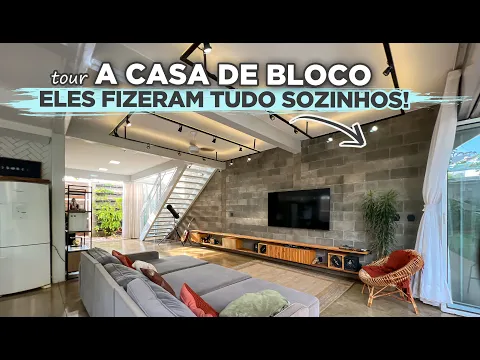

The second floor shows that the house was not completed as a finished product, but rather as an evolving work. There are offices, a workshop, a reversible bathroom, and a bedroom with planned future expansions, including a suite that is yet to be completed. This phased approach is typical of those who build with controlled resources and hands-on execution.
The metal staircase with concrete treads, generous natural lighting, and the chandelier with a metal structure reinforce the standard of the house, where functional elements also become architectural language. The staircase was not treated as a secondary space, and this improves circulation, comfort, and visual quality at the heart of the residence.
On the upper floor, the execution of drywall walls, electrical work, ceilings, painting, furniture, and even mechanical adaptations, such as a bed integrated into a workout space, demonstrates the extent of the couple’s involvement in the work. It is not merely about decorating after it is finished, but about constructing and adapting infrastructure.
There are also economic choices linked to priority of use. A bathroom was dimensioned and organized to serve two areas with the possibility of future division, postponing investment in another complete wet area. In residential construction, wet areas are costly, and delaying this phase without sacrificing functionality is a project decision that has a direct impact on finances.
The exposed block house presented by the couple does not prove that every work should follow the same path but clearly shows where savings can arise when project, technique, and execution walk together. The gain appeared in the reduction of outsourcing, the rational use of exposed materials, the manufacturing of custom pieces, and layout decisions that expanded use without increasing costs.
It is also clear that this model requires repertoire, time, and willingness to test, make mistakes, and redo. It is not passive savings, but savings built step by step, with study and manual labor. If you were planning a house, which part would you have the courage to get hands-on first, structure, finishing, carpentry, or just small details?










-

-

-

-

-

-

12 pessoas reagiram a isso.