





 Portuguese
  English
  Spanish
  6 min of reading
  1 comment


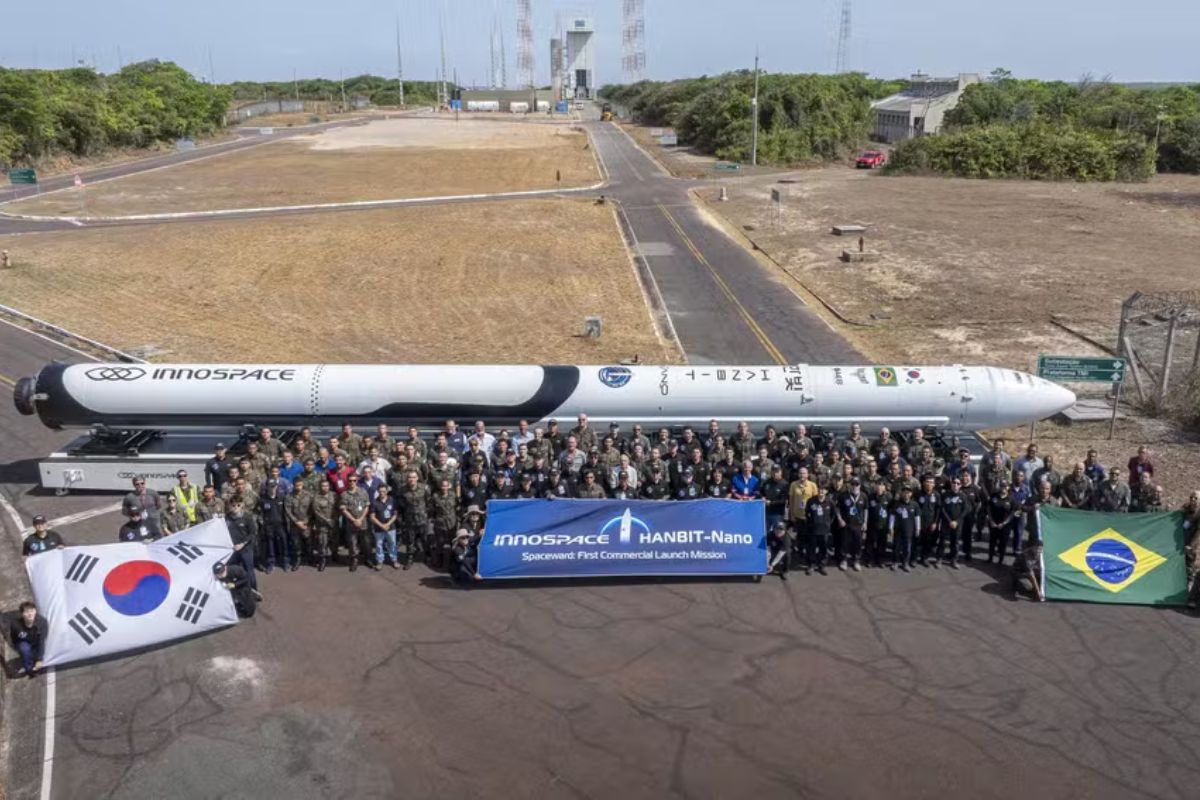


On Brazil’s 1st Commercial Flight, HANBIT-Nano Rocket Launches from Alcântara Launch Center with Brazilian University Satellites and Indian Partner, Measuring Environment, Communication, Solar Activity, and Navigation to Permanently Position the Country in the New Global Economy of Competitive, Sustainable, Strategic, Inclusive, and Historical Space Launches.
On Brazil’s 1st commercial flight, the South Korean HANBIT-Nano rocket will launch this Wednesday (17) from the Alcântara Launch Center (CLA) on the coast of Maranhão, carrying eight payloads and inaugurating the first commercial mission to place satellites in orbit from national territory.
Coordinated by the Brazilian Air Force (FAB) and the Brazilian Space Agency (AEB), the operation mobilizes 500 civilian and military professionals, integrates five satellites and three experiments developed by institutions in Brazil and India and, if successful, could strategically position Brazil in the competitive global space launch market.
Environmental, Communication, and Solar Satellites on Board the HANBIT-Nano

The 1st commercial flight of Brazil carries a constellation of small satellites with very different, but complementary functions for science and industry.
-
Millions of people have been eating yam for centuries without knowing that this humble tuber contains a compound called diosgenin, which scientists have now discovered can improve memory and help control blood sugar levels.

-
Scientists from an international project drill 1,800 meters of ice in Antarctica using hot water and discover details about one of the most intriguing places on planet Earth.

-
Seen from space, a colossal volcano nearly 5,000 meters high in Russia has released 1,600 km of smoke over the Pacific, forming “devil’s horns” of lava and revealing the brutal force of the Ring of Fire.

-
Expedition 501: Scientists drill into the ocean floor and discover a giant reserve of fresh water hidden beneath the sea, extracting nearly 50,000 liters and revealing an invisible system that could reshape the map of water scarcity.


In total, there are five satellites and three onboard experiments, planned to operate in more than five research fronts: environmental data collection, orbital communication, sending messages to space, rocket navigation, solar monitoring, and high-precision positioning.
Among the satellites, one of the highlights is Jussara-K, developed by the Federal University of Maranhão (UFMA) in partnership with startups and national institutions.
Its mission is to collect environmental data in hard-to-reach areas, communicating with strategically positioned ground data collection platforms in the Alcântara region, enhancing the capacity to monitor Maranhão territory in almost real-time.
Also on the 1st commercial flight of Brazil are the FloripaSat-2A and FloripaSat-2B satellites, created in the SpaceLab laboratory at the Federal University of Santa Catarina (UFSC).
The FloripaSat-2B is produced entirely in Brazil and, along with model A, is expected to validate technologies developed at the university in orbit, using the FloripaSat-2 platform as a basis for future space missions.
The satellites will test a communication system via LoRa, a low-energy technology already used in Internet of Things (IoT) applications.
Another emblematic satellite is the PION-BR2, dubbed Scientists of Alcântara. It will send messages from public school students in the Maranhão municipality to space, in an effort to bring quilombola communities closer to space activities.
Developed by UFMA in partnership with AEB, the United Nations Development Program (UNDP), and the startup PION, the device will also test national communication systems, energy, solar panels, and onboard computers, strengthening the Brazilian space industry’s supply chain.
Among the international payloads, the HANBIT-Nano carries Solaras-S2, an experiment from the Indian company Grahaa Space focused on solar observation.
The goal is to monitor solar phenomena that may interfere with communication systems, navigation, and other technologies on Earth, providing data of great interest to both scientists and telecommunications service providers.
Brazilian Navigation Technology Tested in Real Flight
The 1st commercial flight of Brazil also acts as a large laboratory to validate national navigation technologies in real flight conditions.
Aboard the HANBIT-Nano is an Inertial Navigation System (INS) called SNI-GHSS, a 100% Brazilian platform commissioned by AEB and developed by companies such as Concert Space, Cron, and HORUSEYE TECH.
This system is capable of accurately determining the speed, position, and attitude of the rocket along its trajectory, allowing for greater control and mission efficiency.
If performance is confirmed, the technology opens avenues for Brazilian companies to compete in market niches related to rockets, drones, and terrestrial and maritime vehicles, which can also use this type of advanced inertial navigation.
Another navigation experiment carried by the HANBIT-Nano is an Inertial Navigation System with an autonomous navigation algorithm assisted by GNSS, developed by the company Castro Leite Consultoria (CLC). It will be tested in a suborbital environment, generating data for future application in onboard systems on space missions.
The company has two devices onboard, but at the manufacturer’s request, the FAB will have access to data from only one of them, highlighting the sensitive and strategic nature of this type of technology.
What is the Rocket of Brazil’s 1st Commercial Flight Like
Developed by the South Korean startup Innospace, the HANBIT-Nano is a rocket designed for launching small satellites, a segment that is growing the fastest in the global space market.
Authorized by the Brazilian Air Force since May to operate in Alcântara, the vehicle will conduct Brazil’s 1st commercial flight after a history of tests, including a successful test flight with the HANBIT-TLV model, carried out in March 2023, which lasted 4 minutes and 33 seconds.
The HANBIT-Nano is 21.9 meters tall, 1.4 meters in diameter, and weighs 20 tons, equivalent to about four African elephants.
According to specifications, it can fly up to 30 times faster than a commercial airplane, a speed necessary to place satellites in low orbit with precision.
The launch will be performed in two stages and can be seen with the naked eye in the skies of Alcântara and parts of São Luís, reinforcing the symbolic nature of this commercial debut for the local population.
Alcântara, Equator Line, and Brazil’s Advantage in Space
The backdrop of this 1st commercial flight of Brazil is the Alcântara Launch Center, built in the 1980s specifically to meet the technical and logistical requirements of the Brazilian Space Program.
Located near the equator, the Maranhão launch site offers significant natural advantages: the lower the latitude, the less fuel consumption and shorter travel time to orbit, thanks to the greater rotational speed of the Earth’s surface in this region.
Moreover, the coast of Alcântara has an extensive shoreline, low air traffic density, and allows for a wide range of orbital inclinations, facilitating missions of different profiles.
In practice, this means that the CLA can offer cheaper and more flexible launches, a crucial argument for competing in a market where every dollar and every kilogram launched counts.
A fundamental step to turning this geographical advantage into business opportunities was the Technology Safeguards Agreement (AST) signed in 2019 between Brazil and the United States.
Under the agreement, equipment with American technology can be launched from Alcântara, generating financial compensation for Brazil and unlocking access to a large portion of components used in rockets worldwide.
Previously, each launch required specific authorization, which hindered the country’s entry into the global market.
After the AST, the AEB launched a public notice to select private companies interested in using the Maranhão site.
Four companies were approved, including Innospace, the owner of HANBIT-Nano, which now plays a leading role in Brazil’s 1st commercial flight from Alcântara.
Brazil on the Map of the Global Space Launch Market
Brazil’s 1st commercial flight with the HANBIT-Nano is not just a symbolic milestone.
The mission brings together public universities, national startups, an Indian company, and a South Korean operator around the same rocket, showing that Alcântara can function as a platform for international space services and not just as a project for exclusive military or governmental use.
If the environmental, communication, and solar observation satellites meet their goals, and if Brazilian navigation systems are validated in flight, the country gains a strong business card to negotiate new contracts, attract more companies, and consolidate the Maranhão base on the agenda of operators worldwide.
In this scenario, each new launch contract can mean more qualified jobs, more research at universities, and more revenue for the Brazilian Space Program.
The combination of a privileged location, installed infrastructure, international safeguards agreement, and increasing private sector participation makes Brazil’s 1st commercial flight seen as a turning point.
And you, do you think that Brazil’s 1st commercial flight departing from Alcântara has the potential to truly transform the country’s place in the global space market?









É pena que perdi a transmissão do lançamento!🥲