





 Portuguese
  English
  Spanish
  3 min of reading
  0 comments


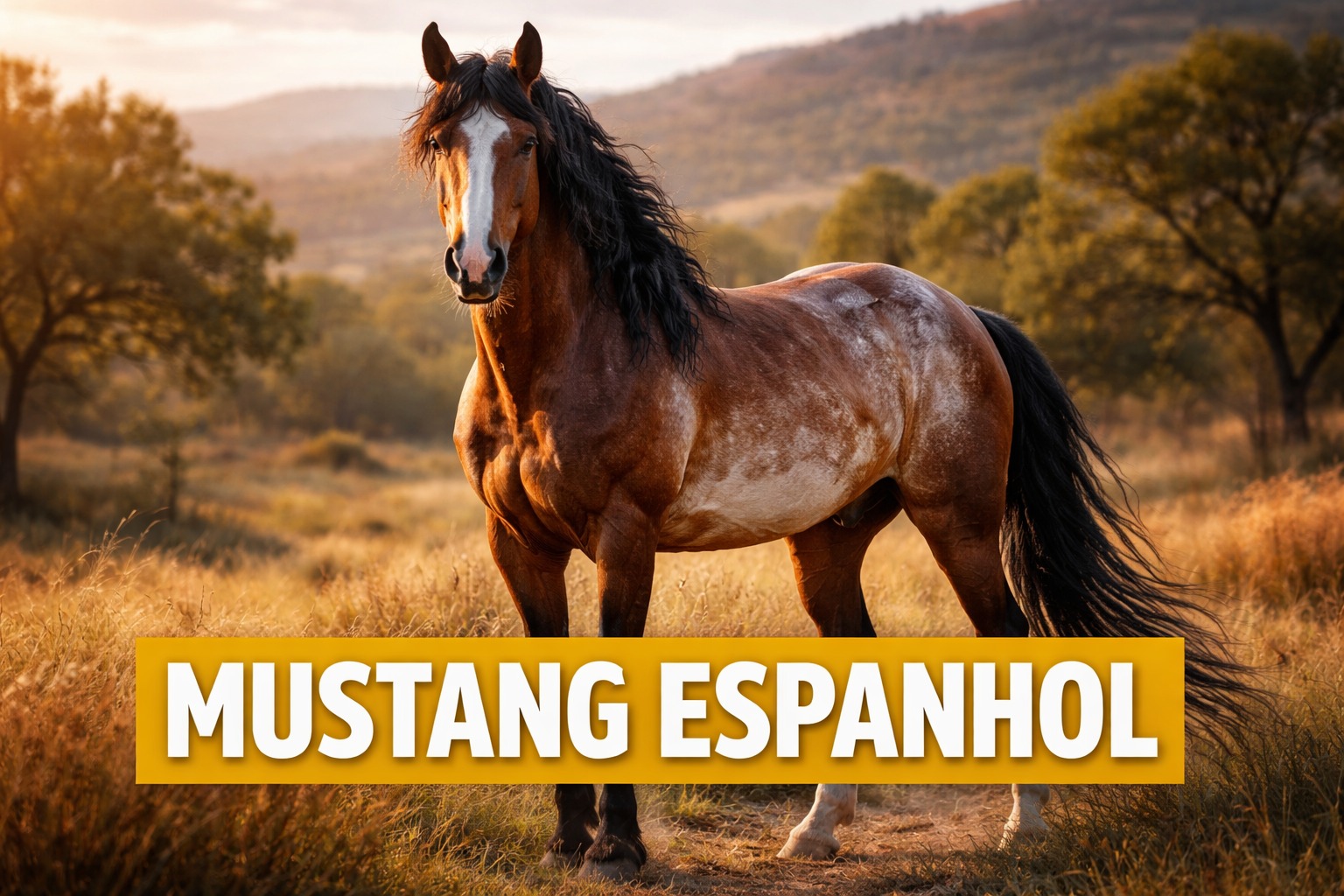
Expression Suggests Nobility, But Records Show That Sultan Is Not a Recognized Lineage. Name Reflects Individual Attributes, While Spanish Mustang Highlights Resistance, Hardiness, Physical and Behavioral Characteristics Shaped by Centuries in the Americas
The name “Spanish Mustang Sultan” may suggest a rare lineage or a recognized title, but the reality is simpler. There is no official record of this designation within the classification of the Spanish Mustang. The expression appears to be, by all indications, a personal choice, created to highlight the grandeur and charisma of a specific horse.
Just like so many other animals, individual names often reflect appearance, temperament, or even the history of the specimen, without necessarily indicating a distinct genetic origin.
A Designation Without Formal Recognition
According to the Spanish Mustang Registry, the entity responsible for maintaining standards and information about the breed, “Sultan” does not appear as an official nomenclature.
-
Friends have been building a small “town” for 30 years to grow old together, with compact houses, a common area, nature surrounding it, and a collective life project designed for friendship, coexistence, and simplicity.

-
This small town in Germany created its own currency 24 years ago, today it circulates millions per year, is accepted in over 300 stores, and the German government allowed all of this to happen under one condition.

-
Curitiba is shrinking and is expected to lose 97,000 residents by 2050, while inland cities in Paraná such as Sarandi, Araucária, and Toledo are experiencing accelerated growth that is changing the entire state’s map.

-
Tourists were poisoned on Everest in a million-dollar fraud scheme involving helicopters that diverted over $19 million and shocked international authorities.


This reinforces that the term does not define an established lineage. Instead, it functions as a descriptive designation, adopted by breeders or owners to highlight striking attributes, such as an upright posture or impressive stature.
The choice of the word symbolically refers to the idea of leadership and a strong presence, qualities often associated with the historical figure of sultans.
Preservation and Historical Legacy
The history of the Spanish Mustang carries a strong component of preservation. In the mid-1950s, a group led by Robert E. Brislawn, in Oshoto, Wyoming, mobilized to safeguard the last specimens considered authentic of the breed.
At that time, these horses, once abundant in the western United States, were already facing the risk of disappearance.
Brislawn conducted a careful selection, keeping only the animals he believed represented the ideal standard.
The choice of the name “Spanish Mustang” for the official registry reflected exactly this essence. The term conveys resistance, tenacity, and Spanish genetic heritage, central characteristics of these equines.
Direct descendants of the horses introduced to the continent during the colonial period, they preserve traits that favored their survival in challenging environments.
Physical and Behavioral Traits
Spanish Mustangs typically stand between 1.35 m and 1.50 m at the withers, with weights ranging from 350 kg to 450 kg. Their coat is varied, including bay, chestnut, gray, black, and pinto.
The head tends to be proportional, with a straight or slightly convex profile, while long, mobile ears ensure sharp hearing. The combination results in a compact, muscular, and agile build.
In terms of behavior, they stand out for their intelligent, alert, and highly resilient temperament. They demonstrate a strong sense of direction, agility, and speed, as well as remarkable hardiness, a trait that allows them to adapt to extreme climates and scarce food.
They are frequently used in endurance competitions and Western events.
Throughout the centuries in the Americas, these horses have undergone notable changes. They developed broader heads, longer ears, sharper vision, and a strong sense of direction.
These adaptations consolidated strength, hardiness, and unusual survival skills in domesticated horses.
Therefore, although “Spanish Mustang Sultan” sounds majestic and evocative, it does not define a recognized lineage.
It is a nominal choice that emphasizes grandeur and symbolism, keeping alive, albeit informally, the historical aura that surrounds the Spanish Mustang and its legacy on the continent.
With information from Compre Rural.









-

-

5 pessoas reagiram a isso.