





 Portuguese
  English
  Spanish
  6 min of reading
  0 comments


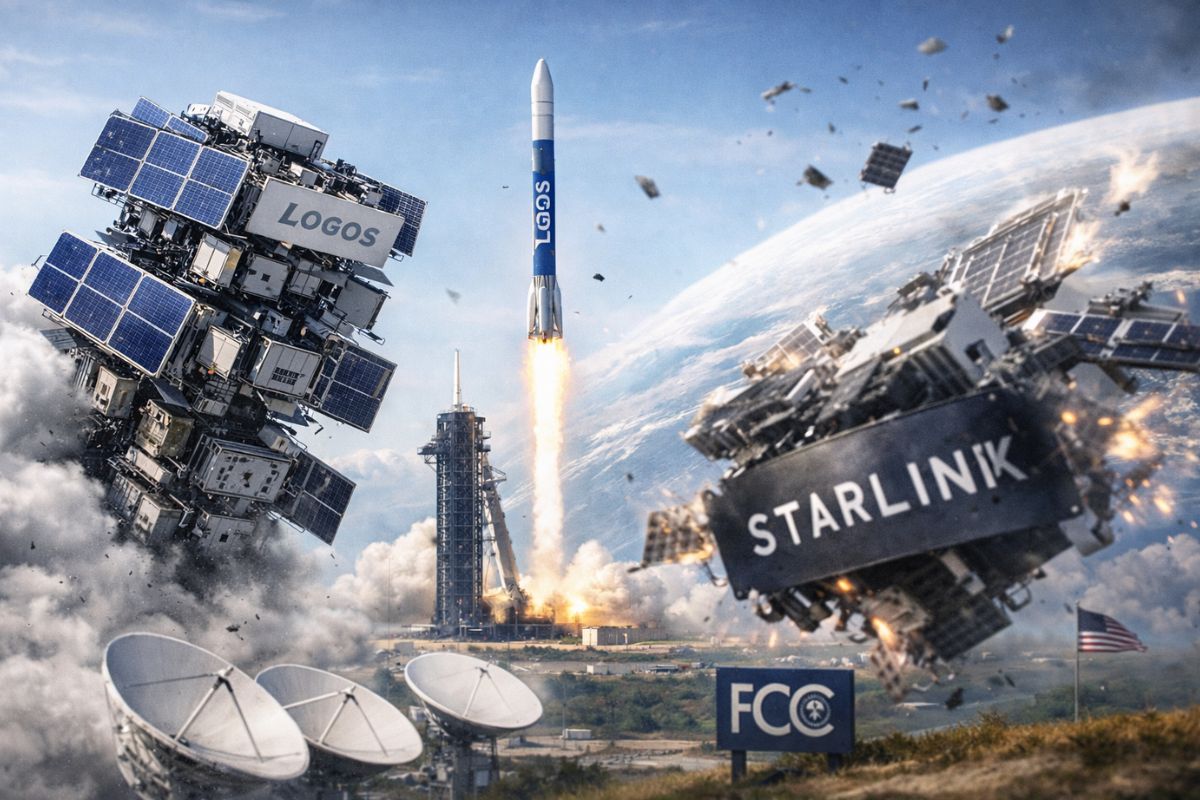
The Approval Of The FCC For Logos To Launch 4,178 Broadband Satellites Signals A New Phase In The Dispute With Starlink, Opening Space For Services Focused On Governments And Large Companies.
For years, Starlink has been practically synonymous with low Earth orbit satellite internet, accumulating about 9,600 operational satellites in a constellation that dominates the sky and the debate about global connectivity. Now, with the decision by the U.S. Federal Communications Commission (FCC) to authorize Logos Space Services to launch up to 4,178 satellites into orbit, the board begins to shift, signaling that Starlink’s dominance is under pressure.
This change does not happen in isolation. Logos joins other players like Blue Origin, founded by Jeff Bezos, which also received approval for thousands of satellites aimed at corporate customers. Instead of competing for the typical residential user of Starlink, these new constellations target governments, military forces, remote data centers, and global businesses, creating a more strategic layer in the space race for communication infrastructure.
How Logos Begins To Challenge Starlink’s Dominance
The FCC approval is not just a bureaucratic stamp. It indicates that the American regulator is willing to accelerate megaconstellations to maintain U.S. space leadership, in a scenario where Starlink has already occupied much of the “mental” and physical space in low Earth orbit.
-
Motorola launched the Signature with a gold seal from DxOMark, tying with the iPhone 17 Pro in camera performance, Snapdragon 8 Gen 5 that surpassed 3 million in benchmarks, and a zoom that impresses even at night.

-
Satellites reveal beneath the Sahara a giant river buried for thousands of kilometers: study shows that the largest hot desert on the planet was once traversed by a river system comparable to the largest on Earth.

-
Scientists have captured something never seen in space: newly born stars are creating gigantic rings of light a thousand times larger than the distance between the Earth and the Sun, and this changes everything we knew about stellar birth.

-
Geologists find traces of a continent that disappeared 155 million years ago after separating from Australia and reveal that it did not sink, but broke into fragments scattered across Southeast Asia.
Today, of nearly 14,000 satellites orbiting Earth, approximately 9,600 are from Starlink, according to estimates from the European Space Agency.
Logos’ entry with thousands of authorized satellites represents, for the first time, a volume capable of starting to dilute Starlink’s hegemony in this type of service, especially in more sensitive segments like defense and critical infrastructure.
Who Is Behind Logos Space Services

Logos Space Services is not a newcomer without a track record. The company was founded in 2023 by Milo Medin, a former project manager at NASA and former vice president of wireless services at Google, along with veteran Rama Akella.
In other words, it is a company created by individuals who deeply understand both space and large-scale communication networks.
Based in Redwood City, California, Logos has already completed a Series A funding round of $50 million, led by U.S. Innovative Technologies (USIT), a fund by entrepreneur Thomas Tull, who also invests in defense and aerospace companies like Anduril and Stoke Space.
This type of investor profile reveals the focus: dual-use connectivity solutions, civil and military, at a criticality level well above the typical residential user of Starlink.
The Plan To Launch 4,178 Satellites By 2035
The plan approved by the FCC stipulates that Logos’ satellites will operate in seven different orbital layers, between 870 and 925 kilometers in altitude, with inclinations between 28 and 90 degrees. This allows coverage from mid-latitudes to regions near the poles.
According to FCC rules, Logos must put at least half of the constellation into operation within seven years and complete the full deployment by January 30, 2035.
Milo Medin himself states that the company only needs about a quarter of the projected satellites to serve its global customer base, which gives it room to grow as demand increases without being held back by the maximum authorized number.
The objective is to have the first operational satellite in orbit by 2027, which positions Logos in a time window that still leaves Starlink with an advantage in scale, but already establishes the company as a credible competitor in the next decade.
Logos, Starlink, and Blue Origin: Very Different Proposals
While Starlink has established itself as a residential internet solution for general consumers, focusing on broad coverage and affordable plans for home and rural use, Logos arrives with a distinct positioning.
Logos’ constellation is designed to serve corporate and government users, very similar to Blue Origin’s strategy in satellite internet for businesses.
Instead of directly competing for Wi-Fi at the farm, fishing boat, or remote house, the aim is to offer high-performance connectivity for corporate networks, critical infrastructure, defense, and industrial applications.
In this scenario, Starlink remains strong in the mass segment but sees a growing ecosystem of constellations aimed at high-value niches, where contracts are larger, security requirements are stricter, and the level of service is comparable to fiber optic networks.
Narrow Beams and Optical Links: Technology Designed For War And Security
One of the central points of Logos’ proposal is the use of spectrum in ultrahigh-frequency bands, such as V, E, Ka, and Q/V.
These bands allow for extremely narrow beams, which are harder to intercept or block, a feature that directly aligns with the context of armed conflicts and cyberattacks against communication infrastructures.
Additionally, the satellites will have coherent optical links between them, which reduces reliance on ground stations and creates a more resilient global mesh, with lower latency and greater redundancy, a sensitive point for military, diplomatic, and financial communications.
While Starlink also invests in optical links and advanced networks, Logos is born with this architecture as a product pillar, not as an additional resource.
This reinforces the difference in focus: a constellation less focused on user volume and more oriented toward traffic criticality.
Target Market: Governments, Data Centers, and Ships At Sea
Logos does not want to compete for the classic domestic subscriber of Starlink, the one who installs an antenna at home or on the farm. The company targets MPLS and Ethernet connectivity services with performance similar to fiber optics for:
- Multinational companies with operations spread around the world
- Remote data centers that need stable and secure connections
- Navy ships and vessels at sea with strategic communication
This dual-use approach, civil and military, was precisely what attracted investors like USIT. For these clients, the differentiator is not just “having internet,” but having secure, resilient communication infrastructure that can continue to function even in crisis scenarios.
Regulation, Spectrum, And A Future With 100 Thousand Satellites
The authorization for Logos was granted on January 30, but partially. The FCC approved operations in the K, Q, and V bands with specific conditions, deferring or denying requests in higher frequencies to avoid spectrum conflicts and interference.
Logos had submitted an initial plan for 3,960 satellites in 2024 and later refined the project to reach the approved 4,178.
Meanwhile, the European Space Agency projects that by 2030 we could have about 100,000 satellites in orbit, combining all constellations.
On SpaceX’s side, the move is equally aggressive. The company has requested FCC permission to reach a million Starlink satellites, although the more concrete number today is closer to the 7,500 already approved in previous rounds.
This reinforces that the competition is not just for customers, but for physical and regulatory space in low Earth orbit.
What Changes, In Practice, For The Future Of Starlink
In the short term, Starlink continues to be the main reference in satellite internet for the end user, with a much larger fleet and established global presence.
However, the entry of players like Logos and Blue Origin, focused on governments and corporations, begins to fragment the market into layers: consumer, corporate use, and strategic/defensive use.
The approval of Logos shows that regulators like the FCC are willing to open space for new business models, even in an environment already dominated by Starlink. In the medium and long term, this could mean:
- More competition in optical link technology and high-frequency bands
- Increased competition for government and defense contracts
- Pressure for Starlink to further differentiate its products for businesses and governments
Starlink’s dominance does not disappear overnight, but it is no longer solitary, and the current movement indicates that the future of low Earth orbit will be shared among multiple constellations, each with well-defined niches and priorities.
And you, looking at this new dispute, do you think that the entry of Logos and other competitors will reduce global dependence on Starlink or will Elon Musk’s company still maintain the majority of this market in the coming decades?







-

Uma pessoa reagiu a isso.