





 Portuguese
  English
  Spanish
  4 min of reading
  1 comment


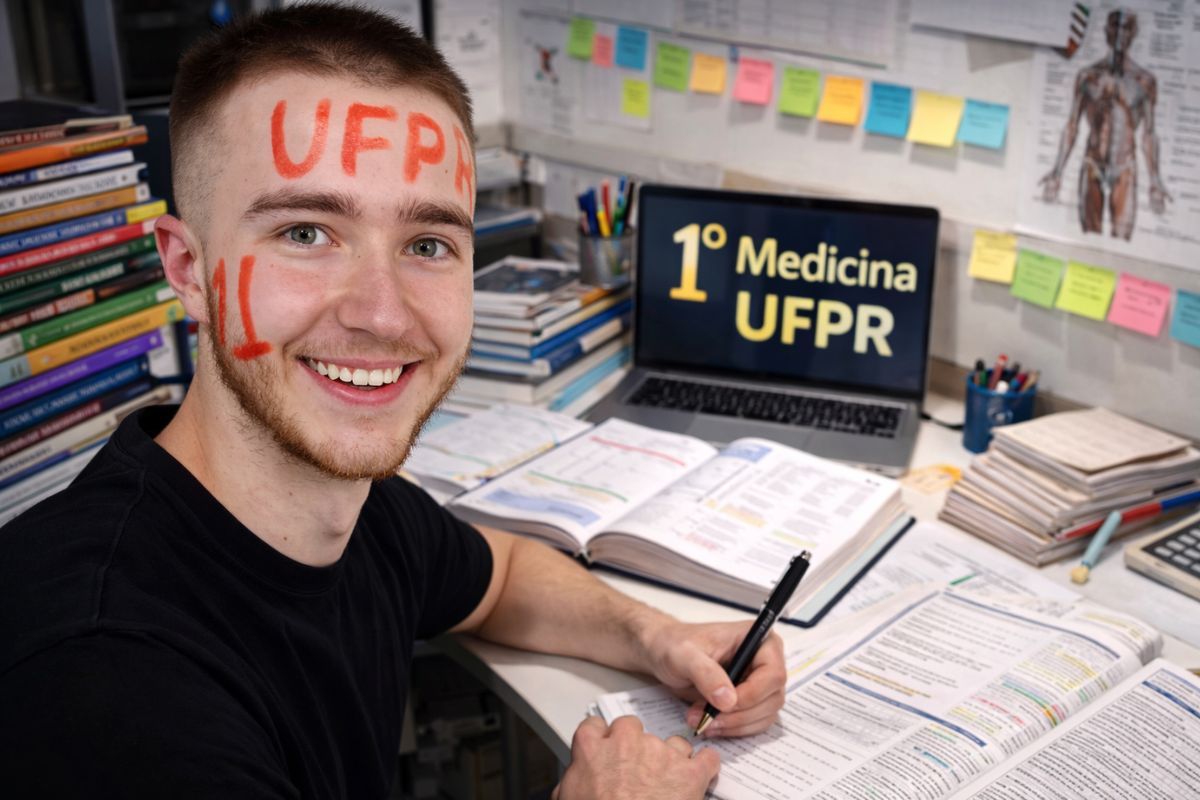


At 18, Student Gustavo Schick Received from the Dean Ricardo Marcelo Fonseca News of His Approval in the 2020/2021 UFPR Entrance Exam, Announced on August 31, 2021, and He Also Led in Medicine. After Failing in 2020, He Returned to Canoinhas During the Pandemic, Studied 12 Hours Daily, and Took Care of His Mental Health.
Student Gustavo Schick, 18, topped the list of the 2020/2021 UFPR Entrance Exam as the overall 1st place and, at the same time, 1st in Medicine, in a result released on August 31, 2021. The news came from Dean Ricardo Marcelo Fonseca, and according to him, it took a while to be “processed” due to the atypical period imposed by the pandemic.
Behind the number, there is a daily repeated choice: maintaining a strict study and review routine, even after a previous attempt without the desired result. The student describes that discipline, strategy, and care for his mind and body were parts of the same system, without relying only on “ease” to learn.
The Previous Attempt That Became a Turning Point
Before reaching the overall 1st place, the student had already faced the frustration of trying to enter UFPR in 2020 and not securing a spot.
-
Friends have been building a small “town” for 30 years to grow old together, with compact houses, a common area, nature surrounding it, and a collective life project designed for friendship, coexistence, and simplicity.

-
This small town in Germany created its own currency 24 years ago, today it circulates millions per year, is accepted in over 300 stores, and the German government allowed all of this to happen under one condition.

-
Curitiba is shrinking and is expected to lose 97,000 residents by 2050, while inland cities in Paraná such as Sarandi, Araucária, and Toledo are experiencing accelerated growth that is changing the entire state’s map.

-
Tourists were poisoned on Everest in a million-dollar fraud scheme involving helicopters that diverted over $19 million and shocked international authorities.


This return for a second attempt did not come with a magic formula, but with the decision to maintain the main goal, Medicine, without treating the negative response as a definitive sentence.
What changes, technically, is the type of preparation required for a highly competitive exam. The student claims that having an ease for learning or memorizing does not solve everything when the standards are high and the filtering is narrow.
The leap happens when preparation becomes focused on performance under pressure, with consistency over months.
“Industrial” Study and Review Routine as a System
The routine reported by the student is straightforward: a period that went from 6 AM to 8 PM, totaling more than 12 hours per day of study and review.
It is not just “time sitting,” it’s the organization of the day to sustain volume and repetition without losing track of what was seen, what needs to be revisited, and what is still weak.
This type of construction tends to function like a learning production line: review to consolidate, revisit to correct gaps, exercises to turn content into responses.
When the routine becomes a system, memory stops depending on chance, because the student revisits the same topics until reducing errors and increasing speed.
Pandemic, Change of City, and the Weight of Mental Health
In the midst of the process, the student reports that he needed to return to Canoinhas (SC) due to restrictions and the pandemic scenario.
This change often affects environment, rhythm, and social support, and he points out that paying attention to mental health was fundamental to avoid burnout in the long term.
His recommendation is practical: study well, but intelligently, taking care of both the mind and the body.
The student warns that neglecting self-care, when prolonged, will take its toll and wear one down.
The intense routine demands brakes and maintenance, because the goal is not just to study a lot, but to continue being able to study.
Why Medicine and Why Stay at UFPR
When explaining his choice, the student says he wants to apply skills for a greater good and describes Medicine as a noble profession, with the potential for real change in people’s lives.
This motivation appears as a driving force of persistence, especially after the first unsuccessful attempt.
He also reports that, through the ENEM, he was accepted at the Federal University of Santa Maria (UFSM), but decided to stay in the capital of Paraná because UFPR was the main objective.
For the future, the student expresses a desire to take advantage of what academic life offers to gain experience and become a doctor who gives back to society.
The achievement does not close a story, it opens a different kind of demand, now within the course.
The case of the student who transformed more than 12 daily hours into a routine, returned from a frustrated attempt, and achieved the overall 1st place at UFPR with 1st in Medicine shows a somewhat uncomfortable point: volume helps, but it only works when it becomes method, review and care to avoid breaking along the way.
In your experience, what weighs most in achieving such a result: the discipline of repeating every day, thorough review, or the ability to protect mental health when the pace picks up? And, if you have tried an entrance exam twice, what truly changed between the first and the second attempt?










Não são 12h de estudos, pois dentre esse período há pausas, idas no banheiro e ir almoçar, tomar café e jantar. Ninguém é capaz de estudar 12h de fato!