





 Portuguese
  English
  Spanish
  4 min of reading
  0 comments


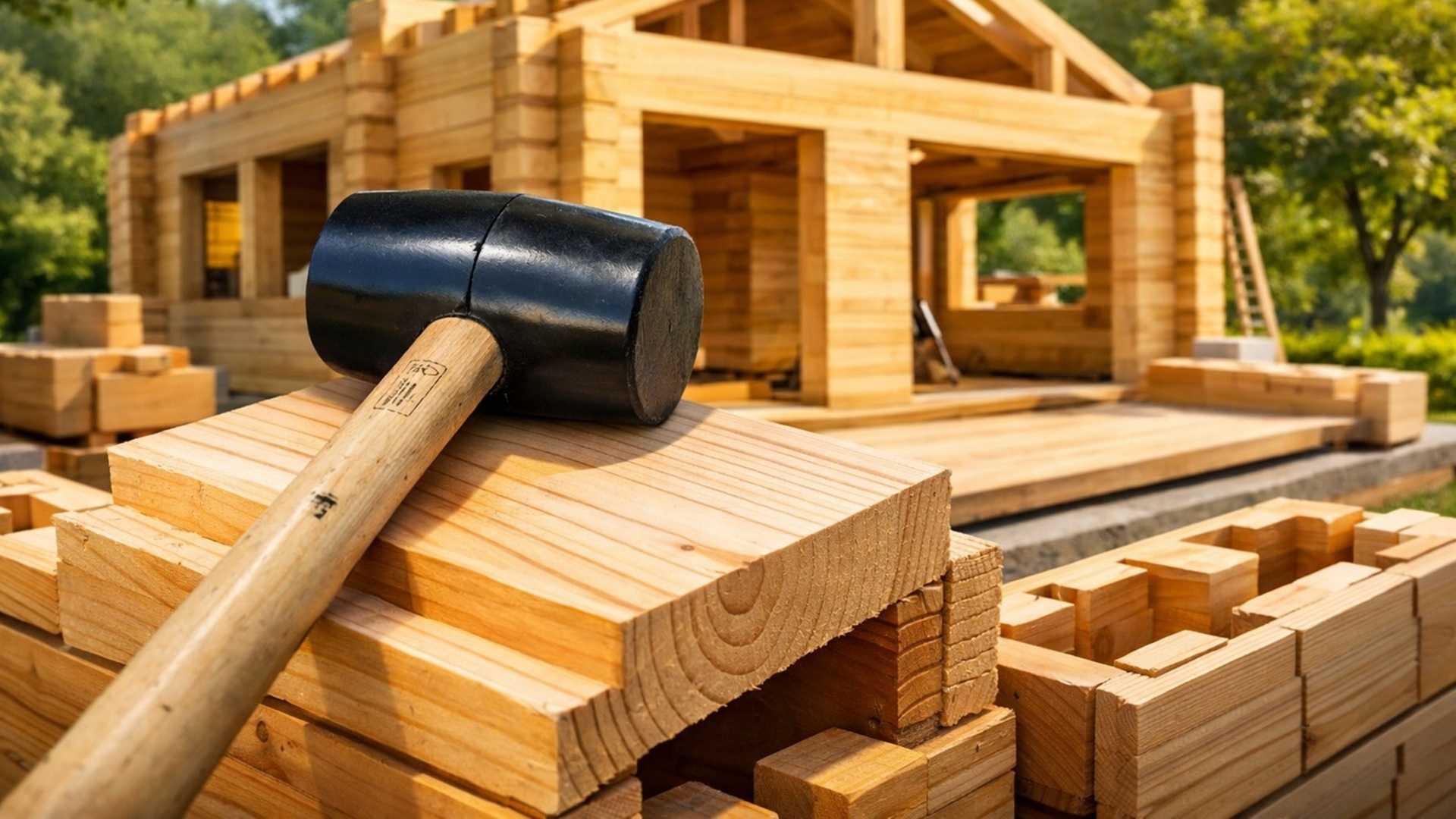
Construction System Developed in France Allows Building a House with Interlocking Wooden Parts, Eliminating Cement, Reducing Construction Steps, and Using Dry Assembly Based on Modular Structural Blocks that Concentrate Support, Thermal Insulation, and Sealing in a Single Construction Element
The Brikawood technology presents a method that allows building a house with wooden parts using industrially produced structural blocks that replace conventional bricks and eliminate traditional construction steps based on cement and mortar.
Building a House with Wooden Parts Changes the Traditional Construction Model
The system was developed to allow building a house with wooden parts through precise mechanical fittings. Each block functions as a structural element capable of connecting to another without the need for chemical or metallic fasteners.
The parts are manufactured with millimeter cuts that ensure automatic alignment during assembly. The process occurs through progressive stacking, forming self-supporting walls capable of sustaining the structure of the building.
-
Motorola launched the Signature with a gold seal from DxOMark, tying with the iPhone 17 Pro in camera performance, Snapdragon 8 Gen 5 that surpassed 3 million in benchmarks, and a zoom that impresses even at night.

-
Satellites reveal beneath the Sahara a giant river buried for thousands of kilometers: study shows that the largest hot desert on the planet was once traversed by a river system comparable to the largest on Earth.

-
Scientists have captured something never seen in space: newly born stars are creating gigantic rings of light a thousand times larger than the distance between the Earth and the Sun, and this changes everything we knew about stellar birth.

-
Geologists find traces of a continent that disappeared 155 million years ago after separating from Australia and reveal that it did not sink, but broke into fragments scattered across Southeast Asia.

Unlike conventional masonry, there is no drying stage between phases of construction. This allows for immediate continuity of assembly from the beginning of the block installation.
By building a house with wooden parts, the construction process becomes more dependent on industrial precision than on the manual mixing of materials on site.
Internal Structure Allows Building a House with Wooden Parts with Integrated Insulation
The blocks used to build a house with wooden parts have internal cavities designed to fulfill specific technical functions within the wall.
These spaces allow the insertion of natural insulating materials during assembly. The internal chambers create thermal barriers that help control the internal temperature of the environments.
The formed wall simultaneously serves as a structural element, thermal insulation, and external sealing. This reduces the need for multiple layers normally applied in traditional systems.
The blocks also include channels designed for the passage of electrical and hydraulic installations, avoiding later cuts that could compromise the structure.
Construction Process Occurs Through Dry and Sequential Assembly
Building a house with wooden parts using the Brikawood system follows a direct execution sequence. Initially, the foundation is prepared to receive the modular structure.
After this stage, the blocks are manually fitted until the walls are fully formed. The method eliminates the use of water and mixing of materials during assembly.
Next, covering elements and other structural components are installed. The final stages focus on the internal and external finishes of the construction.
The absence of wet processes reduces waste generation and simplifies the organization of the construction site.
Another aspect of the system is the possibility of partial disassembly of the structure, allowing the reuse of parts in new construction configurations.
Structural Wood is the Main Element for Building a House with Wooden Parts
When building a house with wooden parts, the material used plays a central structural role within the project.
The wood used in the system comes from controlled management and is directly utilized as a load-bearing component of the building. The material replaces conventional structural elements used in masonry walls.
In addition to providing support, the wood contributes to the internal thermal balance of the environments due to its natural properties.
The construction system eliminates the need for large volumes of materials traditionally used in conventional construction, concentrating the structure in prefabricated components.
Dry assembly also reduces water consumption during the execution of the work.
Applications Include Residences and Modular Constructions
The possibility of building a house with wooden parts expands the use of the system in different types of residential projects.
The method has been applied in permanent housing, residential expansions, and small-scale modular constructions.
The modular nature allows adaptation of dimensions according to specific project needs while maintaining the same structural principle based on fittings.
The standardization of parts facilitates project planning and contributes to greater predictability during execution.
External finishes can vary according to the architectural project, allowing integration with different construction styles.
Industrialization Transforms the Way of Building a House with Wooden Parts
The model is part of an industrialization process in the construction industry. A large part of the components necessary for building a house with wooden parts is produced beforehand in a factory.
This process reduces dimensional variations and improves the technical control of the parts used in the construction.
Industrial manufacturing allows for greater precision in fittings, an essential factor for the structural stability of the system.
The assembly logistics operate as a planned installation of components, replacing traditional manual execution stages.
Method Reorganizes Historical Stages of Civil Construction
Building a house with wooden parts represents a reorganization of the construction process by concentrating various functions in a single modular element.
The system reduces later interventions in the structure and simplifies stages normally distributed throughout the construction.
The use of interlocking blocks transforms the execution of the building into a continuous assembly sequence.
Based on this model, building a house with wooden parts becomes dependent on the technical precision of the produced parts and the organization of the installation, establishing an alternative to traditional methods based on masonry and concrete.








-

Uma pessoa reagiu a isso.