





 Portuguese
  English
  Spanish
  4 min of reading
  0 comments


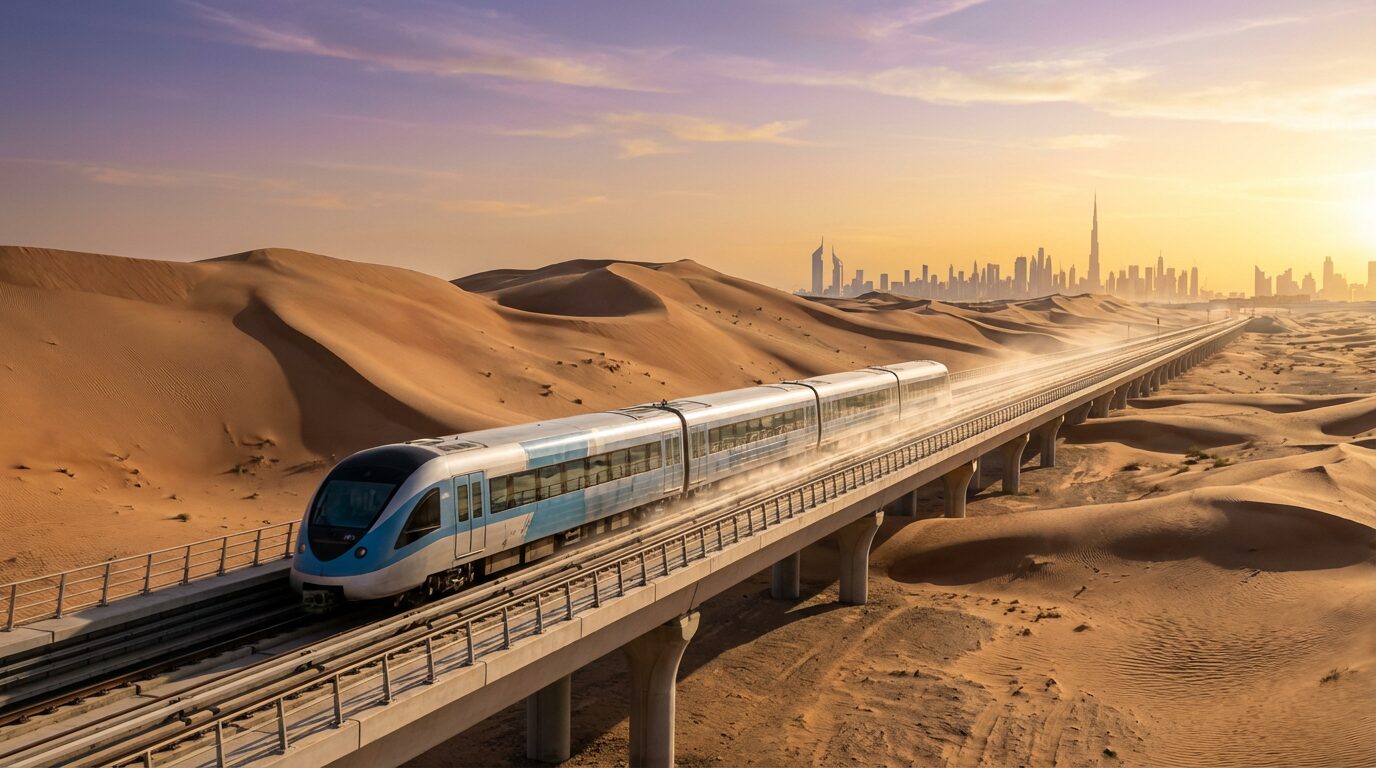
With 1,200 Kilometers Between the Border with Saudi Arabia and the Port of Fujairah, Etihad Rail Consolidates the Emirates as a Logistics Hub, Reduces Costs by Up to 30%, and Promises to Connect Abu Dhabi and Dubai in Less Than 50 Minutes, Aligned with the Vision 2031 Strategy
Etihad Rail was designed as the backbone of the national transport system of the United Arab Emirates, interconnecting strategic ports and industrial hubs. The network crosses areas of extreme desert with engineering solutions to keep the track sand-free and stable under intense heat.
According to BMC News, the route connects the seven emirates and stretches from the border with Saudi Arabia to Fujairah, in the Gulf of Oman, enabling efficient freight flows and, soon, passenger services. The goal is to alleviate congested highways, shorten travel times, and establish the country as a logistic bridge between the East and the West.
Official data indicates that operating heavy freight trains can reduce logistics costs by up to 30%, removing thousands of trucks from the roads each year. The environmental gain is also central, with predictions of a reduction of 2.2 million tons of CO2 per year.
-
Friends have been building a small “town” for 30 years to grow old together, with compact houses, a common area, nature surrounding it, and a collective life project designed for friendship, coexistence, and simplicity.

-
This small town in Germany created its own currency 24 years ago, today it circulates millions per year, is accepted in over 300 stores, and the German government allowed all of this to happen under one condition.

-
Curitiba is shrinking and is expected to lose 97,000 residents by 2050, while inland cities in Paraná such as Sarandi, Araucária, and Toledo are experiencing accelerated growth that is changing the entire state’s map.

-
Tourists were poisoned on Everest in a million-dollar fraud scheme involving helicopters that diverted over $19 million and shocked international authorities.


According to the official Etihad Rail portal and the Ministry of Energy and Infrastructure, the railway is part of the Vision 2031 strategy, which prioritizes modernization, sustainability, and safety. The technological standardization includes ETCS Level 2, a European reference in signaling.
The Backbone of National Transport, 1,200 Kilometers Connecting Ports, Industries, and the Seven Emirates
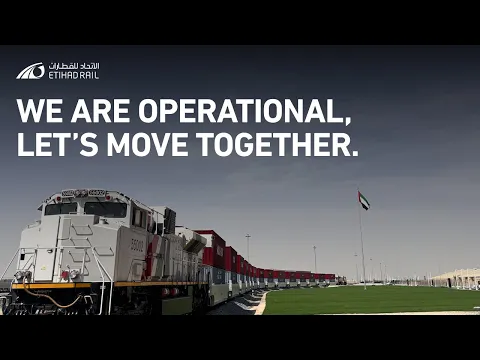

The route was planned to optimize existing trade routes, connecting deep-water ports, industrial zones, and distribution areas. By linking extremes of the territory, the railway creates a continuous corridor of high capacity.
This network allows for cargo consolidation and distribution of goods with fewer transshipments, increasing reliability. According to BMC News, the logistical integration benefits both exporters and importers, enhancing the country’s competitiveness.
On the strategic map, the connection between the border with Saudi Arabia and the port of Fujairah expands access to the Gulf of Oman, opening alternative maritime windows. This reduces the risks of bottlenecks on single routes and increases system resilience.
Technology Against Dunes and Extreme Heat, How the Line Remains Open in the Desert
To face moving dunes and sandstorms, the railway has implemented physical barriers and continuous monitoring systems of the track bed. The design includes tunnels and viaducts that stabilize the route in critical sections.
The maintenance involves automatic rail cleaning machines that operate 24 hours a day, ensuring safety and availability. These solutions demonstrate the country’s engineering capabilities in one of the planet’s most hostile environments.
Economic and Environmental Impact, Fewer Trucks on Highways and Costs Up to 30% Lower
Heavy freight rail transport offers a better cost-energy ratio per ton compared to road transport. This translates into cheaper and more predictable logistics throughout the year.
According to BMC News, the migration of part of the goods flow from road to rail removes thousands of trucks from the roads annually. The combined effect is less congestion, reduced emissions, and fewer accidents.
The environmental gains are significant, with an official estimate of 2.2 million tons of CO2 less per year. This result aligns Etihad Rail with global decarbonization goals and the Vision 2031 of the Emirates.
Passengers in the Next Phase, Abu Dhabi to Dubai in Less Than 50 Minutes with Urban Integration
Although the initial focus is on freight, the next phase plans for passenger trains connecting Abu Dhabi and Dubai in less than 50 minutes. The expectation is to transform workers’ routines and tourist mobility.
The stations are being designed to offer comfort, luxury, and connectivity while maintaining the country’s service standards. Integration with subways, buses, and last-mile modes is expected to make the railway the preferred option for medium and long-distance travel.
With frequent and predictable services, the passenger network could reduce the use of private cars between major centers. The impact on urban traffic and quality of life is expected to be positive.
This change in travel behavior strengthens economic corridors and attracts investments in areas near the stations. The railway thus stimulates regional development beyond mobility.
Official Numbers and Safety Standards, Annual Capacity and European Signaling Enhance Reliability
According to the Etihad Rail portal and the Ministry of Energy and Infrastructure, the projected freight capacity reaches 60 million tons per year. This volume positions the network as a central asset in Gulf logistics.
The adoption of ETCS Level 2, the European signaling standard, enhances safety, efficiency, and interoperability of operations. For the end user, this means more punctual trains and fewer interruptions.
These indicators confirm that Etihad Rail is a national structural investment, designed for the long term and anchored in Vision 2031. According to BMC News, the combination of scale, technology, and sustainability supports the ambition of being a global logistics hub.
What is your opinion on prioritizing a high-standard railway with luxury stations while there are still urban demands for local mobility? Do more tracks for long distances accelerate development or divert resources from daily transportation? Leave a comment and join the debate with your view on the balance between logistical efficiency and quality of life in cities.










-

Uma pessoa reagiu a isso.