





 Portuguese
  English
  Spanish
  5 min of reading
  0 comments


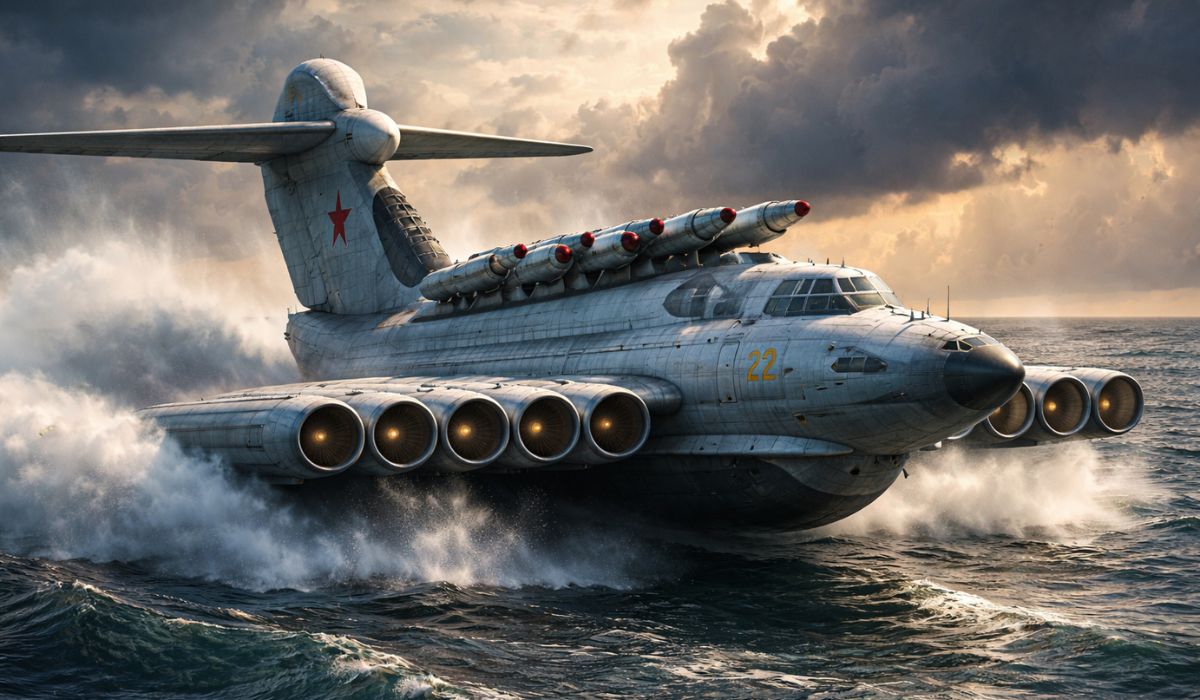
A Soviet project that operated close to the sea and carried anti-ship missiles has resurfaced in recent records and images, raising questions about how the ground effect worked, why the nickname “Caspian Sea Monster” causes confusion, and where the specimen is today.
A Soviet vehicle that combined features of an aircraft and a vessel has returned to debate in publications and historical records: the Lun-class Ekranoplan, a “ground effect vehicle” developed in the final phase of the Cold War for anti-ship attacks.
The only completed specimen, identified as MD-160, was designed to move close to the sea surface, usually just a few meters high, carrying six P-270 Moskit missiles in launchers mounted on top of the fuselage.
Although the name “Caspian Sea Monster” appears associated with the Lun in many texts, the nickname originally arose in reference to an experimental predecessor, the KM, observed by Western intelligence in the 1960s.
-
Motorola launched the Signature with a gold seal from DxOMark, tying with the iPhone 17 Pro in camera performance, Snapdragon 8 Gen 5 that surpassed 3 million in benchmarks, and a zoom that impresses even at night.

-
Satellites reveal beneath the Sahara a giant river buried for thousands of kilometers: study shows that the largest hot desert on the planet was once traversed by a river system comparable to the largest on Earth.

-
Scientists have captured something never seen in space: newly born stars are creating gigantic rings of light a thousand times larger than the distance between the Earth and the Sun, and this changes everything we knew about stellar birth.

-
Geologists find traces of a continent that disappeared 155 million years ago after separating from Australia and reveal that it did not sink, but broke into fragments scattered across Southeast Asia.

The Lun came later, within the same Soviet development line, and also operated in the Caspian Sea, which helps explain the confusion surrounding the nickname.
Ground Effect: How the Ekranoplan Stays in the Air Close to the Water
The basis of the Lun’s operation is the so-called ground effect.
Unlike a conventional airplane, it did not need to gain altitude to fly in its typical operating mode: by staying very close to the surface, the wing works with greater aerodynamic efficiency, with reduced drag and increased lift compared to flying outside this range.

Therefore, technical descriptions and public references indicate that the Lun operated “within a few meters” of the water, exploring an operating zone between aviation and navigation.
In military terms, this profile was designed to reduce the reaction time of naval defenses, as flying very low can limit detection by radars under certain conditions.
Project 903: Engines, Dimensions, and Speed of the Lun-Class
The Lun was developed as Project 903 and used eight Kuznetsov NK-87 engines.
They were mounted in the front section, above small leading-edge devices, a configuration linked to the need for high thrust during acceleration and takeoff in ground effect.
As for dimensions, widely cited references attribute to the MD-160 a length of about 73.8 meters, with wingspan also high for aircraft standards.
Speed is often described in the hundreds of kilometers per hour, with recurring mentions of cruising around 500 km/h and values close to 550 km/h under specific operating conditions.
Numbers regarding weight, however, appear mixed in popular publications.
The level above 500 tons is frequently associated with the KM, the earlier prototype, which had a maximum takeoff weight reported around 544 tons.
For the Lun, the most cited public sources provide differing values, and there is not always consistency between “maximum weight,” “operational weight,” and “payload” in the published summaries.
P-270 Moskit: Anti-Ship Weapon and Range in Open Sources
The best-known configuration of the Lun is aimed at anti-ship attack.
The vehicle was equipped with six P-270 Moskit launchers, a supersonic cruise missile designed to hit vessels and known in the West by the report name SS-N-22 “Sunburn”.
The range of the Moskit varies depending on the version and flight profile and is described differently in public compilations.
In widely cited open sources, a range of around 120 km appears for the commonly referenced versions, while other variants are listed with greater distances depending on the considered set.
The mention of “nuclear missiles” requires a distinction: there are public records that point to the Moskit family as potentially capable of carrying a nuclear warhead in certain configurations.
However, details about specific operational employment, versions effectively equipped with this type of warhead, and how this would have been integrated into the Lun do not appear in a verifiable and consistent manner in widely accessible open material.
Costs, Rough Seas, and the End of the Soviet Program
The ground effect regime brought advantages of fast movement over water but also imposed restrictions.
Operating at low altitude requires fine control and depends on compatible sea conditions; high waves and bad weather reduce the possibilities of use, according to technical descriptions and historical accounts of this type of platform.
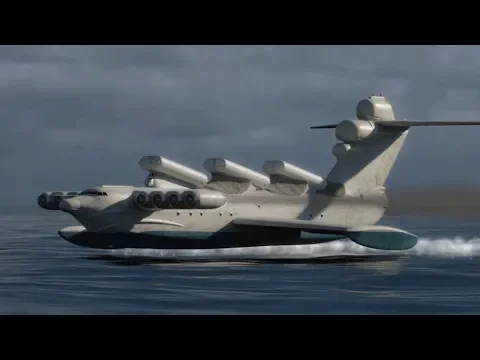

Additionally, maintaining a large structure with multiple engines and constant exposure to the marine environment is often described as complex and costly.
In this context, the program ended up being restricted: references concerning the class indicate that only one specimen was completed and used, deactivated after the Soviet period, with expansion plans interrupted in the post-USSR scenario.
Derbent, Dagestan: Where the “Caspian Sea Monster” Was Exhibited
After years parked at a base in the Caspian region, the MD-160 was removed for transport with the aim of becoming an exhibit piece.
On July 31, 2020, reports about the move indicate that the ekranoplan was towed towards the area of Derbent in Dagestan for integration into a visitor space associated with a “Patriot Park”, and ended up running aground near the coast during the operation.
Since then, images of the vehicle on the beach have circulated frequently, reinforcing public interest in a project that, at the time, sought to meet a specific military demand.
At the same time, the Lun preserves a central point for researchers and enthusiasts of military history: the effort to create a naval attack means capable of quickly approaching maritime targets, operating at low altitude and outside the standard of conventional aircraft.
With the revival of the theme “ground effect” in proposals and studies released in recent years, the Lun often reappears as a historical reference of what was tested and what was left behind.







-

-

-

-

-

11 pessoas reagiram a isso.