





 Portuguese
  English
  Spanish
  7 min of reading
  0 comments


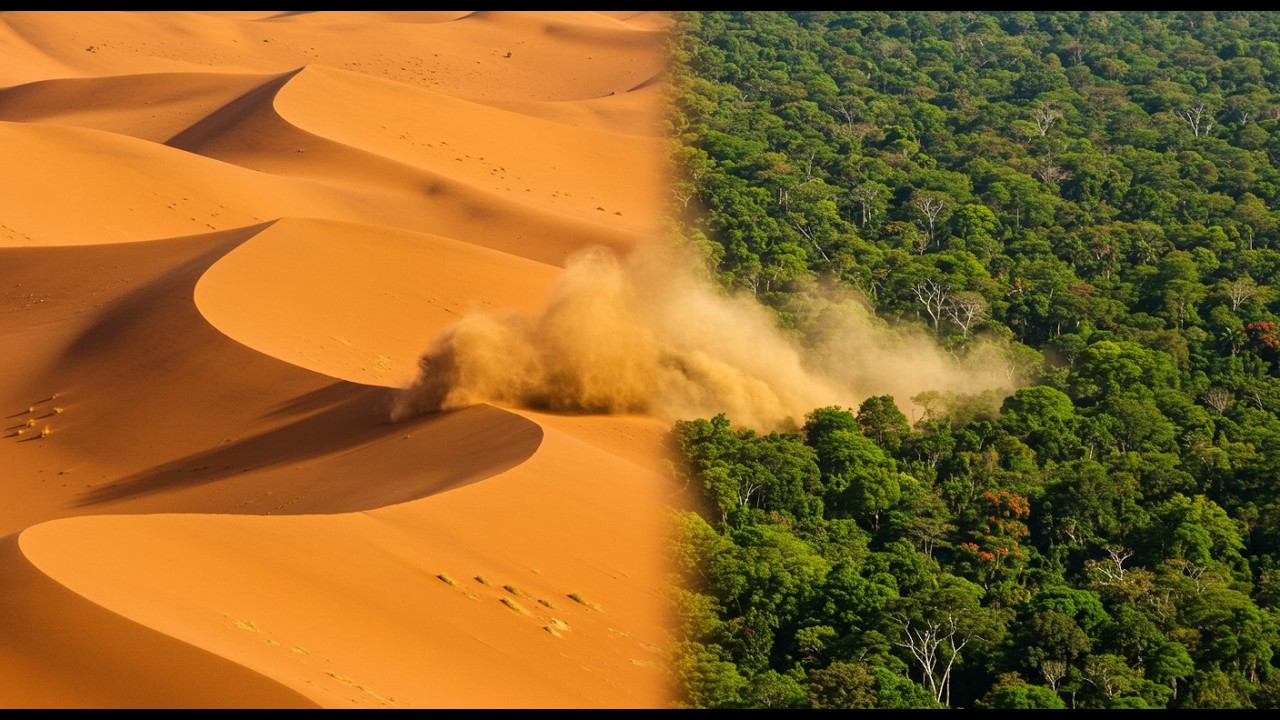
Sahara Dust Crosses 5,000 Km Across the Atlantic and Dumps 27.7 Million Tons of Nutrients in the Amazon, Including 22,000 Tons of Phosphorus Essential to Keeping the World’s Largest Tropical Forest Alive, According to NASA Study.
More than 5,000 kilometers separate the Sahara Desert from the Amazon Rainforest. But these two seemingly opposing biomes maintain such an essential relationship that the survival of the largest tropical forest in the world literally depends on the sand from the largest hot desert on Earth. Every year, 182 million tons of dust cross the Atlantic Ocean from Africa. Of that total, 27.7 million falls into the Amazon Basin carrying 22,000 tons of phosphorus.
The discovery was made by NASA using data collected between 2007 and 2013 by the CALIPSO and CloudSat satellites. Researchers at the University of Maryland measured for the first time in 3D the exact volume of dust and quantified how much phosphorus remains in the sands that make this transatlantic journey. “The entire Amazonian ecosystem depends on Sahara dust to replenish its lost nutrient reserves,” says Hongbin Yu, the study coordinator.
Amazon Soil Paradoxically Poor
The Amazon is one of the most biologically productive places in the world. But it has notoriously poor soil in essential elements for plant growth, especially phosphorus. It seems contradictory, but the lush forest grows over impoverished land.
-
Motorola launched the Signature with a gold seal from DxOMark, tying with the iPhone 17 Pro in camera performance, Snapdragon 8 Gen 5 that surpassed 3 million in benchmarks, and a zoom that impresses even at night.

-
Satellites reveal beneath the Sahara a giant river buried for thousands of kilometers: study shows that the largest hot desert on the planet was once traversed by a river system comparable to the largest on Earth.

-
Scientists have captured something never seen in space: newly born stars are creating gigantic rings of light a thousand times larger than the distance between the Earth and the Sun, and this changes everything we knew about stellar birth.

-
Geologists find traces of a continent that disappeared 155 million years ago after separating from Australia and reveal that it did not sink, but broke into fragments scattered across Southeast Asia.

Amazonian plants receive most of their nutrients through the decomposition of fallen leaves, fruits, dead wood, and animals. This organic matter decomposes quickly in the tropical humid heat, replenishing the ground. However, heavy rains and constant flooding wash away these soluble nutrients, carrying them to creeks and rivers.
The forest produces around 22,000 tons of phosphorus annually from organic decomposition. But it loses almost the same amount through rains and floods. This is where the Sahara comes in, exactly compensating for this loss with wind-transported phosphorus. The balance is perfect and has been working for millennia.
Origin in the Bodélé Depression
The source of this fertilizing dust is in the Bodélé Depression in Chad, Africa. It is the lowest point in Central Africa and the largest source of dust storms in the world. Studies estimate that this depression alone is responsible for 56% of the African dust that reaches the Amazon.
The depression formed when Lake Chad dried up about 1,000 years ago. During prehistoric times, the Sahara was a region of savannas and grasslands full of lakes with algae and microorganisms. About 7,000 years ago, a change in Earth’s orbit caused climatic transformation, resulting in the current desert.


In the dry beds of these ancient lakes, nutrient-rich sand remains. These are deposits of dead microorganisms loaded with phosphorus, iron, manganese, silicon, and aluminum. The chemical composition of the dust found in the Amazon is identical to that of the Bodélé Depression, confirming its origin.
Due to the local geography, the depression is hit by constant and massive sandstorms. Strong winds blow at 150 km/h, lifting billions of tons of dust that rise to the upper atmosphere where it can survive the intercontinental journey.
5,000 Kilometer Journey
The northeast wind carries the dust in the form of aerosols invisible to the naked eye through the free troposphere. This atmospheric zone acts as a super-fast route allowing for intercontinental transport. The ochre air mass crosses the entire Atlantic suspended for days until it reaches South America.
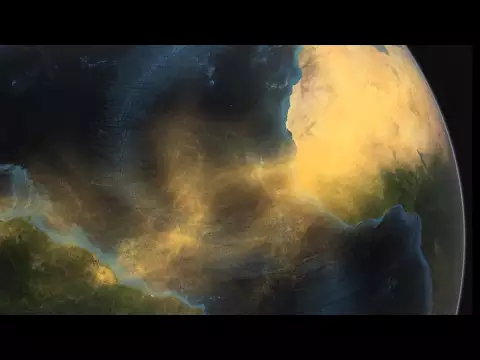
Of the total 182 million tons that leave Africa each year, 132 million remain suspended in the air throughout the journey. About 43 million continue their journey to the Caribbean Sea. And 27.7 million specifically deposit themselves in the Amazon Basin.
Optical instruments called Lidar measured the chemical makeup of substances in the Amazonian atmosphere. The presence and proportion of elements such as aluminum, manganese, iron, and silicon confirm that the dust comes from the Sahara and not from nearby land. These are unique chemical signatures.
Phosphorus Essential for Life
Of those 27.7 million tons, only 0.08% corresponds to phosphorus. It seems small but exactly matches the 22,000 tons that the forest loses annually. It is precise replenishment maintaining a delicate balance.
Phosphorus is a fundamental nutrient for plant growth. It is part of DNA, RNA, and ATP, which stores cellular energy. Without sufficient phosphorus, plants cannot perform efficient photosynthesis nor produce viable seeds.

In the Amazon, this element is extremely rare naturally. Rainwater carries phosphorus from decaying organic matter, preventing it from settling and nourishing local plants. Without the Saharan dust continually replenishing, the forest would not be able to maintain its productivity.
Besides phosphorus, the dust brings potassium, calcium, and magnesium, which also are part of the transcontinental journey. There are 6.5 million tons of iron and 120,000 tons of total phosphorus generated by the Bodélé Depression annually, according to a 2010 study.
Role in Cloud Formation
Saharan dust not only fertilizes the soil. Part of these aerosols acts as condensation nuclei for cloud formation that precipitate over the region. They are hygroscopic particles that attract water vapor, allowing for aggregation into droplets.

The flying rivers of the Amazon transport humidity from the forest to other regions of Brazil. But part of the aerosols that initiate this condensation process comes from the Sahara. It’s a surprising connection between the African desert and torrential rainfall in South America.
Central Amazon has two distinct periods. A rainy period with a clean atmosphere between February and May. And a less rainy period with a more polluted atmosphere between August and November marked by a higher load of African aerosols.
Surprising Annual Variation
The transport of dust varies drastically year by year. There was a change of 86% between the largest amount transported in 2007 and the least in 2011. Scientists identified a correlation with precipitation in the Sahel, a strip of semi-arid land at the southern border of the Sahara.
When rains in the Sahel increase, the transport of dust in the following year decreases. A possible explanation is that more rain means more vegetation and less exposure of soils to wind erosion. The second more likely explanation relates the amount of rain to the circulation of winds that sweeps dust into the upper atmosphere.
Year-to-year analyses show that this model of intercontinental nutrient transfer is extremely variable. It depends on complex climatic patterns that constantly change affecting both the generation and transport of the dust.
Threat of Climate Change
This is where the great concern of scientists comes in. Climate change could disrupt this millennial balance between the Sahara and the Amazon. But there is divergence over how exactly this will happen.
Some researchers argue that dust storms are likely to become more intense and frequent with global warming. Expansion of the desert towards the Sahel would provide more material for transport. Stronger storms would carry more dust out of Africa.

However, a team led by Tianle Yuan from the Goddard Space Flight Center predicts the opposite scenario. Using a combination of satellite data and computational models, they project that annual plumes of African dust may shrink in the next century.
Changes in ocean temperatures may reduce the speed of prevailing winds, decreasing transport from Africa to the Americas. Wind changes may influence the amount of moisture flowing into Africa, leading to more rain and vegetation in dusty regions. They claim that global warming could lead to a 30% reduction in Sahara dust activity in the next 20 to 50 years with a continuous decline afterward.
There is still no scientific consensus. Further studies and new approaches will be necessary. But any significant alteration in this system could have severe consequences for the Amazon, which is already facing threats from deforestation and warming.
Fragile Balance Under Pressure
The long-term productivity of the Amazon rainforest largely depends on this atmospheric deposition of dust coming from a distant ecosystem. It is a global interdependence rarely seen so clearly.
Meanwhile, the Amazon faces multiple pressures. Deforestation alters the atmospheric balance, decreasing humidity and reducing cloud formation. The dry season is extending 13 days per decade. Climate models suggest that large areas may reach a critical point of aridification favoring a transition to drier ecosystems.
If deforestation and warming continue at the current pace, about 16-17% of the Amazon could be at a point of no return. And if the transport of phosphorus from the Sahara really decreases, as some predict, the forest will lose an essential source of nutrients precisely when it needs them most.
It is a dramatic example of how seemingly distant and disconnected ecosystems maintain vital relationships. And how climate change can disrupt balances that have functioned for millennia, creating unpredictable cascading effects across the planet.








-

Uma pessoa reagiu a isso.