





 Portuguese
  English
  Spanish
  5 min of reading
  0 comments


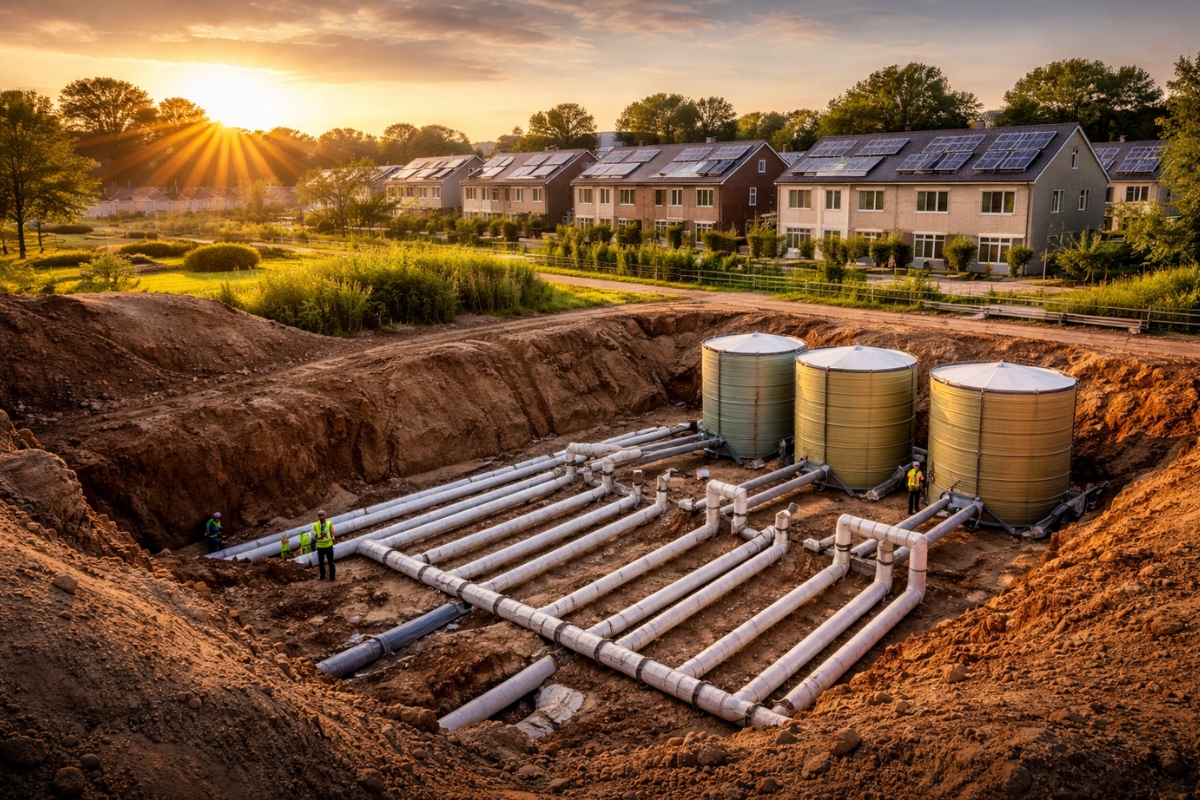
Underground Heat Batteries Use Simple, Abundant Materials, Scale to Serve Neighborhoods for Months, and Show Why Storing Heat Can Be As Strategic As Storing Electricity in Cold Countries
The Netherlands is digging real heat batteries underground to warm entire neighborhoods without relying on gas. These structures mainly use water, sand, pipes, and leftover heat from the summer. It’s a discreet yet powerful way to accelerate the energy transition in cities.
What Is An Underground Thermal Battery
When we talk about batteries, many people think of lithium and electric cars. However, the big challenge in cold countries is to store heat, not just electricity. In the Netherlands, engineers are transforming the underground into a reservoir capable of storing thermal energy for several months.
This concept is known as seasonal thermal energy storage or STES. The idea is simple: store excess heat from the summer and use it in the winter. This way, entire neighborhoods can be heated with renewable energy, reducing the burning of natural gas.
-
Motorola launched the Signature with a gold seal from DxOMark, tying with the iPhone 17 Pro in camera performance, Snapdragon 8 Gen 5 that surpassed 3 million in benchmarks, and a zoom that impresses even at night.

-
Satellites reveal beneath the Sahara a giant river buried for thousands of kilometers: study shows that the largest hot desert on the planet was once traversed by a river system comparable to the largest on Earth.

-
Scientists have captured something never seen in space: newly born stars are creating gigantic rings of light a thousand times larger than the distance between the Earth and the Sun, and this changes everything we knew about stellar birth.

-
Geologists find traces of a continent that disappeared 155 million years ago after separating from Australia and reveal that it did not sink, but broke into fragments scattered across Southeast Asia.


How Seasonal Heat Storage Works
During the warm months, solar thermal panels, heat pumps, and even industrial processes generate excess heat. Instead of wasting this energy, the system sends heated water underground through wells and pipes. This heat is stored in aquifers, layers of soil, or granular materials.
In the winter, the process reverses. The stored hot water is pumped back to the surface and circulates in district heating networks. In many cases, heat pumps increase the temperature to the desired level to heat homes and buildings. The result is a stable system with fewer energy consumption peaks.
The Role of The Netherlands As An Energy Laboratory
The Netherlands has cold weather, high urban density, and ambitious climate goals. This combination has made the country a natural laboratory for underground thermal storage. There are thousands of ATES systems in operation, serving commercial buildings, hospitals, and residential complexes.
Research institutes and universities are continuously improving these projects. They study geology, groundwater movement, and long-term impact. As a result, they can size heat batteries that operate efficiently for decades. For consumers, the effect appears in lower energy bills and greater supply security.

Ecoboroughs That Store Summer Underground
Some Dutch projects have been designed from the outset to use heat batteries on a neighborhood scale. In such ecoboroughs, large areas of solar panels capture energy in the summer. The excess turns into heat and goes underground, where it is stored like a “bottled summer.”
In the winter, homes are primarily heated with this stored energy. This significantly reduces the need for gas or oil boilers. At the same time, it decreases pressure on the electric grid in cold days, as much of the heat is already available and just needs to be pumped. The entire neighborhood works as an integrated system, rather than individual homes fighting against the cold.
Advantages of Sand and Water Heat Batteries
Using the underground as a thermal battery offers several important advantages. The first is the cost per unit of stored energy. Large volumes of water or sand are cheap and abundant, and the infrastructure relies on wells and pipes familiar in engineering. For large amounts of heat, this tends to be cheaper than large chemical battery banks.
Another advantage is scale. A single seasonal thermal battery can provide heating for an entire neighborhood for months. This fits very well with district heating networks, which already distribute hot water through pipes. Instead of relying on central fossil fuel boilers, the network is fed by a renewable, local source.
Technical and Urban Planning Challenges
Despite the advantages, it is not a solution that can simply be copied without studies. It is necessary to analyze the geology of each region, the depth of aquifers, and the dynamics of groundwater. If several systems are installed close to each other, they can interfere with one another without careful planning.
It is also essential to align urban planning, energy companies, and public policies. Thermal batteries work best when the neighborhood is designed for district heating from the beginning. In already established areas, adaptation may require extensive work. Nonetheless, studies show that with the correct design, these systems can operate with high efficiency for decades.
What This Indicates About The Future Of Cities
The underground thermal batteries tested in the Netherlands point to a new model of urban heating. Instead of millions of individual boilers, we will increasingly see neighborhoods connected to large underground reservoirs. There, summer heat, currently wasted, becomes a strategic resource to face the winter.
For cities, this means fewer emissions, greater energy security, and better use of renewable energies. For residents, the system is almost invisible: on the surface, everything looks like a regular street; beneath, there is an intelligent infrastructure that stores the right heat at the right time. It is a silent and efficient way to bring the energy transition beneath our feet.
This article was developed based on studies and information from Deltares (deltares.nl), an independent Dutch research institute specializing in water, underground, and thermal energy storage solutions in aquifers. The institution develops projects aimed at the energy transition and sustainable planning of cities and infrastructure.








-

-

2 pessoas reagiram a isso.