





 Portuguese
  English
  Spanish
  6 min of reading
  0 comments


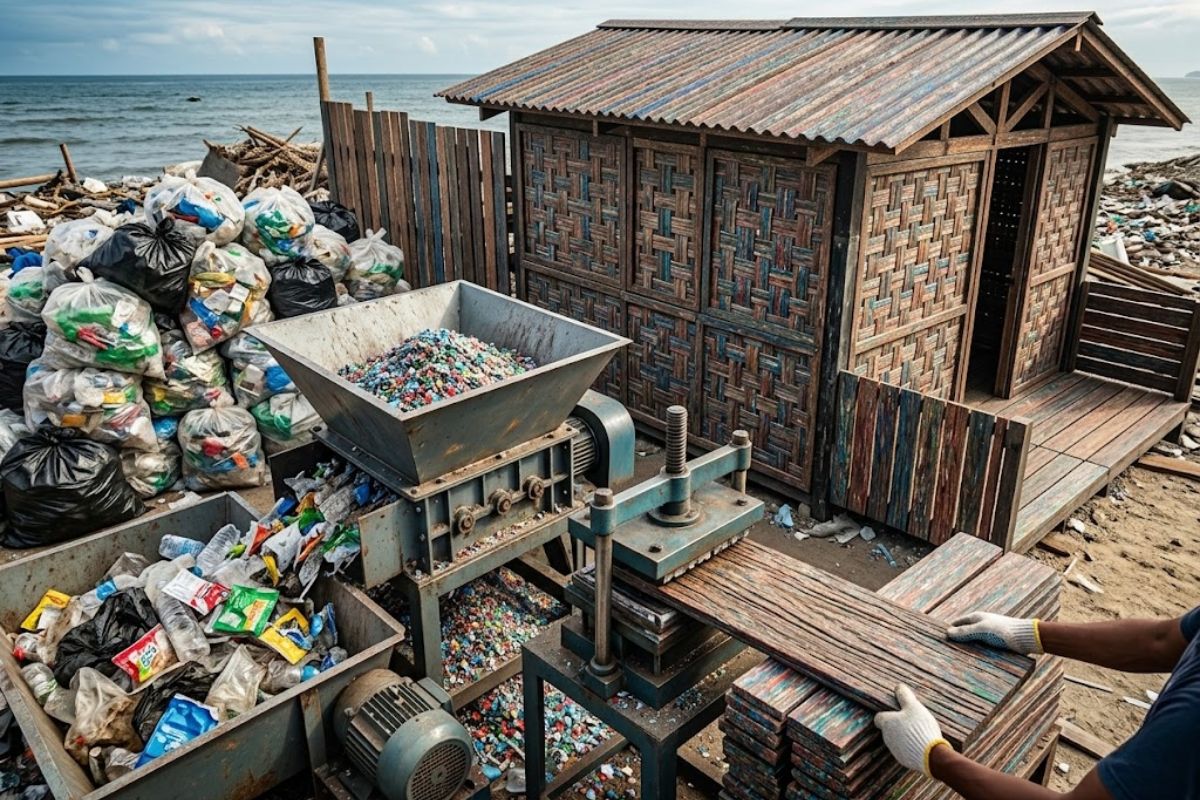
In Muntinlupa, Plastic Flamingo collects plastic waste from companies, restaurants, and consumers, shreds bottles, sachets, and packaging, and creates “eco-wood” boards for fences, decks, and emergency shelters. It has already collected over 100 tons, in a country that dumps a huge part of its plastic via rivers and sees its beaches becoming a warning.
In the Philippines, plastic waste has stopped being just an urban nuisance to become a problem that crosses rivers, reaches beaches, and puts pressure on the ocean. It is in this scenario that a group is trying to change the fate of bottles, sachets, and packaging that usually clog waterways and accumulate on the sandy shore. The idea is simple and difficult at the same time: to prevent plastic from flowing downstream.
The initiative is called Plastic Flamingo, known to many as “The Plaf.” Instead of treating waste as a dead end, it creates an alternative route: collect, shred, and mold the material into posts, boards, and waterproof sheets of “eco-wood,” used in fences, decks, and even in emergency shelters when disasters leave families homeless.
When Local Waste Becomes Global Pressure

A part of the impact of plastic waste in the Philippines arises from everyday life: lightweight packaging, easy to discard, designed to “disappear” quickly. The problem is that this disappearance tends to be only apparent. The plastic that does not enter the correct cycle reappears in the most visible places: rivers choked with waste and beaches with constant accumulation.
-
Friends have been building a small “town” for 30 years to grow old together, with compact houses, a common area, nature surrounding it, and a collective life project designed for friendship, coexistence, and simplicity.

-
This small town in Germany created its own currency 24 years ago, today it circulates millions per year, is accepted in over 300 stores, and the German government allowed all of this to happen under one condition.

-
Curitiba is shrinking and is expected to lose 97,000 residents by 2050, while inland cities in Paraná such as Sarandi, Araucária, and Toledo are experiencing accelerated growth that is changing the entire state’s map.

-
Tourists were poisoned on Everest in a million-dollar fraud scheme involving helicopters that diverted over $19 million and shocked international authorities.


This local effect gains scale when looking at the water’s path. A 2021 study indicates that about 80% of the plastic present in global oceans comes from Asian rivers, with the Philippines alone accounting for one-third of that total.
In other words, waste that escapes into a creek or urban canal can become part of a massive flow that ends up in the sea.
Who Collects the Waste and Where Does Collection Really Happen
Plastic Flamingo operates as a social enterprise and organizes plastic waste removal from different locations, including restaurants, businesses, and consumers.
It’s not just “cleaning for the sake of cleaning”: the collection needs to generate raw materials with a minimum standard to enter machines and become a final product. Without consistency in what arrives, there is no consistency in what goes out.
In practice, this means dealing with a mix of materials and formats: bottles, disposable sachets, and snack packaging—common items in urban and coastal environments.
The operation mentioned takes place in Muntinlupa, where there is infrastructure to receive the material, shred it, and send it for molding that transforms waste into boards and posts.
From Shredding to “Eco-Wood”: What Changes When Waste Becomes a Board
The turning point is in processing. Plastic waste is shredded and then molded to form pieces that resemble wood in shape and use but work differently.
According to operations director Erica Reyes, this is 100% recycled material, 100% made from plastic waste, with additives and dyes. The focus is to transform disposables into something durable and predictable.
This “eco-wood” is described as resistant to the typical degradation of wood in humid environments: it doesn’t rot, does not require maintenance, and does not splinter. These attributes are important because fences, decks, and structures exposed to the elements suffer from water, sun, and temperature variations.
When waste becomes a board, it stops being a short-lived waste and starts to compete with materials used in construction and light infrastructure, including waterproof boards.
How Much Waste Has Already Gone from the Ocean’s Path
The magnitude of what has been removed helps to understand the effort: Plastic Flamingo claims to have collected over 100 tons of plastic waste so far.
This number does not solve the problem alone, but it serves as an indicator of operational capacity and continuity. Ton is not a metaphor here: it is real cargo that stops clogging rivers and invading beaches.
At the same time, the situation is harsh: if the country is already pointed out as one of the main polluters of the oceans, the volume of waste that circulates out of control is not occasional.
What enters the production cycle needs scale, regularity, and logistics to compete with the “easier” path of wrong disposal that pushes plastic into drainage channels and then into the sea.
Why the Pandemic Tightened the Waste Cycle Even More
COVID-19 complicated the battle against plastic waste for a practical reason: it increased the consumption of disposable items.
The global scenario of plastic waste production is enormous; the United Nations Environment Program estimates around 300 million tons per year, and the pandemic worsened the problem with the rush for face shields, gloves, takeout containers, and bubble wrap, driven by the surge in online shopping.
More plastic in circulation means a greater chance of leakage into rivers and beaches.
In addition to the volume, there is the bottleneck of “how to discard.” Allison Tan, from the initiative’s marketing department, summarizes a critical point: many people do not know how to discard these plastics.
When guidance is confusing and the collection system does not keep pace, waste becomes an invisible liability until it appears in clogged drains, standing water, floating waste in rivers, and sand with mixed residues.
What Is Needed for the Waste to Stop Coming Back: Strategy, Manufacturers, and Final Destination
The challenge is not only technological; it is structural. The Philippines does not have a clear strategy for dealing with the plastic problem, and the environmental department stated it is in contact with manufacturers to identify ways to manage waste.
This detail changes the game because plastic waste originates in the production and consumption chain: if there is no planned destination, the pressure falls entirely on municipalities, volunteers, social enterprises, and urban cleaning systems.
From a management perspective, recycling initiatives gain strength when there are stable routes: drop-off points, continuous sorting, transportation, processing, and demand for the final product. Without this, waste returns to the irregular disposal circuit.
When the system fails, the river becomes a conveyor belt for waste. And when it rains heavily, what has accumulated on the streets and banks rushes into waterways all at once.
When Waste Becomes Shelter: Why “Eco-Wood” Enters the Conversation About Disasters

In the Philippines, natural disasters exacerbate vulnerabilities, and typhoons can destroy homes and displace families.

In this context, Plastic Flamingo claims to be in negotiations with other non-governmental organizations to help rebuild homes using its sustainable building materials. It’s not just recycling for the sake of recycling: it’s trying to fit plastic into a quick response to emergencies.
The “eco-wood” emerges as an alternative for its useful characteristics in field situations: standardized pieces, resistant to moisture, and requiring no frequent maintenance.
For fences, decks, and temporary shelters, this can mean simpler assembly and reduced dependency on natural wood in environments where logistics are complicated.
Still, the impact depends on scale, continuity of collection, and the capacity to transform waste into sufficient pieces when demand grows.
The waste that today clogs rivers and invades beaches in the Philippines did not appear from nowhere—it came packaged, was consumed, discarded, and pushed into the shortest path to the water.
Plastic Flamingo tries to interrupt this trajectory with a straightforward logic: collect, shred, and transform plastic into “eco-wood” that returns to the world as fences, decks, or emergency shelters. What decides the reach of this turnaround is less the discourse and more the machinery: collection, destination, and scale.
And here’s a very practical provocation for you to respond to with your reality: in your city, where does plastic waste most “appear” in drains after rain, at riverbanks, on the beach, or at your doorstep?
If there were a drop-off point for sachets and packaging near you, would you use it? And if this waste became “eco-wood” boards, where would it make the most sense to apply: fences, decks, urban furniture, or emergency shelters?










Seja o primeiro a reagir!