





 Portuguese
  English
  Spanish
 4 min of reading
  0 comments


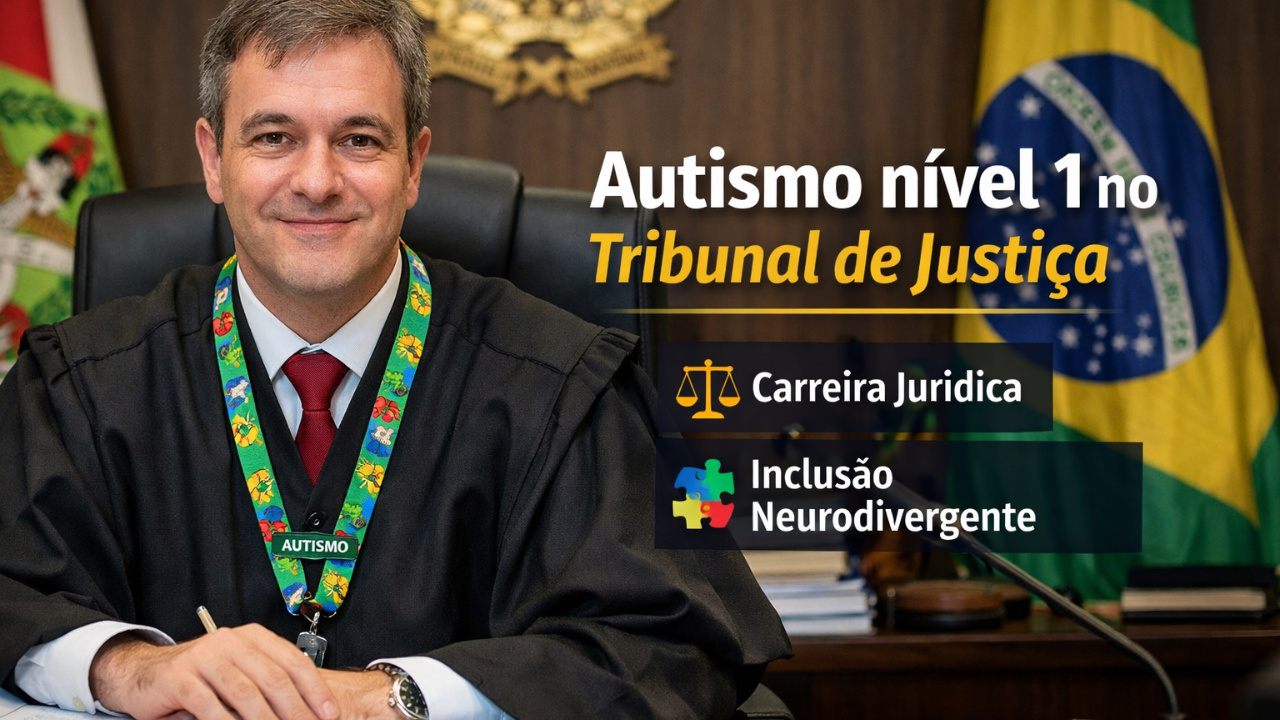
Level 1 Autistic Judge Takes Office at the Court of Justice and Reinforces Neurodivergent Inclusion in the Legal Career.
Judge and professor Alexandre Morais da Rosa, 52, was appointed to the Court of Justice of Santa Catarina (TJSC) in November 2025.
The announcement formalizes his ascent to the Court of Justice after decades of work in the judiciary and academia.
Diagnosed with Level 1 Autism in 2021, he turns his own journey into an example of Professional Resilience and Neurodivergent Inclusion in the Judiciary.
-
The noise law will no longer be in effect at 10 PM starting in June with a new rule valid during the 2026 World Cup.

-
The Chamber opens a debate on driver’s licenses at 16 years old as part of a reform that includes around 270 proposals to change the Brazilian Traffic Code and may redesign rules for licensing, enforcement, and circulation in the country.

-
The new Civil Code could revolutionize marriages in Brazil with “express divorce” and changes that could exclude spouses from inheritance.

-
Banco do Brasil sues famous influencer for million-dollar debt and intensifies debate on delinquency, risks of seizure, and direct impact on Gkay’s credibility.


Born in Florianópolis and graduated in Law from the Federal University of Santa Catarina (UFSC) in 1997, the judge built a solid Legal Career.
Additionally, from 2022 to 2023, he worked as an assistant judge to Minister Gilmar Mendes at the Federal Supreme Court, in the criminal area.
The appointment to the Court of Justice of Santa Catarina comes after years of experience in the first instance and second degree.
Thus, his arrival at the Court of Justice symbolizes not only technical recognition but also progress in Neurodivergent Inclusion in high-responsibility positions.
Level 1 Autism: Late Diagnosis Brought Self-Knowledge
The Level 1 Autism diagnosis came at the age of 47, after 13 weeks of psychological follow-up.
Furthermore, Alexandre was also identified with high abilities, which helped him better understand his cognitive profile.
According to him, the process was transformative. “I was able to better understand my limitations concerning my professional activity and my relationships.
There was a significant change to reposition myself, and now I understand why many times I would get annoyed, for example,” he reports.
Level 1 Autism is characterized by a lower need for support, but it can involve difficulties in social interaction and interpreting nuances of language.
Therefore, the late diagnosis brought answers to challenges faced since adolescence.
From Adolescence to the Judiciary: Professional Resilience from an Early Age
As a young man, Alexandre describes himself as reserved and focused on his studies.
The difficulty in understanding irony and jokes made him a target of hostility among peers.
“We tend to take everything we hear literally, and only later do we try to make a connotation. It’s a challenge we face daily, which we eventually learn,” he explains.
He also remembers: “I was always that teenager who liked to study. I had few friends, didn’t interact much, wasn’t popular. In my time, these issues were not discussed, so I had no suspicion about my autism.”
To avoid exposure, he adopted his own strategies.
“I tried to never get everything right, so I wouldn’t draw attention,” he states.
This experience shaped his Professional Resilience, a characteristic that follows his entire Legal Career.
Court of Justice Requires Adaptation to Collegial Work
One of the most challenging moments occurred in 2023 when he began working in the second degree.
Until then, as a first-instance judge, he decided individually.
In the Court of Justice, however, the judgments are collegial.
This means that decisions are made collectively, requiring dialogue and consensus-building.
“When we are state judges, we decide alone, without a collective.
The court is a learning experience because it’s a collegial body, so you have to negotiate with others.
Negotiation is part of life in a collegial environment,” he explains.
Over time, he developed new strategies. “Today, I am used to having this relationship of listening and waiting, not interrupting anyone.
I got accustomed to a more dialogical space, which was not customary in my private life or my life as a judge. This collective learning is very significant.”
Neurodivergent Inclusion Still Faces Resistance
After the Level 1 Autism diagnosis, Alexandre began wearing an identification badge at work. For him, the gesture represents more than a symbol: it is a public stance.
<p“In a binary world view between normals and abnormal, we would fall into the latter. Many people have a diagnosis and avoid wearing the badge because there is significant prejudice.
Many colleagues come to talk to me saying they don’t disclose their condition due to fear of the hostility that still prevails due to ignorance,” he states.
He argues that Neurodivergent Inclusion in the Court of Justice still needs to advance.
<p“We have to be tolerant to the extent that it doesn’t harm us or others. It’s about the paradox of intolerance. We have to confront people, fight for rights, and not shy away, because no one is better or worse for being neurotypical or autistic. We all have the same dignity.”
Recognition at the STF Strengthened Legal Career
During the time he worked in Gilmar Mendes’s office at the Federal Supreme Court, Alexandre worked on significant cases in the criminal area.
He participated in drafting votes and discussions on sensitive topics, such as the judge of guarantees and plea bargaining.
Regarding the judge, the minister stated: “His trajectory demonstrates solid training, technical rigor, and commitment to jurisdiction, qualities that fully justify his rise to the Court of Justice of Santa Catarina.”
The experience at the STF further strengthened his Legal Career and reinforced his technical reputation.
Level 1 Autism and the Court of Justice: An Example of Transformation
Today, as a judge at the Court of Justice, Alexandre Morais da Rosa represents a symbolic change in the Brazilian Judiciary.
His journey combines Level 1 Autism, Professional Resilience, and technical excellence.
More than an individual achievement, his appointment broadens the debate on Neurodivergent Inclusion in leadership positions.
Thus, his story demonstrates that cognitive diversity and high performance can go hand in hand in a Legal Career.
See more at: Diagnosed with Autism, Judge is Appointed Judge of the TJSC










Seja o primeiro a reagir!