





 Portuguese
  English
  Spanish
  5 min of reading
  2 comments


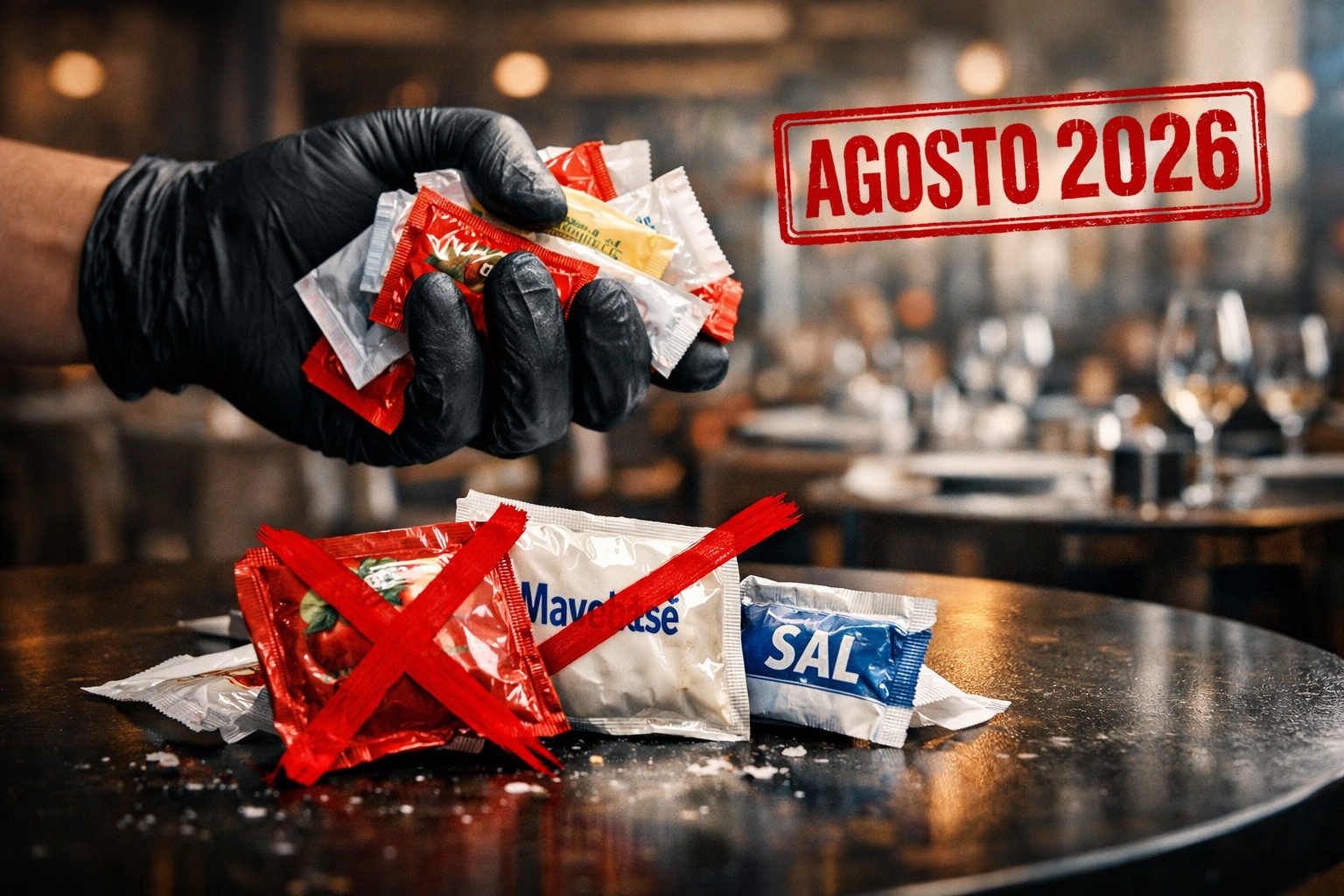


Starting August 2026, Restaurants in the European Union Will Have to Remove Disposable Ketchup, Mayonnaise, and Salt Sachets from Tables.
Starting on August 12, 2026, restaurants, bars, and cafés in the European Union will no longer be allowed to offer individual disposable sachets of ketchup, mayonnaise, mustard, salt, sugar, and other condiments for on-site consumption. This measure is part of the new Packaging and Packaging Waste Regulation (PPWR), approved under the European Commission’s environmental policy to reduce plastic waste and accelerate the transition to a circular economy. The information is included in the official documentation from the European Commission and in announcements published on the bloc’s institutional portal.
The change does not prohibit the food itself but eliminates single-use plastic packaging from the tables of establishments. The decision is part of a broader regulatory package that redefines standards for the production, reuse, and disposal of packaging throughout Europe.
New European Rule Changes Consumption Standards in Restaurants
The regulation requires establishments serving food for on-site consumption to stop providing condiments in individual disposable packaging. This includes the traditional plastic sachets commonly used in fast-food restaurants, snack bars, cafés, and bars.
-
Friends have been building a small “town” for 30 years to grow old together, with compact houses, a common area, nature surrounding it, and a collective life project designed for friendship, coexistence, and simplicity.

-
This small town in Germany created its own currency 24 years ago, today it circulates millions per year, is accepted in over 300 stores, and the German government allowed all of this to happen under one condition.

-
Curitiba is shrinking and is expected to lose 97,000 residents by 2050, while inland cities in Paraná such as Sarandi, Araucária, and Toledo are experiencing accelerated growth that is changing the entire state’s map.

-
Tourists were poisoned on Everest in a million-dollar fraud scheme involving helicopters that diverted over $19 million and shocked international authorities.

The measure specifically targets on-site consumption. In takeaway or delivery orders, the rule allows exceptions for logistical and sanitary reasons, according to the current interpretation of the regulatory text. In other words, the focus of the restriction is the automatic and indiscriminate offering of individual sachets on tables.
The European Commission argues that small disposable packaging represents a disproportionate volume of plastic waste that is difficult to recycle. Because they are made up of multiple layers of materials, these sachets rarely enter efficient recovery chains.
PPWR Regulation and the European Strategy Against Plastic
The PPWR replaces previous guidelines that were deemed insufficient to curb the increasing generation of waste. According to data from the European Commission itself, the European Union produces tens of millions of tons of packaging waste each year, a significant portion of which consists of single-use plastics.
The regulation sets progressive reduction and reuse targets through 2030 and beyond. The ban on disposable sachets in restaurants is just one of the first practical applications of this new policy.
The declared goal is to reduce the consumption of unnecessary packaging and encourage reusable models, such as refillable dispensers, durable containers, and collective condiment systems.
Economic Impact on Bars, Cafés, and Food Chains
The transition will require operational adjustments. Restaurants will need to replace individual packaging with reusable alternatives, which implies initial investment in new equipment and adjustments to hygiene protocols.
On the other hand, the recurring cost of purchasing disposable sachets is expected to disappear. For large establishments that consume thousands of units per month, the savings can be significant in the medium term.
Manufacturers of single-use plastic packaging will also need to adapt their production lines. The regulatory change affects the entire industrial supply chain, from polymer suppliers to distributors of packaged condiments.
Sanitary Issues and Technical Adaptation
One of the main debates involves hygiene and contamination control. Reusable systems need to ensure adequate sanitary standards. European legislation maintains stringent food safety requirements.
Dispensers will need to be designed to prevent cross-contact, external contamination, and waste. Restaurants may choose sealed, refillable containers with individual flow control.
The regulation does not relax existing sanitary norms; it only changes how condiments are presented.
Exceptions and Limits of the Ban
The rule applies to on-site consumption. In delivery and takeaway services, sachets may still be provided when requested or when necessary for the safe transport of food.
Institutions like hospitals and food services with specific sanitary requirements may rely on their own guidelines from national authorities.
Each member state of the European Union will be responsible for monitoring compliance and imposing sanctions in the case of violations.
Circular Economy and Environmental Goals by 2030
The PPWR establishes broader goals that go beyond sachets. Among the objectives are:
- Progressive reduction of single-use plastic packaging.
- Increased reuse rates.
- Standardization of recyclable materials.
- Reduction of the total volume of packaging waste.
The European Union aims to transform the logic of linear production into a circular model, where materials return to the productive cycle instead of becoming waste.
The elimination of disposable sachets is seen as a symbolic and practical step within this structural transformation.
International Comparison and Global Impacts
The European decision may influence other markets. The bloc is one of the largest consumer markets in the world, and European environmental regulations often serve as an international reference.
Multinational companies operating in Europe tend to standardize practices globally to simplify logistics and production.
In Brazil, there is still no specific federal legislation prohibiting sachets in restaurants, although there are municipal initiatives aimed at reducing disposable plastics.
If the European model demonstrates environmental efficacy and economic viability, it is likely that other regions will adopt similar measures.
Cultural Change on European Tables
The removal of sachets also represents a cultural change. For decades, the use of individual packaging has been associated with practicality and hygiene.
The new rule replaces the disposable logic with controlled reuse. This alters the consumer experience and requires adaptation from both establishments and the public.
The European Union expects the change to be gradual but irreversible.
What to Expect Starting August 2026
As of the stipulated date, national authorities may begin formal inspections. Establishments that violate the rule will face penalties as prescribed in the environmental legislation of each member country.
International chains have already begun testing alternatives even before the mandatory implementation.
The removal of disposable sachets marks a concrete step in the European policy to reduce waste. More than just a simple change on tables, it represents a structural adjustment in the packaging consumption chain.
The European Union’s decision places restaurants at the center of a broader environmental strategy. By eliminating millions of small disposable packages every day, the bloc seeks to reduce the cumulative impact of plastic on the environment.
The end of disposable sachets does not change what is served but redefines how it is served. And, starting August 2026, this change will be mandatory throughout Europe.










Entrada da notícia não menciona o país , daí vc tem que realmente entrar na notícia para verificar aonde está acontecendo , como sempre , repórter sendo repórter.
Europa número 1 em fazer leis bostas e desnecessárias.