





 Portuguese
  English
  Spanish
  8 min of reading
  0 comments


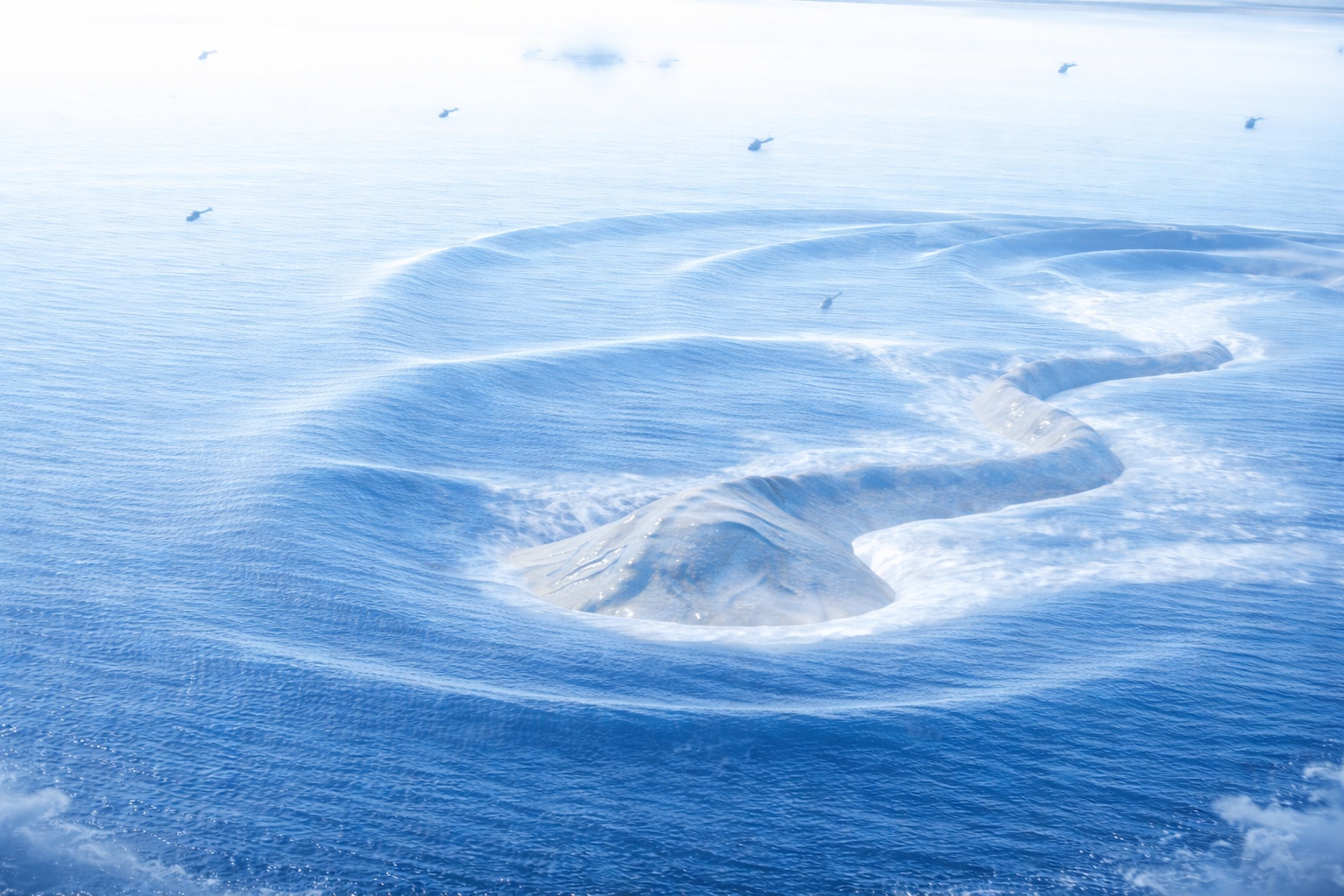
In 1997, an ultra-low sound detected over 5,000 km in the Pacific intrigued NOAA and became known as “The Bloop,” one of the greatest acoustic mysteries of the ocean.
In the summer of 1997, something in the depths of the South Pacific Ocean made a noise so loud that it was detected by underwater microphones separated by more than 5,000 kilometers. It was not a submarine. It was not a bomb. It was not an earthquake. The sound had a unique characteristic: it started at a ultra-low frequency and quickly rose over approximately a minute, as if something gigantic was groaning in the depths. It was so powerful that it traveled across the entire ocean, activating sensors from the coast of Chile to the middle of the Pacific. NOAA scientists (National Oceanic and Atmospheric Administration) gave this phenomenon a simple and unsettling name: “The Bloop”.
And 28 years later, what really caused the most mysterious sound ever recorded in the ocean is still a subject of debate, because the official explanation does not convince everyone.
The Sound That Should Not Exist
- Date: Summer of 1997
- Location: Approximately 50°S 100°W, a remote point in the South Pacific, west of the southern tip of Chile
- Detection Distance: More than 5,000 km between sensors
- Duration: Approximately 1 minute
- Frequency: Ultra-low, rising quickly
- Amplitude: Sufficient to be heard across the entire ocean
The hydrophones that captured the Bloop were not installed to discover sea monsters — they were originally developed by the U.S. Navy during the Cold War to detect Soviet submarines.
-
Friends have been building a small “town” for 30 years to grow old together, with compact houses, a common area, nature surrounding it, and a collective life project designed for friendship, coexistence, and simplicity.

-
This small town in Germany created its own currency 24 years ago, today it circulates millions per year, is accepted in over 300 stores, and the German government allowed all of this to happen under one condition.

-
Curitiba is shrinking and is expected to lose 97,000 residents by 2050, while inland cities in Paraná such as Sarandi, Araucária, and Toledo are experiencing accelerated growth that is changing the entire state’s map.

-
Tourists were poisoned on Everest in a million-dollar fraud scheme involving helicopters that diverted over $19 million and shocked international authorities.



After the end of the Cold War, NOAA began to use these same hydrophones (the SOSUS system — Sound Surveillance System) to monitor:
- Submarine volcanic activity
- Earthquakes on the ocean floor
- Movement of icebergs
- Populations and migration of marine mammals
What they did not expect to find was a completely new sound, unlike anything ever recorded.
Why Was The Bloop So Disturbing?
Three characteristics made the Bloop instantly famous (and frightening):
“Biological” Pattern, But Impossible
The acoustic profile of the Bloop resembled vocalizations of marine animals. Specifically, it resembled the pattern of sounds made by whales: a rapid variation in frequency, as if something was “sings” or “calling.”
The problem: To produce a sound with that amplitude and range, the animal would have to be several times larger than a blue whale, the largest animal that has ever existed on Earth.
Christopher Fox, a NOAA scientist, said in an interview with CNN in 2001:
“Although the audio profile of the Bloop resembles that of a living creature, the source was a mystery because it would have to be far more powerful than the calls made by any animal on Earth.”
In 2002, Fox told New Scientist:
“Fox’s guess is that the sound nicknamed Bloop is the most likely (among other unidentified sounds recorded) to come from some kind of animal because its signature is a rapid variation in frequency similar to those of known sounds produced by marine beasts. However, there is one crucial difference: in 1997, the Bloop was detected by sensors spaced up to 4,800 km apart.”
For context: an adult blue whale (the loudest animal on the planet) produces sounds of about 188 decibels, which can travel hundreds of kilometers. The Bloop was detected over thousands of kilometers — several times farther.
Theoretical Estimate: If the Bloop was indeed of biological origin, the animal would have to be over 75 meters long, almost double the size of a blue whale.
Location: Near the “Most Isolated Place on Earth”
The Bloop was triangulated to a region near Point Nemo — officially called the “oceanic pole of inaccessibility.”
Point Nemo is in the middle of nowhere, so far from any land that:
- It is closer to the International Space Station (when it passes over the region) than to any human on Earth
- The nearest land is 2,688 km away
- It is used by NASA and other space agencies as a “spacecraft cemetery,” where decommissioned satellites and space stations are intentionally dropped
And it gets even stranger: in the books of H.P. Lovecraft, the lost city of R’lyeh, where the cosmic monster Cthulhu sleeps, is located precisely in this region of the South Pacific. Coincidence? Certainly. But it fueled a thousand conspiracy theories.
Never Repeated
The Bloop was detected multiple times during the summer of 1997, but after that, total silence. The sound was never recorded again.
This created an additional mystery: if it was a recurring natural phenomenon (like volcanic activity), why did it stop? If it was an animal, where did it go? Did it die? Did it migrate?
Theories: From Scientific to Absurd
During the 2000s, while NOAA investigated, the internet exploded with theories:
Theory 1: Unknown Giant Sea Creature
The most popular. If the sound seemed biological and was more powerful than a blue whale, maybe it was:
- A unknown species of whale or giant cetacean
- A surviving megalodon (prehistoric shark that lived 3.6 million years ago)
- An unprecedentedly large colossal squid
- A plesiosaur or other prehistoric marine reptile
Problem: We have explored less than 5% of the ocean, but large marine mammals need to breathe at the surface. A creature large enough to produce the Bloop would be seen regularly.
Theory 2: Cthulhu Awoke (Seriously, There Were People Who Believed It)
The proximity to the fictional location of R’lyeh created a “cryptozoological” theory:
- The Bloop would be the sound of Cthulhu moving in the ocean depths
- Or some other massive entity unknown to science
Problem: Cthulhu does not exist. But let’s be honest — this theory was the most entertaining.
Theory 3: Secret Submarine / Military Exercise
Some speculated that the Bloop was:
- A test of a secret underwater weapon
- Ultra-advanced submarine propulsion
- A classified military experiment
Problem: Christopher Fox from NOAA dismissed this possibility in 2002, stating that “he did not believe the origin was artificial, like a submarine or bomb.”
Theory 4: Submarine Volcanic Activity
The ocean has active underwater volcanoes that sometimes produce strange sounds.
Problem: Volcanoes tend to produce constant low-frequency sounds, not ascending patterns like the Bloop.
Theory 5: Iceberg Breaking (The Official Explanation)
In 2005, NOAA began deploying more hydrophones near Antarctica to study volcanoes and earthquakes on the ocean floor.
Between 2005 and 2010, researchers conducted acoustic surveys in the Bransfield Strait and the Drake Passage (around Antarctica) and found that breaking and cracking ice was a dominant source of natural sound in the Southern Ocean.
In 2008, while tracking the iceberg A53a as it disintegrated near South Georgia Island, scientists noticed something: the spectrograms (visual graphs of sound) of icequakes (icequakes) were almost identical to the Bloop.
In 2012, NOAA officially announced:
“The Bloop was the sound of an icequake (cryoseism), an iceberg breaking off from an Antarctic glacier.”
Oceanographer Robert Dziak told WIRED:
“NOAA’s hydrophones capture tens of thousands of sounds similar to the Bloop in the ocean every year.”
With global warming, increasingly more icequakes occur yearly as glaciers break, crack, and ultimately melt into the ocean.
Why Does The Official Explanation Not Convince Everyone?

Although NOAA declared the case closed in 2012, many remain skeptical. Here’s why:
Unprecedented Amplitude
Even among icequakes, the Bloop was extraordinarily louder than similar events.
Scientists confirmed that icequakes can travel thousands of kilometers in water, but the Bloop had an unusual power, suggesting an event of massive proportions.
If it was an iceberg breaking, there would need to be a massive-scale collapse. Possible? Yes. But no specific iceberg has ever been found that caused the sound.
The “Biological” Frequency Pattern
Icequakes tend to produce more chaotic and abrupt sounds. The Bloop had a smooth ascending frequency progression, which many still find biologically suggestive.
Some bioacousticians argue that the pattern indicates organic movement or vocalization, not ice fracturing.
Never Repeated
If the Bloop was caused by icequakes that, according to Dziak, happen tens of thousands of times a year, why have we never detected a sound exactly like that again? Icebergs continue to break. Glaciers continue to calve. But no icequake since 1997 has had the unique signature of the Bloop.
Location Does Not Perfectly Coincide
Although NOAA attributed the sound to events near Antarctica (possibly between Bransfield Strait and Ross Sea, or near Cape Adare), the original triangulation pointed to an area much further north, not directly in the Antarctic zone.
Other Mysterious Sounds of the Ocean
The Bloop was not alone. NOAA detected several other unexplained sounds using the SOSUS system:
“Julia” (March 1, 1999)
- Duration: 2 minutes and 43 seconds
- Detected throughout the Equatorial Pacific
- NOAA concluded: grounded iceberg near Antarctica
“Slow Down” (May 19, 1997)
- Sound that decreases in frequency over 7 minutes
- Detected across the entire range of the hydrophone array
- NOAA concluded: iceberg
“Upsweep” (detected since 1991)
- Continuous long-lasting sound
- Consists of a “train” of narrowband sounds that rise in frequency
- Seasonal — peaks in spring and autumn
- Origin: still unknown (possibly volcanic)
“Train” (March 5, 1997)
- Sound that rises to nearly constant frequency
- Name comes from sounding like a distant train
- NOAA concluded: giant iceberg grounded in the Ross Sea
The Cultural Legacy of The Bloop
Even with the official explanation, the Bloop has never left popular imagination.
In Video Games:
- Subnautica (underwater exploration game): includes creatures that emit Bloop-like sounds
- Minecraft: the ambient sound of deep oceans is partially inspired by the Bloop
On the Internet:
- Threads on Reddit still debate whether it was really an iceberg
- Conspiracy theories suggest it was an unrecognized underwater signal
- Documentaries on “unsolved mysteries” still feature the Bloop
In Fiction:
- The Bloop became a “marine creature meme” — artists create depictions of what the “monster that made the Bloop” would look like
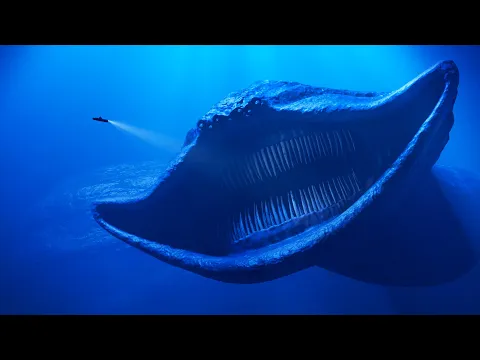
- A famous image from 2009 on DeviantArt (by Jef Chang) shows a giant blue leviathan — which many mistakenly assumed to be an “official representation”
The honest answer: it was probably an iceberg. But not with 100% certainty. And maybe that’s for the best.
Because in a world where we have mapped almost all land surfaces, where satellites spy on every corner of the planet, where technology seems to explain everything. It’s comforting to know that there are still mysteries. That there are sounds in the depths that we cannot fully decipher.
That the ocean, vast and dark, holds secrets that we may never reveal. The Bloop reminds us: we are still visitors on a planet we barely understand.
And down there, in the icy depths of the South Pacific, something made a noise so loud that it crossed an entire ocean.
Was it an iceberg?
Probably.
Was it something more?
We may never know for sure.
And perhaps, just perhaps, it’s better to leave some mysteries unanswered.










-

-

2 pessoas reagiram a isso.