





 Portuguese
  English
  Spanish
  6 min of reading
  0 comments


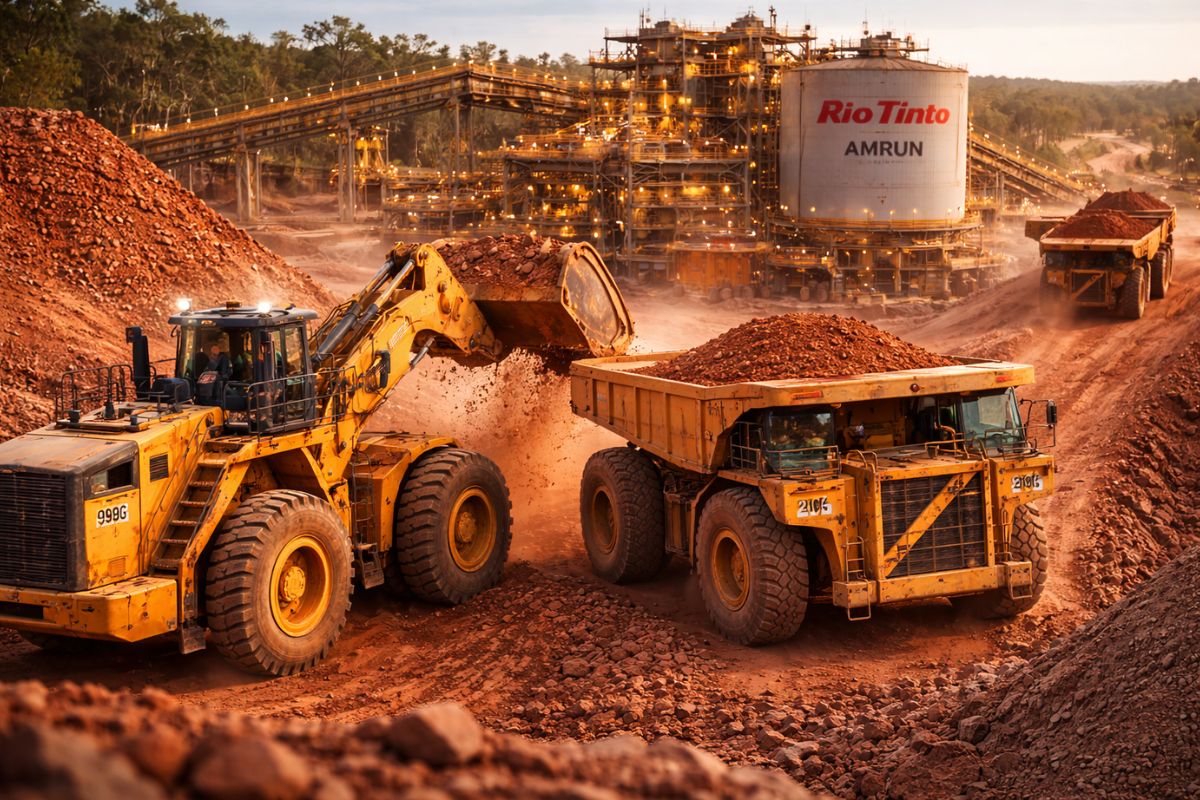
In Northern Queensland, The Mine That Operates Like A Clock From Rio Tinto Extracts Shallow Bauxite Without Drilling, Mapped By GPS, Loads With Caterpillar 993 In Eight Passes, Supplies Continuously 24 Hours, And Sustains The Plant With 6,000 Tonnes Per Hour, While Distance Can Change Everything.
The mine that operates like a clock does not have the bang of explosions, but has the same pressure of a production line. The aluminum that comes out of this cycle is in planes, cans, and electronics, and depends on a reddish-orange rock that few people recognize at first: bauxite.
In the far north of Queensland, near Cape York, Rio Tinto’s Amrun operation runs 24 hours a day, 7 days a week. The rhythm is calibrated so that the ore never runs out at the plant, even when the cut shifts and the internal roads get longer.
Where The Ore Is Shallow, Time Is Short

In the mine that operates like a clock, bauxite is treated as a shallow deposit. This changes the design of the mining: there is no drilling or blasting. The chain begins with “development,” which prepares an area to be mined.
-
Friends have been building a small “town” for 30 years to grow old together, with compact houses, a common area, nature surrounding it, and a collective life project designed for friendship, coexistence, and simplicity.

-
This small town in Germany created its own currency 24 years ago, today it circulates millions per year, is accepted in over 300 stores, and the German government allowed all of this to happen under one condition.

-
Curitiba is shrinking and is expected to lose 97,000 residents by 2050, while inland cities in Paraná such as Sarandi, Araucária, and Toledo are experiencing accelerated growth that is changing the entire state’s map.

-
Tourists were poisoned on Everest in a million-dollar fraud scheme involving helicopters that diverted over $19 million and shocked international authorities.


The development first removes the top layer of soil, pushed by bulldozers into piles to be stored. Next, a layer of reddish overburden is taken out until the bauxite is exposed. This separation is not a bureaucratic detail: it defines what goes to the plant and what goes back for land restoration.
After an area is mined, the pit floor receives the overburden again. Later, the top layer returns on top, averaging about 300 millimeters.
In the rainy season, the logic is to accelerate regrowth and reduce visible marks on the land over the years. Production and restoration go hand in hand because the mine’s space grows over time.
GPS In The Cut And The Weight Of The Bucket

The mine that operates like a clock relies on an invisible layer of control: GPS in the cut. The deposit has been mapped, and the positioning allows for maintaining the bucket at the correct level, leveling the floor and preparing the area for the next step, without improvised steps.
In the center of this phase, Rio Tinto uses the Caterpillar 993, identified as the second-largest loader produced by the manufacturer. The routine involves filling a truck in eight passes, with about 30 tonnes per pass, repeating the loading cycle in sequence.
Fueling is accounted for with numbers that don’t fit in a regular tank.
The Caterpillar 993 receives about 1,500 liters to sustain a 12-hour shift and is refueled twice a day. When the plant demands consistency, every minute stopped ceases to be a pause and becomes a bottleneck.
Gigantic Trucks And Two Routes To Prevent The Plant From Bottling Up

The bauxite that leaves the cut cannot wait for the next window. In the mine that operates like a clock, the flow is sustained by dispatch and by wide roads designed for heavy material to circulate without interruption.
In Amrun, reference is made to 22 trucks, with a load capacity cited at around 215 tonnes, using belly dump.
The dumping has been designed with two routes to avoid queuing at the plant’s entrance. Trucks can dump directly into the hopper that feeds the crusher or unload onto a stockpile. A D11 bulldozer appears as a management tool for this yard, pushing material and feeding the system when the direct route gets congested.
Distances are also part of the problem. The current reference is corridors ranging from 8 to 10 kilometers, and the trend is to increase as the mine advances. That’s why the mine that operates like a clock speaks not only of machines, but of cycle times.
A Plant That Consumes 6,000 Tonnes Per Hour
Upon arrival at the plant, bauxite enters primary crushing and follows on belts to six identical modules. The reported feeding rate is 6,000 tonnes per hour, with 1,000 per module. At this pace, any delay turns into a domino effect.
The processing does not attempt to “alter” the rock, but rather to standardize what arrives at the end of the line. Screens remove fines, washing removes dirt, part of the waste returns through a third crusher, and organic matter is separated.
Quality varies according to the mining front, so the mixture is planned to deliver a consistent product, including production oriented toward nearby shipments.
Quality control accompanies this design with hourly routine. Samples are automatically collected, weighed, and homogenized; then passed through infrared ovens at 105°C to remove moisture, through crushing and pulverization, and dried again to reduce air interference.
Subsequently, the material is melted with lithium tetraborate in a furnace at 1,000°C, forming discs that are analyzed by X-rays. The monitored elements include aluminum, silica, iron, and titanium.
The mine that operates like a clock transforms the laboratory into a gear, and if the composition changes, the mixture and the destination of the material also change to ensure that the final product meets the planned specification.
From A Stockpile Of 500,000 Tonnes To A 73,000-Tonne Ship
The mine that operates like a clock is also a storage system. The stockyard operates with something close to 500,000 tonnes, a volume comparable to that of several ships. A reclaimer extracts material from the floor and places it on belts that take the bauxite to loading.
Marine loading maintains the industrial logic of the beginning of the chain. The total mentioned rate reaches 9,500 tonnes per hour, from the reclaimer to the ship loader.
The filling sequence follows a loading plan because concentrating weight in a single hold can unbalance the vessel and cause structural damage.
The cited example is of a ship with about 73,000 tonnes and a total loading in the range of 15 to 18 hours. In the end, the vessel would remain about 14 meters below water, with adjustments related to tides and reference marks, coordinated with surveyors and pilots.
This is where the mine that operates like a clock stops being just mining and turns into global logistics.
What Ties The Clock Behind Aluminum
The sense of “clock” is not in an isolated piece of equipment. Rio Tinto combines GPS in the cut, Caterpillar 993 for productivity at the mining front, high-capacity trucks to protect the flow, and modular processing to absorb variations and maintain consistency.
Bauxite is the link that often goes unnoticed in everyday life. Without it, aluminum does not enter the Bayer process to become alumina, and alumina does not reach the smelting stage that separates aluminum from oxygen.
What seems like just red earth ends up determining entire industrial chains.
In the end, the mine that operates like a clock is explained by numbers and routines: 6,000 tonnes per hour at the plant, 22 trucks to sustain the flow, 500,000 tonnes in the yard, 73,000 on a ship, and a cycle that cannot stop.
The lingering question is what society does with this information when it realizes that efficiency and impact walk down the same corridor.
When you think of aluminum, what should weigh more: the efficiency of this chain or the effects of expanding mining and logistics at this pace? And in your daily life, what aluminum object reminds you that everything starts with bauxite?










-

-

-

-

-

7 pessoas reagiram a isso.