





 Portuguese
  English
  Spanish
  4 min of reading
  0 comments


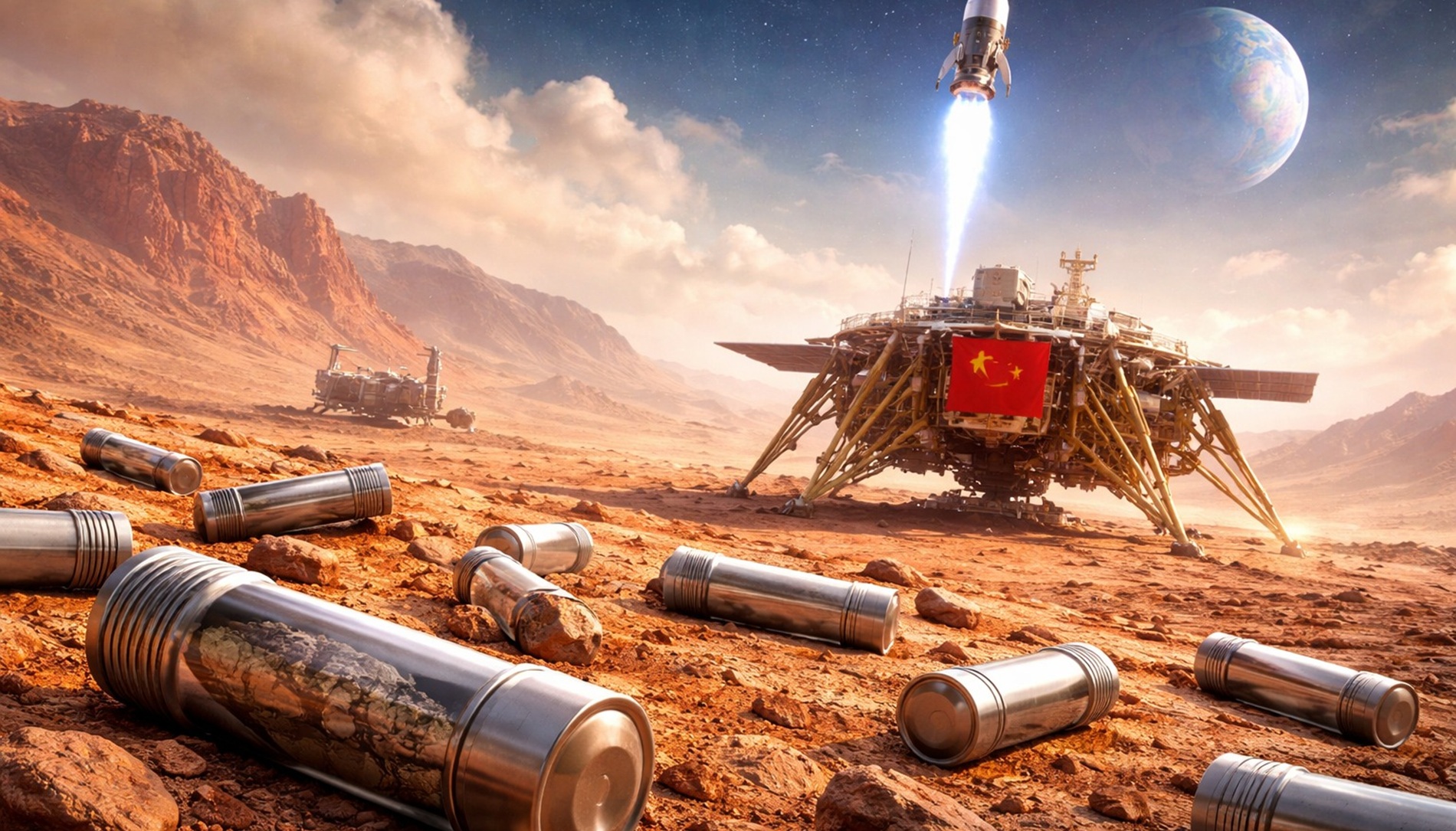
US Congress Decision Interrupts Estimated Plan Between US$ 8 Billion and US$ 11 Billion to Bring More Than 30 Tubes Collected on Mars by the Perseverance Rover, Keeps US$ 110 Million for Future Missions and Opens the Way for China to Try to Return 500 Grams from the Planet by 2031, Before Any New American Effort
The mission to bring the Earth’s most valuable rocks from Mars is considered a failure after the US Congress rejected funding for the current plan, keeping US$ 110 million for future missions to Mars, while China plans to return samples in 2031.
Congress Suspends Mars Sample Return Plan
Several dozen metal tubes scattered across Mars may contain clues about past life. They will remain on the planet after the US Congress rejected support for the existing Mars Sample Return program.
In the report of the new budget bill, lawmakers state that they do not support the current program, although they allocate about US$ 110 million for a new funding line called Future Mars Missions.
-
Motorola launched the Signature with a gold seal from DxOMark, tying with the iPhone 17 Pro in camera performance, Snapdragon 8 Gen 5 that surpassed 3 million in benchmarks, and a zoom that impresses even at night.

-
Satellites reveal beneath the Sahara a giant river buried for thousands of kilometers: study shows that the largest hot desert on the planet was once traversed by a river system comparable to the largest on Earth.

-
Scientists have captured something never seen in space: newly born stars are creating gigantic rings of light a thousand times larger than the distance between the Earth and the Sun, and this changes everything we knew about stellar birth.

-
Geologists find traces of a continent that disappeared 155 million years ago after separating from Australia and reveal that it did not sink, but broke into fragments scattered across Southeast Asia.

This amount maintains work on entry, descent and landing systems, as well as radar, spectroscopy and other tools that can support future missions to Mars, including potential attempts to collect the stored samples.
The total NASA budget remains close to US$ 24.4 billion, with about US$ 7.25 billion allocated to science. Space research continues, but the most ambitious robotic mission aimed at Mars has been suspended.
High Costs and Extended Timeline Weighed Against Mars
The Mars sample return mission has always been considered bold and expensive. Independent analyses warned that the cost could reach between US$ 8 billion and US$ 11 billion.
The latest NASA estimate pegged the costs close to US$ 11 billion, with the arrival of the samples not expected before 2040. The extended timeline and high costs were central to the decision.
To succeed, NASA and the European Space Agency would need to land near the Perseverance rover, collect more than 30 stored tubes, launch them off Mars, and capture the container in orbit before sending it to Earth.
During much of 2024, NASA requested the industry to propose simpler projects based on proven hardware rather than entirely new systems. Still, Congress chose not to support even a revised campaign.
Engineers remain focused on key technologies, but the possibility of a large-scale sample return from Mars has been shelved for now.
Jezero Rocks and Signs Associated with Mars
The decision impacts planetary scientists because the Perseverance rover has already drilled rocks that may preserve clear evidence of ancient microbes on Mars.
In Jezero Crater, clay-rich shales sprinkled with mineral-rich nodules such as vivianite and greigite have been identified. On Earth, these formations typically occur where microbes interact with mud and flowing water.
A core from the region, nicknamed Cheyava Falls, contains organic matter and mineral patterns described by NASA researchers as possibly the clearest signal of life ever found on Mars.
Scientists emphasize that non-biological explanations are still possible. Confirmation will require precise measurements and strict contamination controls, possible only in large-scale terrestrial laboratories.
The US National Academies’ Decadal Surveys have named Mars Sample Return as the top priority for robotic planetary exploration, reinforcing the scientific relevance of the stored material.
China Plans Mars Return in 2031
With the United States stepping back, attention shifts to China. The Tianwen 3 mission is scheduled to launch around 2028.
The goal is to collect at least 500 grams of Martian material, with a return to Earth planned for around 2031. If successful, China could deliver Mars samples nearly a decade before any new US efforts.
The spacecraft is expected to land in an area considered relatively simple and accessible, unlike the river delta explored by Perseverance.
This choice reduces operational risks but may offer fewer opportunities for obtaining clear biosignatures. Still, the timeline positions China at the forefront of returning materials from Mars.
Experts compare this shift to a renewed space race, with symbolic and strategic implications related to leadership in Mars exploration.
Scientific Impacts and Next Steps on Mars
The samples stored on Mars may reveal how long water lasted on the planet, the speed of climate changes, and whether any form of simple life managed to establish itself there.
This data contributes to understanding planetary habitability, atmospheric erosion, greenhouse gas variations, and long-term climate stability.
The Mars Sample Return Mission is also seen as a dry run for safer human exploration. Landing heavy equipment, launching off-world rockets, and containing extraterrestrial material without contamination are essential skills.
For now, the tubes collected by Perseverance remain in Jezero Crater, covered in Martian dust and awaiting a nonexistent ride.
NASA will continue to refine landing, radar, and re-entry technologies within the Future Mars Missions line.
In practice, the rocks considered most promising to answer the question of life on Mars remain in limbo as budgets and political decisions adjust.
Whether they will end up in a lab in Houston, Beijing, or elsewhere remains an unknown. The official statement was released by the US House of Representatives.








-

-

-

-

-

-

22 pessoas reagiram a isso.