





 Portuguese
  English
  Spanish
  4 min of reading
  0 comments


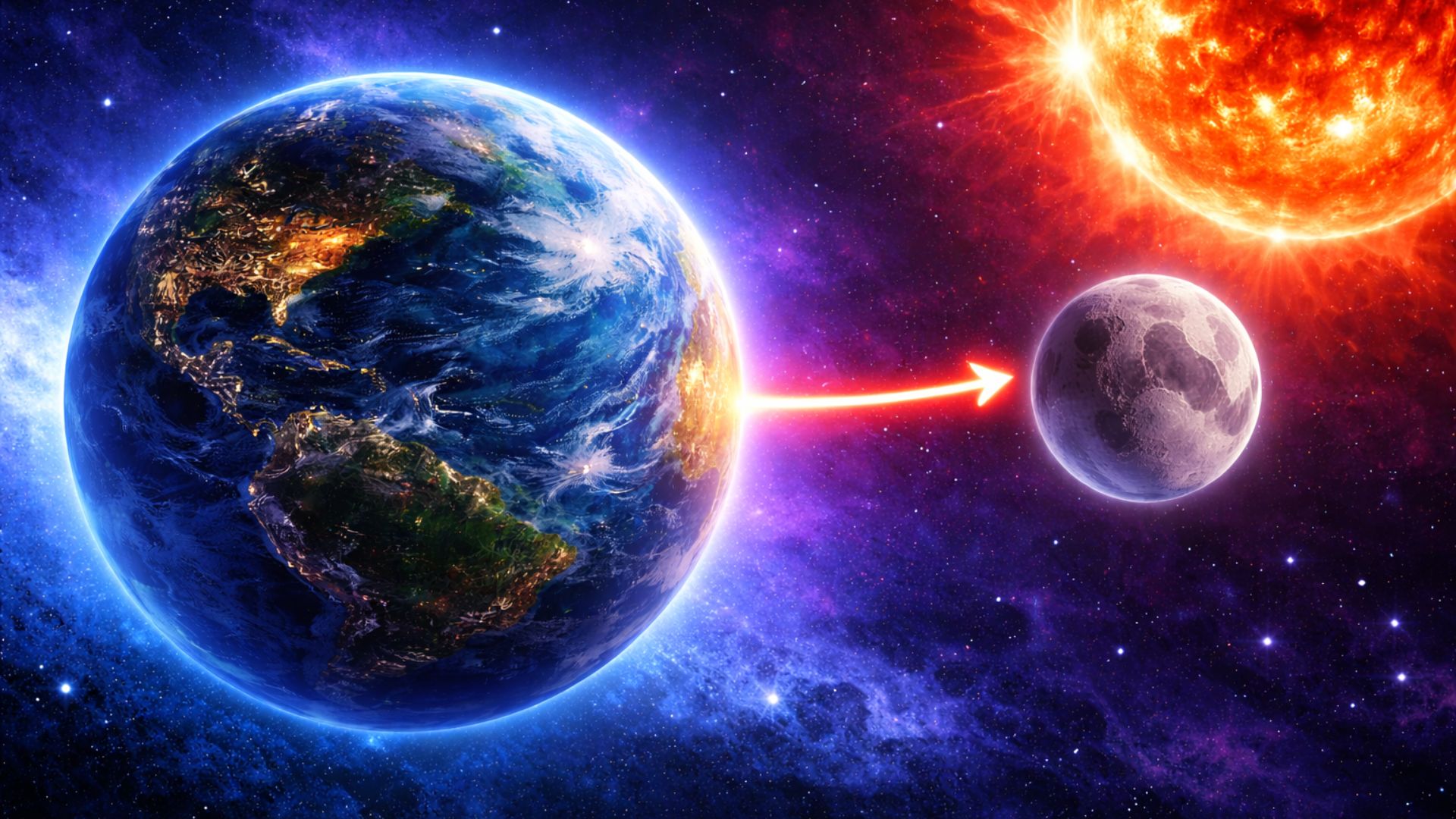
Silent Recession of the Satellite, Tides as Planetary Brake, and Traces Preserved in Ancient Rocks Redraw the History of Time on Earth.
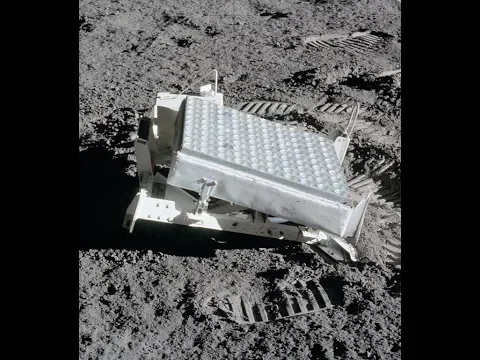
Measured with lasers fired from the Earth’s surface against reflectors left on the lunar surface by Apollo program missions, the average rate of the Moon’s distancing from the Earth reaches 3.8 centimeters per year, a number confirmed by decades of precise monitoring.
Known as lunar recession, this distancing does not arise from loss of gravity but from a continuous transfer of energy and angular momentum within the Earth-Moon system, a process that directly influences the planet’s rotation and the length of days.
Dynamics of Tides and the Deceleration of Earth
At the center of this mechanism are the tides, formed by the gravitational pull of the Moon on oceans and the Earth’s crust, which create deformations slightly ahead of the alignment axis between the two bodies, generating a persistent torque.
-
Motorola launched the Signature with a gold seal from DxOMark, tying with the iPhone 17 Pro in camera performance, Snapdragon 8 Gen 5 that surpassed 3 million in benchmarks, and a zoom that impresses even at night.

-
Satellites reveal beneath the Sahara a giant river buried for thousands of kilometers: study shows that the largest hot desert on the planet was once traversed by a river system comparable to the largest on Earth.

-
Scientists have captured something never seen in space: newly born stars are creating gigantic rings of light a thousand times larger than the distance between the Earth and the Sun, and this changes everything we knew about stellar birth.

-
Geologists find traces of a continent that disappeared 155 million years ago after separating from Australia and reveal that it did not sink, but broke into fragments scattered across Southeast Asia.

As a result of this gravitational push, part of the Earth’s rotational energy is transferred to the lunar orbit, causing the satellite to gradually gain altitude while the Earth’s rotation slows down over geological time scales.

Currently, the secular change associated with tidal friction adds about 2.3 milliseconds per century to the length of the day, a small amount in daily experience but significant when accumulated over millions and billions of years.
Primitive Earth and 13-Hour Days
Geological records and orbital modeling allow for the reconstruction of past deep scenarios when the Moon orbited much closer and the system was dynamically more intense, significantly altering the pace of the Earth’s rotation.
Based on tidal data preserved in ancient formations, researchers estimate that, around 3.2 billion years ago, a solar day lasted about 13 hours, highlighting how the lunar proximity accelerated the dynamics of the planet.
As the satellite moved away over billions of years, the dissipation of energy by tides lost relative intensity, allowing the Earth’s rotation to progressively slow down until reaching the current pattern of about 24 hours.
Variations in the Recession Rate Over Time


Although the contemporary average value is measured with high precision, the lunar recession rate has not remained identical throughout geological history, as it depends on the configuration of ocean basins, the depth of seas, and the efficiency of energy dissipation on continental shelves.
Changes in the arrangement of continents, associated with continental drift, alter tidal behavior and modulate the braking effect on Earth’s rotation, producing phases in which the lengthening of the day occurred at different rates.
Recent research also discusses how oceanic resonances and specific atmospheric conditions may have influenced the evolution of the length of the day during certain periods of the Precambrian, enhancing the understanding of the complexity of this coupled system.
Climate, Mass Redistribution, and Effects on Rotation
In addition to tides, climatic processes also interfere with the planet’s rotation by redistributing masses of water and ice, modifying the moment of inertia of the Earth and causing measurable adjustments in the length of the day on decadal to century scales.
The melting of large ice sheets and glaciers displaces significant volumes of water from high latitudes to the oceans, contributing to a slight lengthening of the day, a phenomenon already incorporated into recent scientific analyses of temporal variations.
Studies published in international journals indicate that this climatic component has begun to play an increasing role in the long-term budget of changes in the length of the day, adding to the dominant effects of tidal friction.
Future of the Moon and Fate of the Inner Solar System
In time frames compatible with human history, the annual distancing is too small to produce noticeable changes in the night sky, and the Moon will remain gravitationally bound to the Earth for an extremely long time.
In scales of billions of years, however, the evolution of the Sun takes center stage, as the star is expected to expand as it enters the red giant phase, possibly swallowing Mercury, Venus, and possibly the Earth before turning into a white dwarf.
Should this scenario be confirmed according to current projections of stellar astrophysics, the fate of the planet will be defined by solar transformation long before any definitive separation between Earth and Moon becomes the deciding factor.
Considering that the cosmic clock advances at different rates for tides, climate, and stellar evolution, which of these processes should receive more attention when discussing the long-term future of Earth?







-

-

-

-

-

17 pessoas reagiram a isso.