





 Portuguese
  English
  Spanish
  6 min of reading
  0 comments


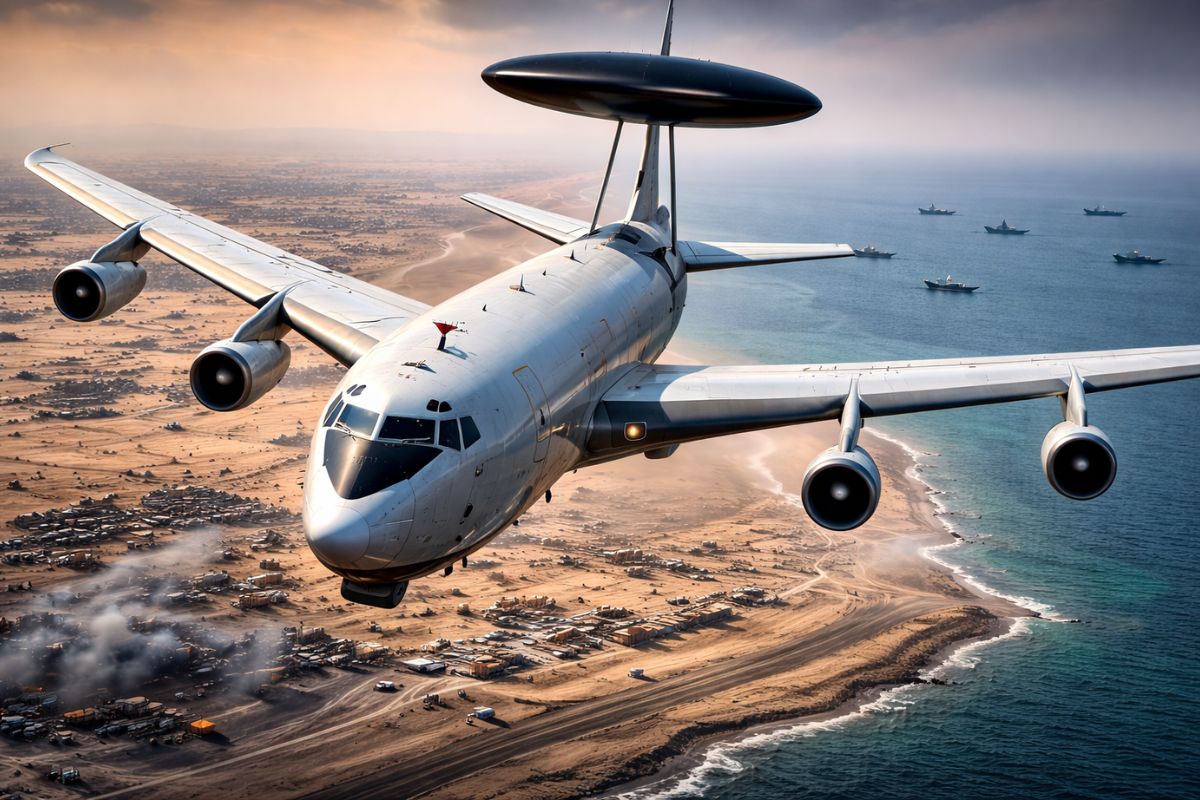
The Most Important Airplane of the U.S. Air Force, Identified in the American Air Surveillance Center, Has Resumed Operations with Unusual Presence in the Persian Gulf as the Crisis with Iran Grows, Exposing a Reduced Fleet of 16 Units and the Mobilization of Six Aircraft to the Region at This Time.
The most important airplane of the U.S. Air Force has returned to focus in the Middle East amid escalating tensions with Iran, with a presence considered unusual for a fleet that is currently small. The most sensitive data is straightforward: six aircraft have been relocated to bases in Europe and around the region, within an inventory of only 16 active units.
This movement draws attention because it is not an attack fighter, but rather a command, surveillance, and coordination platform. When Washington concentrates this type of aircraft in a crisis, the signal is not just one of observation but of preparation to control a complex airspace should the situation escalate.
At the center of this discussion is the E 3, identified as the primary air warning and control system of the United States, known for the large disc on the fuselage. In a scenario with missiles, fighters, drones, and support aircraft operating simultaneously, the value of the platform is less about the image it projects and more about the function it serves.
-
Motorola launched the Signature with a gold seal from DxOMark, tying with the iPhone 17 Pro in camera performance, Snapdragon 8 Gen 5 that surpassed 3 million in benchmarks, and a zoom that impresses even at night.

-
Satellites reveal beneath the Sahara a giant river buried for thousands of kilometers: study shows that the largest hot desert on the planet was once traversed by a river system comparable to the largest on Earth.

-
Scientists have captured something never seen in space: newly born stars are creating gigantic rings of light a thousand times larger than the distance between the Earth and the Sun, and this changes everything we knew about stellar birth.

-
Geologists find traces of a continent that disappeared 155 million years ago after separating from Australia and reveal that it did not sink, but broke into fragments scattered across Southeast Asia.

The reappearance in significant numbers also highlights a contrast. Operational demand grows just as the fleet has shrunk and aged following retirements made between 2023 and 2024 to save resources and keep remaining aircraft with repurposed parts.
Why This Aircraft Remains Central Even in a Modern Air War

The most important airplane of the U.S. Air Force is described as a kind of flying control tower, designed to solve a physical problem that ground radars cannot eliminate: the curvature of the Earth. In operational terms, this means detecting low-flying aircraft before they become too late to see on ground radars.
The logic was born at the height of the Cold War, when the fear was the approach of Soviet bombers at low altitude. The solution was to raise the radar as high as possible, taking the sensor into the sky and turning the aircraft into an early warning sentinel.
Over time, the function evolved. What was primarily a platform for early warning has become a center for air battle management. Today, the aircraft not only detects, but also organizes the fight, distributes the tactical picture in real-time, and helps synchronize different assets in the same combat environment.
This point helps to understand why it reappears precisely during times of crisis. In an operation with multiple vectors, the advantage is not just in having better weapons but in keeping all means operating at the right time, in the right corridor, and without conflict among friendly forces.
What’s Inside the E 3 and Why Its Numbers Still Impress

Although it is based on a commercial aircraft structure, the E 3 has been heavily modified for the mission. The material describes the platform as derived from the Boeing 707 320B Advanced, with four engines, a cruising speed of 580 kilometers per hour and a range of over eight hours without refueling.
This time in the air would already be significant on its own, but the aircraft can also be refueled in flight, extending missions for many hours. In surveillance and air command, time in the sky is decision power, as it allows monitoring the evolution of a crisis without having to change the control team all the time.
The most visible element is the large disc on the fuselage, measuring 9 meters in diameter, almost 2 meters thick and mounted 3.3 meters above the plane. During operation, this assembly spins at six rotations per minute to ensure 360-degree radar coverage.
The S-band radar with pulse Doppler capability is presented as an important technical differentiator, especially for looking down and separating moving targets from ground echoes. The cited range exceeds 400 kilometers for low-flying targets and can be greater at medium and high altitudes, which explains the image of a platform that continuously and broadly perceives the airspace.
The Shrinking Fleet and the Data That Raises Alerts in Washington
The most important airplane of the U.S. Air Force reappears in significant numbers in the Middle East precisely when the American fleet is reduced to 16 active aircraft. This data changes the weight of the mobilization, as deploying six units means committing more than a third of the inventory to a single tension front.
In terms of readiness, this is the most delicate point of the presented scenario. It is not just a demonstration of presence, but a concentrated use of a scarce, aging, and difficult-to-maintain asset, in a context that also requires coverage in other regions.
The reduction results from the retirement of nearly half the fleet between 2023 and 2024, aimed at saving and transferring parts to the remaining aircraft. In practice, this decision alleviates short-term costs but increases operational sensitivity when a crisis demands a more robust response.
Therefore, the reappearance of the aircraft in the Persian Gulf not only exposes tensions with Iran but also highlights an internal American problem: the dependence on an aging platform that remains essential even in a highly technological air force.
Why the Crisis with Iran Makes This Aircraft Even More Decisive
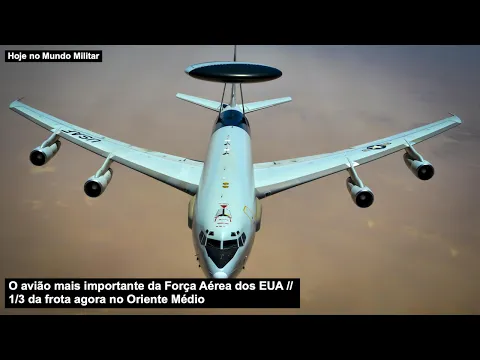

The most important airplane of the U.S. Air Force gains extra value in the Iranian scenario because Iran’s air defense is described as dense and overlapping, with radars and surface-to-air missiles making up a complex network. In such an environment, synchronization errors can mean aircraft loss, mission delays, or friendly fire.
If there were a large-scale military operation, the package would include stealth bombers, fighters, electronic warfare aircraft, drones, and cruise missiles launched from ships. Coordinating all of this in the correct time and space, while monitoring Iranian reaction, is a task that requires an airborne command center functioning at a high level.
The role of the aircraft in this context goes far beyond surveillance. It helps define routes, timings, separation between aircraft, integration with in-flight refueling, and real-time battlefield assessment. Without this coordination hub, technological superiority loses operational efficiency.
This is the central reason for the concentration of units. The expanded presence does not prove, in itself, that an attack will happen, but indicates that the United States has prioritized command and control capability for a scenario where the crisis may escalate quickly and require an immediate response.
The reappearance of the most important airplane of the U.S. Air Force in the Middle East with unusual presence places two facts in the same frame. On one side, the ongoing importance of the E 3 in modern air wars, even as an aging platform. On the other, a warning sign about American readiness itself, as six mobilized aircraft represent more than a third of a fleet of only 16 active units.
For those following geopolitics and defense, the most interesting discussion may not be just about Iran, but about sustainability capacity. In their view, the most concerning data is the regional escalation or Washington’s dependence on an aging fleet to coordinate complex operations, and what this indicates about the next moves of the U.S. in the region?








-

Uma pessoa reagiu a isso.