





 Portuguese
  English
  Spanish
  5 min of reading
  0 comments


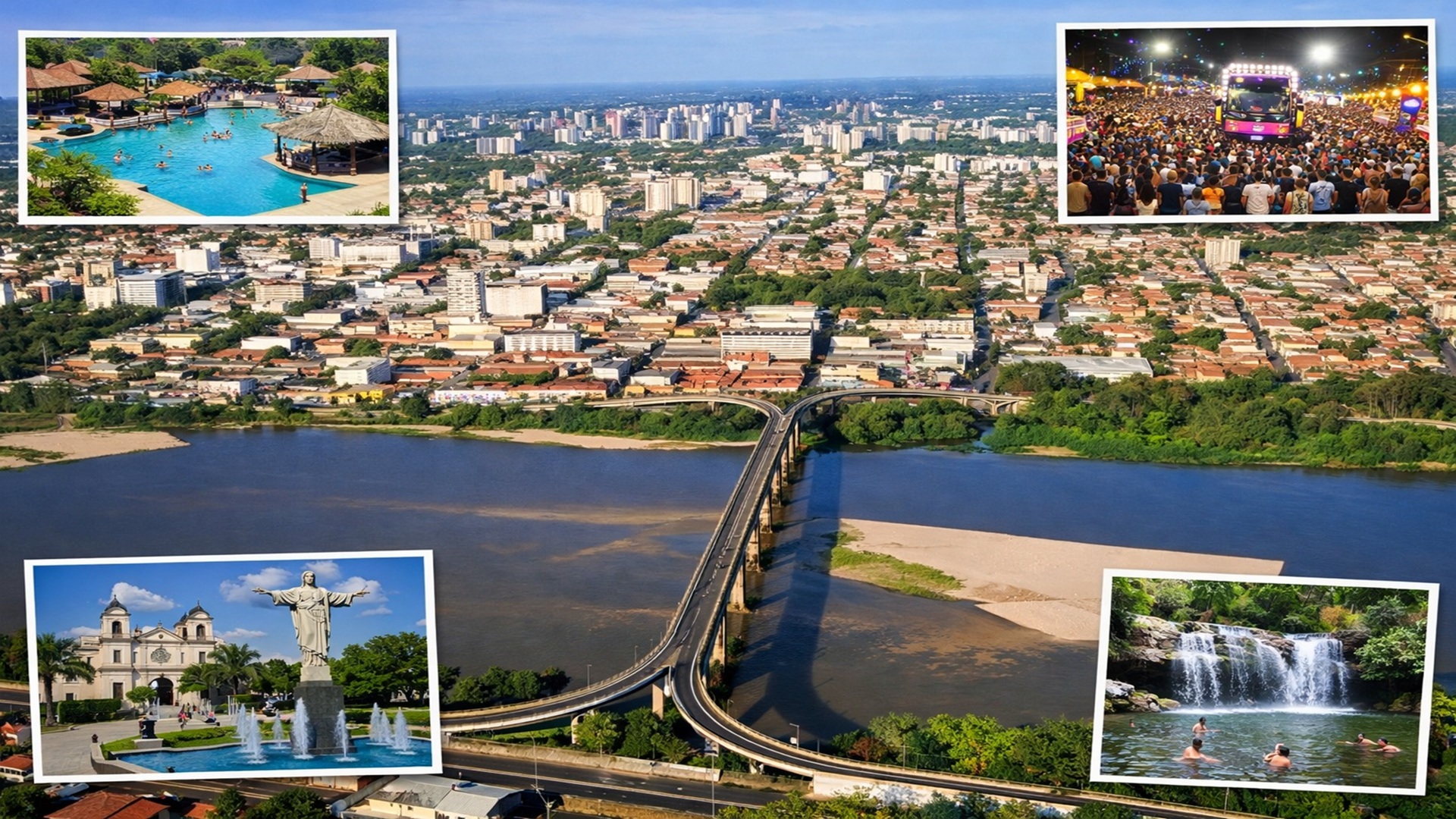
The Only City in the Country to Have Direct Urban Borders with a State Capital, Timon Covers 1,763.220 km², Has 170,222 Inhabitants, and Intense Economic Integration with Teresina, Capital of Piauí, Forming a Regional Axis Marked by Daily Circulation, Cultural Events, and Leisure Structure
Timon is the only Brazilian city that borders directly with the capital of another state, separated only by the Parnaíba River from Teresina, the capital of Piauí, forming an integrated urban area with intense daily circulation and a strong regional economic impact.
Considering exclusively state capitals, Timon is the only municipality in the country that has direct urban borders with a state capital. Located in Maranhão, the city is physically adjacent to Teresina, capital of Piauí, being separated only by the Parnaíba River.
The two cities are contiguous and form an integrated urban area, connected by bridges and marked by daily circulation of people, services, and economic activities. There is no other case in Brazil where a state capital is physically adjacent to a municipality in another state.
-
Friends have been building a small “town” for 30 years to grow old together, with compact houses, a common area, nature surrounding it, and a collective life project designed for friendship, coexistence, and simplicity.

-
This small town in Germany created its own currency 24 years ago, today it circulates millions per year, is accepted in over 300 stores, and the German government allowed all of this to happen under one condition.

-
Curitiba is shrinking and is expected to lose 97,000 residents by 2050, while inland cities in Paraná such as Sarandi, Araucária, and Toledo are experiencing accelerated growth that is changing the entire state’s map.

-
Tourists were poisoned on Everest in a million-dollar fraud scheme involving helicopters that diverted over $19 million and shocked international authorities.


In other states, even though some capitals are close to state borders, there is no other example of a capital with direct urban borders with a city from another state. The situation of Brasília does not count, as it is the federal capital, not a state capital.
Therefore, within the criterion of a city that borders the capital of another state, Timon is the only case recorded in the country.
Capital and Urban Integration Between Timon and Teresina
Timon is well-known for bordering Teresina, the capital of Piauí. Situated on the left bank of the Parnaíba River, it integrates the Integrated Development Region of Greater Teresina, also known as the Metropolitan Region of Teresina.
The city has an area of 1,763.220 km² and an estimated population of 182,241 inhabitants, according to IBGE. It is the third largest municipality by population in Maranhão, behind the capital São Luís and Imperatriz, and surpassing Caxias.
Despite its physical proximity to the capital of Piauí, Timon is little known for its tourist attractions, as Teresina tends to gain more visibility for being a state capital. Nevertheless, the municipality has its own attractions and a consolidated urban structure.
Timon has a Sustainable Cities certificate and is the second in the Northeast to have a recycling plant. The city also has about 42 bathing sites distributed throughout the municipality, which have become one of the main leisure spots.
Historical Formation Linked to Navigation and the Capital of Piauí
The origin of Timon is related to the communication between Villa da Mocha, now Oeiras in Piauí, and Aldeias Altas, now Caxias in Maranhão, in the 18th century. At that time, the Parnaíba River was navigable.
The crossing was known as the Passage of Santo Antônio. After the founding of Teresina, the capital of Piauí, the port of São José do Parnaíba gained prominence for being located across from the new capital, which boosted local development.
Farmers, adventurers, and Jesuits began to settle in the region. With the Proclamation of the Republic in 1889, the settlement of São José das Cajazeiras was elevated to the category of Village with the name of Flores.
The decree was sanctioned on December 22, 1890, by Governor José Viana Vaz. On April 10, 1924, by Law No. 1,139 signed by Godofredo Mendes Viana, Flores was elevated to city status.
Subsequently, by IBGE’s determination, the name Flores was changed, as there was a city with the same name in Rio Grande do Sul. Decree-Law No. 820, issued by Paulo Ramos, changed the name to Timon, in honor of João Francisco Lisboa.
The reference relates to the “Jornal de Timon,” a work by the Maranhão author inspired by the Greek philosopher Timon.
Bathing Sites and Leisure Structure in the Municipality Neighboring the Capital
Timon is recognized for its 42 bathing sites located mainly in the rural area. Due to the predominantly hot climate, many residents seek refuge in these spaces with rivers, streams, natural and artificial pools.
Among the most well-known is the Balneário Sítio Seu Chico, which is very popular during the B-R-O BRÓ period, when temperatures rise. The location is also noted for its northeastern cuisine.
Other options include Balneário Cajueiro, with children’s leisure areas, playgrounds, a children’s pool, and slides. Balneário Roncador is another visited spot, with streams, waterfalls, and facilities to receive visitors.
The Hotel Fazenda Portal da Amazônia is noted as the largest club-hotel in the mid-north region of Brazil. Located in an area of transition between the cocais forest and the Amazon, it offers leisure facilities and medicinal waters rich in vitamin E.
Public Spaces, Shopping, and Urban Equipment
Among urban spaces, Praça São José stands out, located in the city center. After revitalization, it now features a wooded area, playground, outdoor gym, and facilities aimed at socializing.
In the center of the square is the Igreja Matriz de São José. A miniature statue of Christ the Redeemer also composes the space, becoming a spot for photographic records.
The Sucupira Environmental Park, inaugurated in September 2020, covers 70,000 m². It has areas for cycling and walking, an adapted children’s park, outdoor gym, courts, a skate park, a society field, LED lighting, and parking.
Access is free. Another highlight is Cocais Shopping, located on Avenida Piauí, next to the MIX Matheus supermarket. The space has two floors, stores, a food court, cinema, and parking.
Cultural Events and Economic Impact in the City Neighboring the Capital
Timon hosts cultural events such as folk gatherings during the São João period. Timon Junino seeks to strengthen cultural identity through music and folk dance.
The municipality has the Grupo Proposta de Teatro, a participant in ENTEPOLA – Meeting of Latin American Popular Theater, being the only group from Maranhão in the event and one of three from the Northeast.
The Canta Timon festival is organized by the City Hall and the Beija-flor School of Arts, promoting artistic manifestations and the discovery of local talents.
During Carnival, the Zé Pereira de Timon takes place on Avenida Piauí. The celebration features electric trios, street blocks, and large crowds. The last edition had over 80,000 people over three nights.
The event boosts the local economy, with increased demand for hotels, inns, bars, and restaurants. The large influx of visitors reinforces economic integration with the neighboring capital.
Thus, Timon establishes itself as a unique municipality in the country for having direct borders with a state capital, bringing together urban integration, leisure structure, historical heritage, and cultural events that impact its regional dynamics.










-

-

-

-

11 pessoas reagiram a isso.