





 Portuguese
  English
  Spanish
  4 min of reading
  0 comments


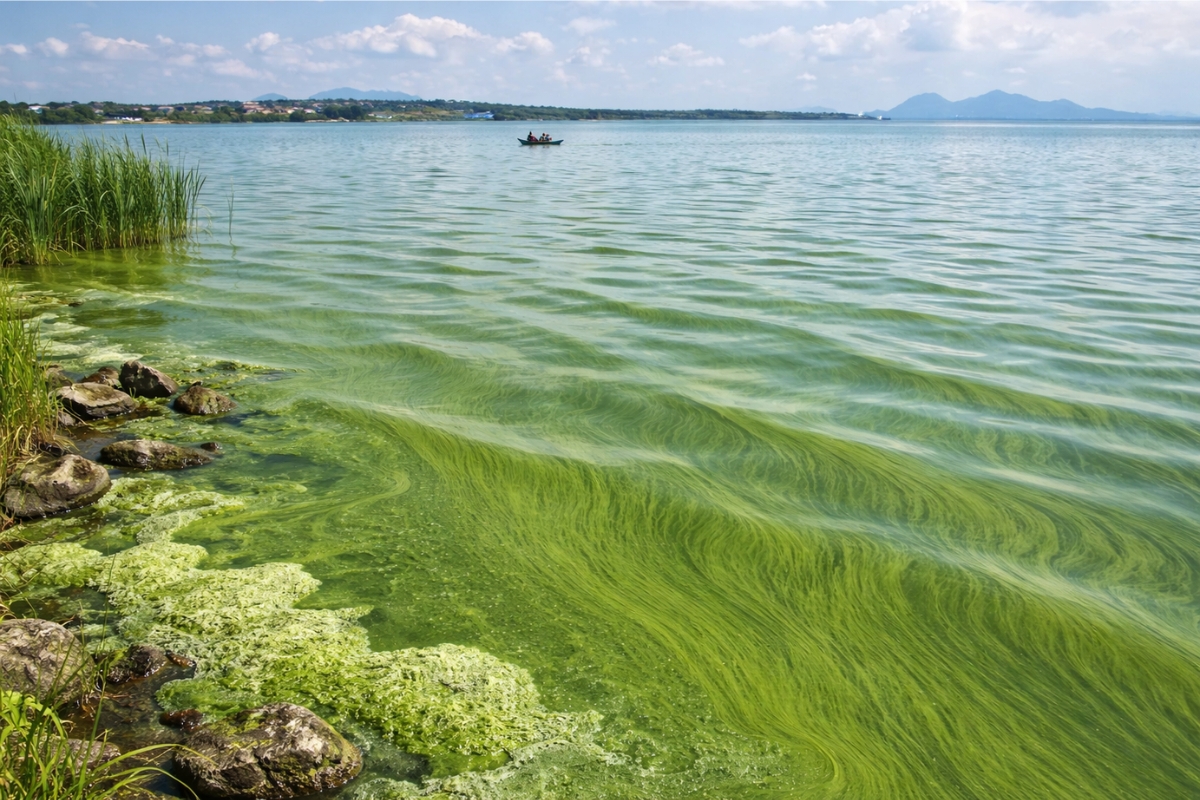
In Winam Gulf, Lake Victoria, an international team collected samples from over 31 locations and analyzed DNA from cyanobacteria to identify dangerous toxins, revealing risks to drinking water and paving the way for more accurate monitoring by local authorities
Lakes have always been synonymous with life. They provide water, food, sustain fishing, and keep local economies active.
But in various regions of the planet, the landscape is changing. Crystal clear water is giving way to a dense, foul-smelling green.
This green is not just aesthetic. It can be deadly.
-
Friends have been building a small “town” for 30 years to grow old together, with compact houses, a common area, nature surrounding it, and a collective life project designed for friendship, coexistence, and simplicity.

-
This small town in Germany created its own currency 24 years ago, today it circulates millions per year, is accepted in over 300 stores, and the German government allowed all of this to happen under one condition.

-
Curitiba is shrinking and is expected to lose 97,000 residents by 2050, while inland cities in Paraná such as Sarandi, Araucária, and Toledo are experiencing accelerated growth that is changing the entire state’s map.

-
Tourists were poisoned on Everest in a million-dollar fraud scheme involving helicopters that diverted over $19 million and shocked international authorities.


What Is Turning the Water Green and Why It Concerns the World
The phenomenon is caused by microscopic organisms called cyanobacteria. When they find heat, sunlight, and an excess of nutrients like nitrogen and phosphorus, they multiply rapidly.
These nutrients mainly come from agricultural fertilizers, manure, and sewage.
The result is blooms known as cyanoHABs, an acronym for harmful algal blooms. They form green foams on the water’s surface and release dangerous toxins.
These toxins make the water unsafe to drink, swim, or even touch. In some cases, particles can become airborne and be inhaled.
The impact goes beyond human health. Blooms reduce the oxygen in the water, kill fish, harm fishing, and alter entire food chains. Estimates suggest that the problem is becoming more frequent with rising global temperatures.

Lake Victoria Receives Increasing Nutrient Load and Becomes Critical Area
Lake Victoria, Africa’s largest lake, has been experiencing a significant increase in nutrients due to population growth around its shores and changes in land use.
Agriculture, industry, and urbanization have intensified the influx of phosphorus and nitrogen into the water.
Blooms occur in various basins of the lake but are highly concentrated in Winam Gulf, in southwestern Kenya, an area that is shallower and more vulnerable.
Riparian communities rely on the gulf’s water for consumption and domestic tasks, which elevates the risk of exposure to toxins.
The most striking detail is that changes in temperature and nutrients can alter which species dominate and which toxins are produced.
Genetic Analysis at 31 Sites Reveals Dominant Bacteria Different Than Expected
During the most recent research, scientists collected samples from over 31 locations in Winam Gulf.
Instead of only using microscopy, a traditional method that does not distinguish between toxic and non-toxic cells, the team analyzed the DNA from the samples.
Genomic sequencing allowed for the identification of almost all the genes present at each site. The DNA acts like a biological manual that reveals how the organism grows and produces toxins.
Previous reports pointed to Microcystis as dominant in the region. However, the new analysis revealed that Dolichospermum was the most abundant during major bloom events.
The shift may be linked to recent environmental changes, according to experts.
Microcystis and Microcystin Exceed Safety Limits
Although Dolichospermum was more abundant, Microcystis remains a concern.
It is associated with the production of microcystin, a toxin that affects the liver and can be fatal to animals and humans, especially people with compromised immune systems.
In Winam Gulf, microcystin frequently exceeds health limits set by the World Health Organization.
Another critical point is that Microcystis primarily appears in murkier river mouths, where the green foams are not visible. This complicates visual identification and reinforces the need for constant scientific monitoring.
Now, local authorities can direct specific actions to reduce phosphorus and other nutrients that fuel the blooms.
More Than 300 Unknown Genes May Reveal Risks and Opportunities
The genomic analysis revealed an additional finding: over 300 uncharacterized genes were identified.
These genes may produce new cyanobacterial molecules, with possible toxic or even therapeutic effects.
Genomic data from large African lakes is still scarce, which means that the chemical potential of these bacteria is underexplored.
While they pose a public health threat, these blooms may also hide compounds with future applications. What seemed like just an environmental problem could also open doors for medical research.
Population growth around lakes and increased urbanization are raising nutrient levels in water bodies worldwide. With higher temperatures driven by global warming, the scenario is likely to intensify.
The data collected in Lake Victoria provides a scientific basis for tackling the problem and protecting communities that depend directly on these waters.
Have you ever seen a lake completely green due to algae? Do you believe Brazil could face a similar situation in reservoirs and dams? Share your opinion in the comments.










-

-

4 pessoas reagiram a isso.