





 Portuguese
  English
  Spanish
  5 min of reading
  1 comment




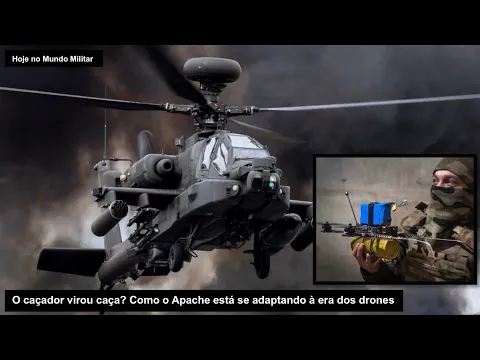
In Tests in Yuma, the Most Feared Hunter in the World Tries to Learn How to Spot Small Drones Before They Appear Out of Nowhere. The XM1225 Apex Ammunition Creates Fragments on Proximity, the APKWS2 Becomes a Cheap Guided Missile, and Network Tactics Promise Survival for the Apache on the Saturated Front Line.
The most feared hunter in the world is making headlines again, not for a new target on land, but for a cheap and fast aerial threat. Instead of looking for armored vehicles, the Apache has been tasked with another role: detecting, classifying, and taking down small drones that share the same flight level.
The change is less aesthetic and more about survival. Recent war experience, with the air near the ground congested, has posed a tough dilemma: the attack helicopter remains valuable, but only if it can see first, decide faster, and not spend much to neutralize something cheap.
When Flying Low Became a Shared Risk

For decades, flying low to the ground has been the classic trick of the attack helicopter to break radar line of sight and reduce the chance of engagement.
-
Motorola launched the Signature with a gold seal from DxOMark, tying with the iPhone 17 Pro in camera performance, Snapdragon 8 Gen 5 that surpassed 3 million in benchmarks, and a zoom that impresses even at night.

-
Satellites reveal beneath the Sahara a giant river buried for thousands of kilometers: study shows that the largest hot desert on the planet was once traversed by a river system comparable to the largest on Earth.

-
Scientists have captured something never seen in space: newly born stars are creating gigantic rings of light a thousand times larger than the distance between the Earth and the Sun, and this changes everything we knew about stellar birth.

-
Geologists find traces of a continent that disappeared 155 million years ago after separating from Australia and reveal that it did not sink, but broke into fragments scattered across Southeast Asia.

The Apache was born within this reasoning, with the idea of appearing fast, hitting hard, and disappearing, accepting that operating near the front line also means being hit.
The problem is that drones have begun to occupy the same flight envelope.
In practice, what protected the Apache against traditional air defenses has become a corridor contested by swarms and FPV drones, capable of appearing in seconds.
The most feared hunter in the world has been exposed to the same kind of surprise that it used to impose.
From Soviet Armored Vehicles to the Connected Battlefield

The project that led to the Apache was selected in 1976, in the context of fear of a massive advance of Soviet armored vehicles in Europe.
The mission was ambitious for the 1980s: see at night, shoot from afar, withstand hits, and return in one piece to base, combining electro-optical and infrared sensors, guided anti-tank missiles, and a 30mm automatic cannon as an organic weapon.
Over time, the Apache gained a symbolic transition: the radar on the mast, the disc above the rotor, allowing it to observe the terrain while the body hides behind obstacles.
Connectivity for command and control has also been introduced, including Link 16 to share data.
The aircraft is described with a maximum speed of 293 km per hour and a fully armed combat radius of nearly 500 km. This package became a reference, but drones changed the cost of error.
Detect and Classify Drones Before Thinking About Taking Them Down
The central issue in adapting the Apache does not begin with firing. It starts with the previous sequence: detecting, classifying, and tracking.
Small and fast drones can appear out of nowhere, and even with an effective weapon, the reaction window is short, especially at low altitude, near obstacles, and with visual noise.
Therefore, the American response described for the Apache goes beyond an accessory.
It is a conceptual transformation where the helicopter needs to be, at certain times, a drone hunter, with more eyes outside the cockpit and greater situational awareness.
Instead of relying solely on what the pilot sees, doctrine pushes the Apache to receive cues from other platforms.
XM1225 Apex and the 30mm Cannon Trying to Hit the Invisible
One of the bets is the XM1225 Apex, a 30mm ammunition with a proximity fuse, successfully tested in Yuma.
The logic is to reduce the requirement for a direct hit against a small and evasive target: instead of relying on impact, the XM1225 Apex detonates when approaching and creates a cloud of fragments.
This opens two operational readings, without promising magic. The first is to increase the chance of taking down individual drones at short distances when the target has already been identified.
The second is the possibility of affecting more than one target when drones fly in proximity. The XM1225 Apex tries to give the Apache a margin of error that the drone does not offer.
APKWS2 as Cheap Guided Ammunition Instead of Expensive Missiles
Another solution being evaluated is the APKWS2, a kit that converts the unguided Hydra 70 rocket into laser-guided ammunition.
In practice, the APKWS2 functions as a mini guided missile at a lower cost than traditional air-to-air missiles, which makes sense when the target is a cheap drone.
Additionally, there is a data point mentioned that weighs in the debate: the APKWS2 has reportedly been successfully used in Ukraine, including by Ukrainian F16 fighters to take down Shahed-type drones.
This does not guarantee automatic repetition in all scenarios, but indicates that the ammunition has already left the drawing board.
The Apache needs layered options, and the APKWS2 serves as a bridge between the cannon and the expensive missile.
Network Doctrine for the Apache Not to Fall First

Even with XM1225 Apex and APKWS2, the sensitive point remains the first step: perceiving first.
The response described for the Apache insists on operating in a network, with more eyes outside the helicopter, receiving data from other helicopters and drones, to reduce surprises at low altitude.
The idea is simple: if the sky close to the ground is infested with drones, no one can rely solely on their own sensor.
This change alters the way to deploy the most feared hunter in the world. It continues to fly low because the terrain still helps avoid radars and break line of sight from air defenses.
However, now survival depends on connection, coordination, and choosing the right means of engagement for each type of drone.
In the end, the question that decides everything is not who shoots first; it is who sees first.
The adaptation of the most feared hunter in the world is not a chapter of technological glamour; it is a pragmatic response to a cheap threat that has altered the pace of combat.
The Apache remains relevant when it can combine detection, networks, and a menu of responses ranging from the cannon with XM1225 Apex to the use of APKWS2, without falling into the trap of spending much to solve the cheap.
Would you trust the XM1225 Apex, the APKWS2, or the network doctrine to reduce the risk from drones, and why? If you were on the front lines, would you prefer to see the Apache as close protection or as a long-range attack platform in a drone-saturated sky?








Muito interessante a matéria.