





 Portuguese
  English
  Spanish
  6 min of reading
  0 comments


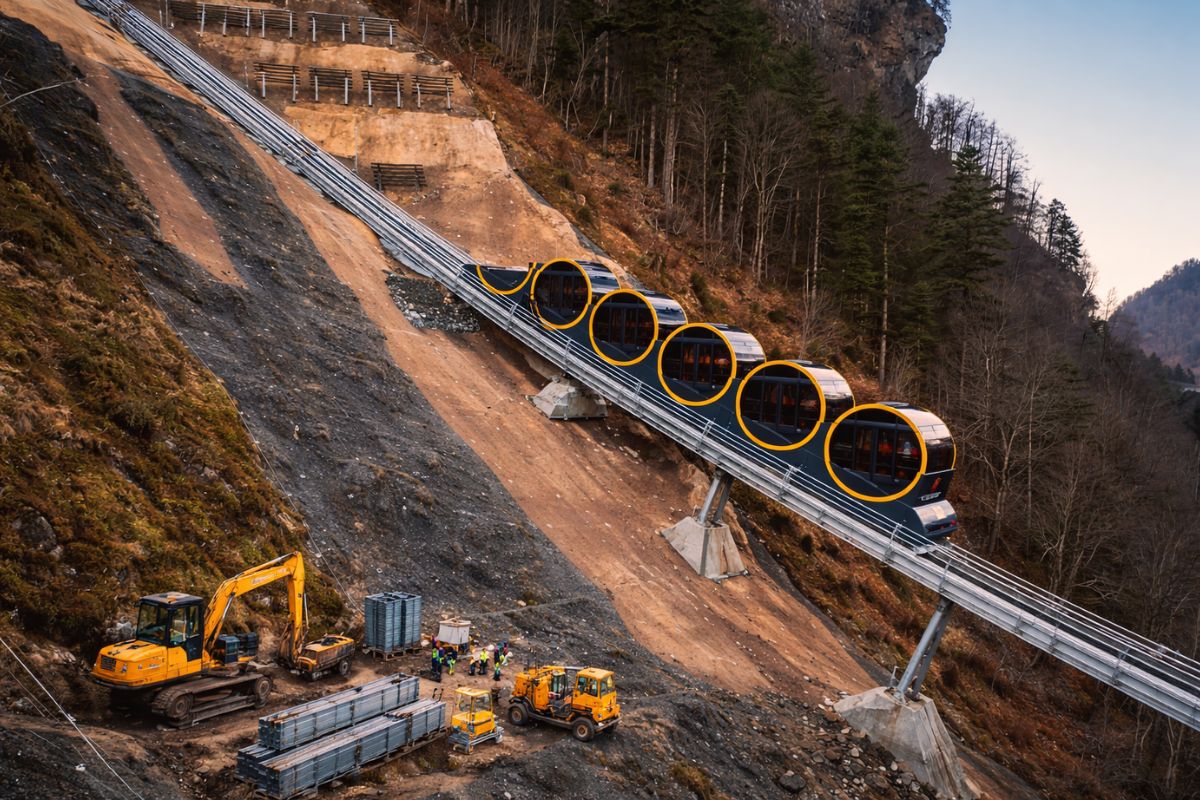
In The Swiss Alps, The Steepest Railway In The World Does Not Rely On Raw Power: It Combines Modern Funicular, Historic Rack And Pinion, And Dynamic Brakes To Conquer Nearly Vertical Walls. Over 5 Km, An Elevation Gain Of 1,115 Meters Requires Tunnels At 48° And Precise Control To Keep Cabins Level Without Scaring Anyone.
In The Swiss Alps, The Steepest Railway In The World Is Not Just Notable For Its Numbers. The Steeper The Mountain, The More Delicate The Train Needs To Be, and that is the point that separates curiosity from infrastructure: Switzerland integrated funicular, rack, and brakes into the same safety system.
The Route Was Born To Connect An Alpine Village To The Valley Below, In A Place Where Winter Multiplies The Population And Mobility Becomes A Condition For Economic Survival. What Seems Like An Adventure, In Practice, Is Public Service, With Engineering Designed To Ascend, Stop, Descend, And Repeat, Every Day, At The Limit Of The Terrain.
Climbing 1,115 Meters Over 5 Km Without Slipping On Steel

The Math Of The Steepest Railway In The World Begins With Traction.
-
Friends have been building a small “town” for 30 years to grow old together, with compact houses, a common area, nature surrounding it, and a collective life project designed for friendship, coexistence, and simplicity.

-
This small town in Germany created its own currency 24 years ago, today it circulates millions per year, is accepted in over 300 stores, and the German government allowed all of this to happen under one condition.

-
Curitiba is shrinking and is expected to lose 97,000 residents by 2050, while inland cities in Paraná such as Sarandi, Araucária, and Toledo are experiencing accelerated growth that is changing the entire state’s map.

-
Tourists were poisoned on Everest in a million-dollar fraud scheme involving helicopters that diverted over $19 million and shocked international authorities.


On Inclines That Challenge Ordinary Wheels, The Steel-On-Steel Contact Has Low Friction And Does Not Provide Sufficient Grip, No Matter How Much Power Is Put Into The Locomotive.
On The Rigi Railway, Engineer And Locomotive Builder Nicholas Rianmbback Solved This With A Third Rack Rail Positioned Between The Running Rails.
A Gear On The Axle Fits Into The Rack And Prevents Slipping, Pushing The Train Up The Mountain. Without The Rack, Gravity Makes The Decisions; With The Rack, Gravity Becomes A Calculation.
The Descent Is The Real Test And The Brakes Cannot Fail

In The Mountains, Climbing Is Impressive, But Descending Defines Reputation.
On The Rigi, A 25% Incline Put Pressure On The Boiler And The Band Brakes, As Well As Accelerating Wear And Damaging The Tracks, A Set Of Factors That Usually Arise Before Serious Failures.
To Avoid The Scenario Of Losing Brakes On A Loaded Descent, The Solution Was To Transform The Motor Itself Into A Brake.
With The Throttle Valve Closed And The Air Valve Activated In The Opposite Direction, The Pistons Begin To Draw In Clean Air, Compressing This Air In The Cylinder; The Compressed Air Acts As A Damper And Reduces Speed.
The Faster The Train Goes, The Stronger The Braking Response, A Valuable Behavior When The Terrain Offers No Second Chances.
When The Wall Becomes Nearly Vertical, The Funicular Becomes Another Species

The Steepest Railway In The World Changes Category When The Slope Approaches The Vertical.
In The Alpine Village Of Stoves, At About 1,300 Meters Above Sea Level, An Old Funicular Was The Only Link To The Valley, But It No Longer Met The Volume Of Passengers: The Permanent Population Hovers Around 100 People And Surges To More Than 2,000 In The High Season.
The Replacement Required Abandoning Curves And Opting For A Straight Track, Parallel To The Old Route, After 84 Years Of Use Of The Previous System.
Project Leader Bruno Leart Described The Standoff Directly: The Natural Wall Is Practically Vertical, And Yet The Line Needed To Exist.
In December 2017, The New Line Opened To The Public With An Incline Of 48° And Sections Reaching 110%. Here, Funicular Is Not A Metaphor; It Is The Only Way To Keep The Ascent Under Control.
Level Cabins So The Passenger Does Not Feel The Angle
The Most Visible Paradox Of The Steepest Railway In The World Is Human: The Track Inclines, But The Passenger Needs To Stand, Enter With Strollers, Wheelchairs, And Luggage, Without Tripping Over A Constant Sensation Of Falling.
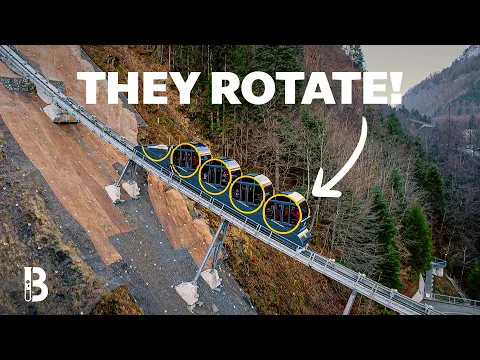
The Solution Was To Create A Car With A Fixed Chassis And Individual Cylindrical Cabins That Rotate To Keep The Floor Horizontal. Embedded Inclinometers Detect The Angle Of The Track And Activate Hydraulic Cylinders, Compensating For The Incline By Rotating The Cabins.
Maintenance Enters A Tight Cycle, Taking Advantage Of 15-Minute Windows At The Station For Testing And Adjustments.
The Neutrality That The Body Perceives Depends On Sensors, Hydraulics, And Operational Discipline, Not Luck.
Tunnels At 48° And 25,000 Tons Of Rock Descending By Gravity
The Straight Route Required Excavating What The Mountain Was Unwilling To Yield.
Three Tunnels Were Dug In Solid Rock; The Highest One Came Out With Simple Drilling And Explosion, But The Two Lower Tunnels Required A New Approach Due To The Extreme Incline.
The Team Used Elevated Drilling With A Specially Designed Device.
A Small Pilot Hole Is Made With Directional Drilling; When The Drill Emerges, It Is Replaced By A Rotating Cutting Tool Pulled Up, Enlarging The Diameter For Insertion Of Explosives And Final Widening.
The Steepest Stretch Cited Is 250 M, With 200 M At 110%, And The Material Removed Was About 25,000 Tons, Descending By Gravity Because The Angle Does Not Allow For Another Logistics.
The Same Effect That Facilitates Disposal Becomes A Risk For Those Working Below, And Therefore The Safety Control Needs To Be Redundant.
Slope Safety And The Engineering Of Details That Prevents Accidents
Working Affixed To The Mountain Changes The Scale Of Danger.
The Team Was Secured To The Slope By Safety Cables, Because A Lost Tool Can Gain Enough Energy To Become A Projectile In A Few Meters, Especially When There Are People Below In The Same Vertical Alignment.
The Work Record Is Pragmatic: There Were No Truly Serious Accidents, And This Connects To Choices Of Method And Routine.
In Operation, Two Huge Motors Allow For Maintaining Maximum Speed Regardless Of The Angle, And The Line Includes 580 M Of Some Of The Steepest Railway Tunnels In The World.
The Mentioned Speed Reaches 36 Km/h With Inclination Close To 50°, Which Only Makes Sense When Brakes, Leveling, And Driving Adhere To The Design.
In Such A Corridor, A Small Failure Becomes A Major Headline.
What Changed In Switzerland When The Impossible Became A Regular Line

The Impact Is Not Limited To Technical Curiosity.
The System Was Designed To Transport 1,500 People Per Hour On The Steepest Sections, With Larger Cars And Accessibility At The Stations, While The Travel Speed Is About Two And A Half Times Faster Than The Old Funicular.
At The Same Time, Switzerland Carries A Memory Of Innovation That Starts Earlier, With The Rigi Railway. In 1871, The Rigi Became A Reference For Using Rack And Pinion To Conquer A Mountain, And Required Brakes Capable Of Controlling Descents Without Collapse.
Today, The Steepest Railway In The World Resumes This Logic With Another Technology: It Swaps Steam For Sensors And Hydraulic Cylinders But Maintains The Same Goal, To Control Gravity With Predictability.
The Steepest Railway In The World Seems To Defy Gravity Because Switzerland Chose Not To Negotiate With Improvisation.
The Project Combines Rack For Traction, Brakes That Use Compressed Air For Deceleration, A Funicular With Level Cabins, And Excavated Tunnels At Angles That Require A Specific Method.
The Spectacle Is A Consequence; The Priority Is Safe Repetition.
If You Were Inside This Funicular On A Windy And Snowy Day, What Would Weigh Heavier On Your Confidence: Hearing The Work Of The Brakes, Knowing That The Rack Is Engaged, Or Feeling The Cabin Level While The Steepest Railway In The World Climbs A Nearly Vertical Wall? And At What Point Would You Be Willing To Make This Journey With Children Or The Elderly?










-

-

-

4 pessoas reagiram a isso.