





 Portuguese
  English
  Spanish
  3 min of reading
  2 comments


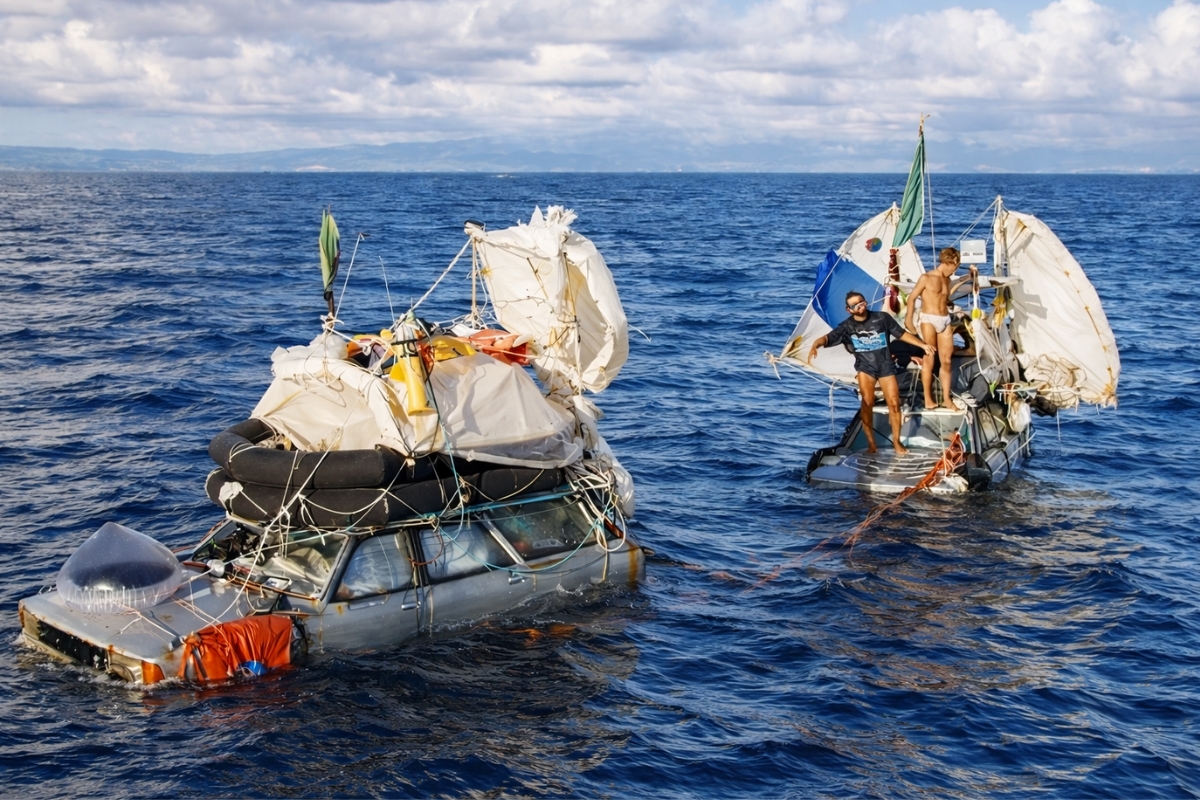


A 1987 Passat and a 1981 Taunus Are Handcrafted to Float, Given Makeshift Sails and Minimal Shelter, and Take Two Men on a 119-Day Journey That Ended in Martinique and Shocked the World
They did not arrive by boat. Nor by plane. They came in something that seemed impossible: two cars transformed into vessels, made in the backyard with foam, metal, and a lot of courage.
The story took place in 1999 and features Marco Amoretti, his brothers Fabio and Mauro, and their friend Marcolino De Candia. Without being naval engineers or professional explorers, they decided to fulfill the dream their father could not complete: to prove it was possible to cross the ocean inside a floating car.
An Inherited Dream — And a Promise to Keep
Their father, Giorgio Amoretti, a photographer and adventurer, had tried years earlier to cross the Atlantic in an adapted Volkswagen Beetle, named “Automare.” But, hindered by authorities and facing terminal cancer, he realized he could not complete the idea.
-
Friends have been building a small “town” for 30 years to grow old together, with compact houses, a common area, nature surrounding it, and a collective life project designed for friendship, coexistence, and simplicity.

-
This small town in Germany created its own currency 24 years ago, today it circulates millions per year, is accepted in over 300 stores, and the German government allowed all of this to happen under one condition.

-
Curitiba is shrinking and is expected to lose 97,000 residents by 2050, while inland cities in Paraná such as Sarandi, Araucária, and Toledo are experiencing accelerated growth that is changing the entire state’s map.

-
Tourists were poisoned on Everest in a million-dollar fraud scheme involving helicopters that diverted over $19 million and shocked international authorities.


That’s when the sons made a radical decision: to make the crossing for him.

How Two Cars Became “Boats” in the Middle of the Ocean?
The preparation was entirely handcrafted. They used two vehicles — a 1987 Volkswagen Passat and a 1981 Ford Taunus — modified and filled with polyurethane and foam to gain buoyancy. The cars were sealed and adapted with small engines, makeshift sails, and minimal space for shelter.
To increase safety, they placed inflatable rafts on the roof and tied the two vehicles together with ropes, trying to prevent them from separating in open water.
The Atlantic Showed Its Toughest Side
A few days after the start, the plan almost collapsed. Fabio and Mauro could not withstand the extreme fatigue and intense seasickness and gave up the crossing. From then on, only Marco and Marcolino continued, practically alone in an endless expanse.
The following weeks were tense: they depended on the wind and currents, dealt with leaks, did constant repairs, and faced storms. At one point, they lost contact with land when the s satellite phone stopped working. To survive, they improvised — even fishing to ensure food.
Meanwhile, Giorgio died on May 28. The family chose not to share the news at that moment, fearing it would destroy the two’s determination in the middle of the ocean.

119 Days at Sea and Nearly 4,700 km to the Caribbean
On August 31, 1999, after 119 days and about 4,700 kilometers, Marco and Marcolino finally reached Martinique Island, in the Caribbean.
With this, they entered history as the first people to cross the Atlantic aboard floating cars — a crossing driven by improvisation, resilience, and, above all, by the promise to fulfill a father’s last wish.










Faltou dizer de onde eles partiram.
Interessante.