





 Portuguese
  English
  Spanish
 6 min of reading
  1 comment


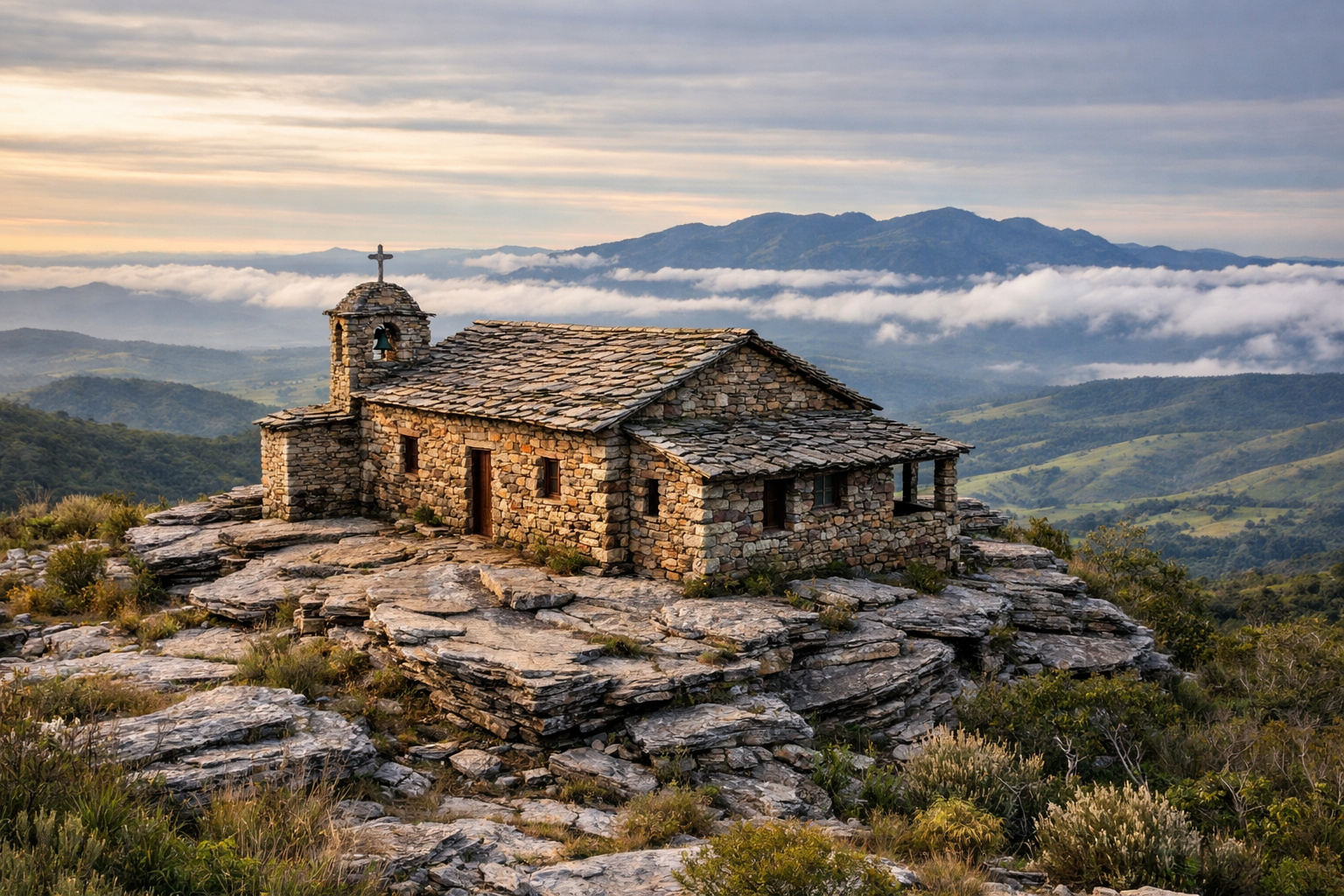


Mining Municipality Built Streets, Houses and Churches on a Massif of Quartzite, Mixing Mystical Legends, Mineral Economy and a Unique Historical Heritage in Brazil
The streets are made of stone. The walls of the houses are too. Churches, walls, sidewalks, and even the police station follow the same logic. In São Thomé das Letras, in southern Minas Gerais, everything seems to arise from the very rock that sustains the city at a 1,440-meter altitude, at the top of the Mantiqueira Mountains. With about 7,000 inhabitants, the municipality has become nationally known as the “Mystical City,” bringing together unique geology, religious stories, esoteric legends, and an economy literally based on stone.
At the same time that it arouses curiosity for its tales of secret tunnels and unexplained phenomena, São Thomé das Letras has a rare characteristic: it was built on a huge natural deposit of quartzite, a material that shaped not only the urban landscape but also the cultural identity and the main economic activity of the region.
This information has been disclosed in historical and tourist reports published by specialized portals, as well as technical records from official institutions linked to Brazilian heritage and geology.
-
Friends have been building a small “town” for 30 years to grow old together, with compact houses, a common area, nature surrounding it, and a collective life project designed for friendship, coexistence, and simplicity.

-
This small town in Germany created its own currency 24 years ago, today it circulates millions per year, is accepted in over 300 stores, and the German government allowed all of this to happen under one condition.

-
Curitiba is shrinking and is expected to lose 97,000 residents by 2050, while inland cities in Paraná such as Sarandi, Araucária, and Toledo are experiencing accelerated growth that is changing the entire state’s map.

-
Tourists were poisoned on Everest in a million-dollar fraud scheme involving helicopters that diverted over $19 million and shocked international authorities.

The Quartzite Mountain That Became a City and Sustains the Local Economy

Geologically speaking, São Thomé das Letras is seated on a quartzite deposit from the Neoproterozoic period, a rock formation hundreds of millions of years old. Starting in the 1940s, the extraction of the so-called “São Tomé stone” began to drive the local economy, transforming the municipality into one of the main production hubs of this type of ornamental rock in the country.
The quartzite from the region is highly valued for an important technical characteristic: it does not retain heat, making it ideal for pool edges, outdoor floors, facades, and architectural coatings. Therefore, the stone extracted in São Thomé das Letras is marketed in various regions of Brazil and also abroad.
In 2024, this relevance was officially recognized when the National Institute of Industrial Property granted the local quartzite the Geographical Indication registration, certifying the origin and exclusive quality of the material extracted from the region.
This link between geology and urbanism is visible in the historic center. Houses and walls are constructed with stacked stone slabs without the use of mortar, in a fitting system that resembles medieval techniques. Due to this architectural value, the State Institute of Historical and Artistic Heritage of Minas Gerais registered the historic center and the Main Church in 1996, ensuring legal protection for the urban complex.
The Legend of the Slave, the Cave, and the Origin of the City’s Name
The origin of the name São Thomé das Letras is linked to one of the oldest and most symbolic stories of the municipality, dating back to the late 18th century. According to local tradition, the slave João Antão, who escaped from Captain João Francisco Junqueira’s farm, is said to have hidden in a cave atop the mountain.
According to the legend, a man dressed in white appeared at the site and handed the slave a perfectly written letter. Upon delivering the note to the farmer, João Antão received his freedom. In the same cave, an image of Saint Thomas was found, which impressed the owner of the farm.
As a consequence, Junqueira ordered the construction of a chapel next to the cave. The current Main Church, initiated in 1785, occupies that same site today and preserves Rococo-style paintings attributed to Joaquim José da Natividade, one of the relevant names in Minas’ sacred art.
The addition “das Letras” refers to the petroglyphs found in the original cave, still visible to visitors. These records reinforce the historical and archaeological character of the location, long before the municipality was established.

Caves, Pyramid, Waterfalls, and the Mystical Tourism of the Mountains
Currently, São Thomé das Letras features a series of natural and cultural attractions accessible from the urban center. Caves, viewpoints, trails, and waterfalls are part of the city’s tourist routine, with itineraries often accompanied by local guides accredited by the city hall.
Among the main points are the Casa da Pirâmide, located at the highest point of the Antônio Rosa Municipal Park, famous for its 360-degree panoramic view and one of the most photographed sunsets in Minas Gerais. The Gruta de São Thomé, beside the Main Church, serves as a historical and religious reference. The Pedra da Bruxa attracts visitors for its curious rock formations and the expansive view of the mountains.
Another highlight is the Stone Church (Our Lady of the Rosary), built by enslaved people in the 18th century with stacked quartzite slabs without mortar and listed as a heritage site by the state in 1985. In the surrounding area, waterfalls like Eubiose, Véu de Noiva, and Sobradinho complement the itinerary with water falls surrounded by rocky fields and native forest.
Additionally, travel videos and comprehensive itineraries produced by content creators have increased the city’s visibility in recent years, reinforcing its mystical and natural appeal.
The Myth of the Secret Tunnel and the Cave That Never Ended
Among all the stories associated with the city, none is as famous as that of the Gruta do Carimbado, located about 6 km from the center, on the road to São Bento do Abade. According to residents and enthusiasts of mysticism, the cave is said to be a supposed underground portal connecting São Thomé das Letras to Machu Picchu, approximately 4,000 kilometers away.
From a technical perspective, the Brazilian Speleological Society has recorded only 212 meters of explored topography, with no evidence of transcontinental tunnels. Still, the popular imagination remains strong, especially after the airing of the miniseries Filhos do Sol by Rede Manchete in 1991, which used the city as a backdrop for a plot involving extraterrestrials and subterranean civilizations.
Currently, the Gruta do Carimbado is closed by court decision, but nearby attractions, such as Ladeira do Amendoim, remain open. At the site, cars in neutral seem to move uphill by themselves, a phenomenon explained by physics as optical illusion, but continues to intrigue visitors.
Climate, Altitude, and the Best Time to Visit the Stone City
The 1,440-meter altitude directly influences the local climate. Even in summer, nights tend to be cool, while winter can register temperatures close to 6°C. The dry period, from May to September, is considered the best time for trails, viewpoints, and observing the clear sky, which feeds frequent reports of luminous sightings.
According to reference data from Climatempo, average temperatures vary between 6°C and 27°C, depending on the season, with higher precipitation in summer, when the waterfalls are fuller and suitable for bathing.
How to Get to São Thomé das Letras
São Thomé das Letras is located 346 km from Belo Horizonte and about 370 km from São Paulo. The main access is via BR-381 to Três Corações, followed by LMG-862 and LMG-868 highways, with paved stretches. There is no airport in the city; the closest one is in Varginha, approximately 70 km away. Intermunicipal buses depart from Três Corações, but a personal or rented car is the most practical option.
Climb the Mountain and Step into the City That Literally Arises from the Rock
São Thomé das Letras is not just a tourist destination. It is a municipality where geology, history, faith, and legends blend into the daily life of just over 7,000 residents. There, stone becomes home, the cave becomes narrative, and the horizon, seen from the mountaintop, needs no explanation.









Uma materia que começa com uma foto fake de uma edificação que não existe na cidade, ja perde boa parte da credibilidade.