





 Portuguese
  English
  Spanish
  4 min of reading
  0 comments


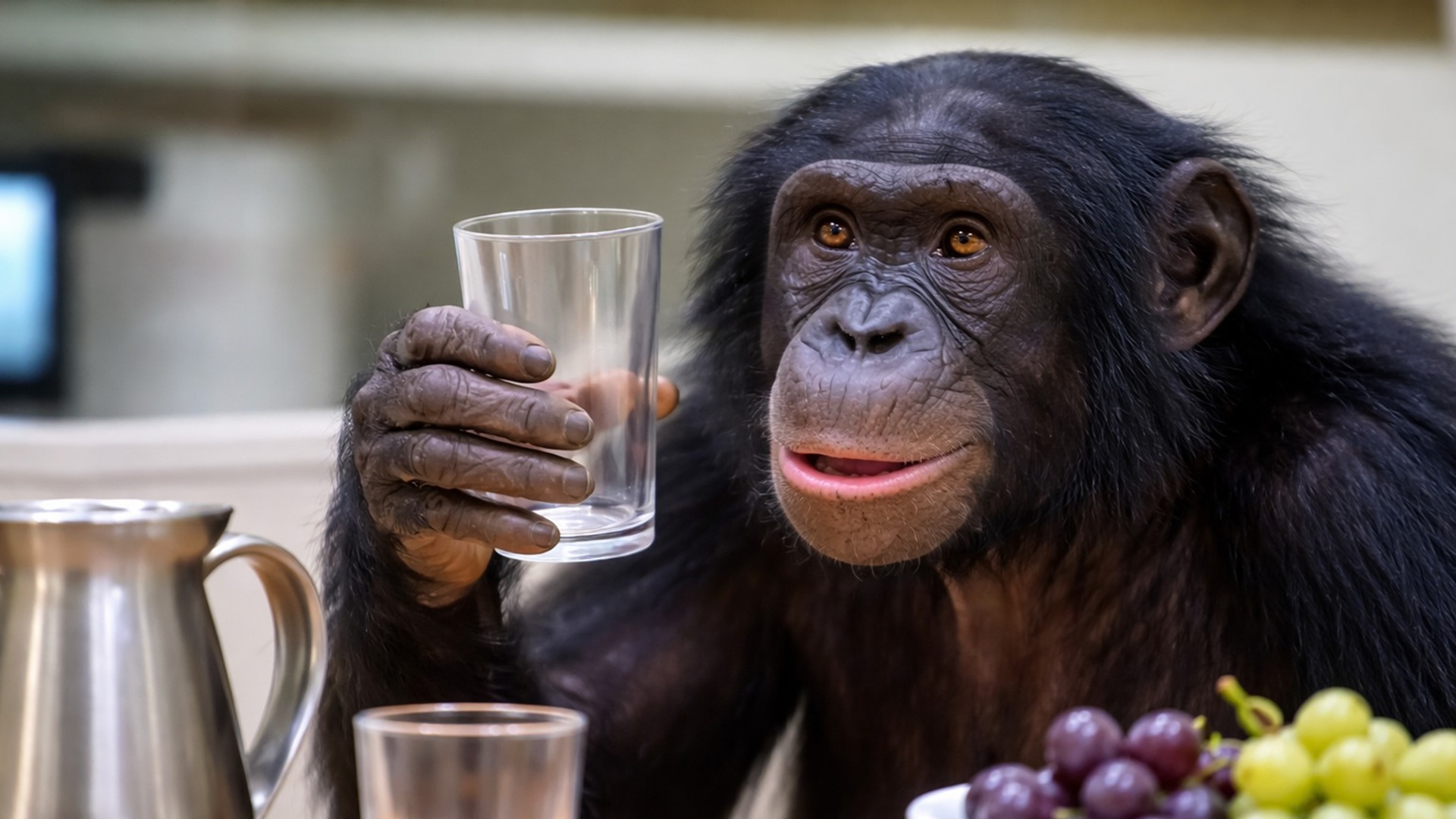
Study Published on February 5, 2026 in Science Describes Three Controlled Tests Conducted by Johns Hopkins University in Which a 43-Year-Old Bonobo Tracked Imaginary Juice and Grapes, Indicating That the Ability May Date Back to a Common Ancestor 6 to 9 Million Years Ago
A bonobo demonstrated the ability to track imaginary objects in three controlled tests conducted by Johns Hopkins University and published on February 5, 2026 in Science, suggesting that imagination may have shared evolutionary roots dating back 6 to 9 million years.
The research presents the first controlled demonstration that a monkey can imagine objects that are not physically present. In experiments inspired by children’s tea parties, the bonobo interacted with invisible juice and imaginary grapes consistently and reliably.
The results challenge the belief that imagination is exclusively human. The researchers concluded that understanding imaginary objects is within the mental capabilities of at least one acculturated primate.
-
Motorola launched the Signature with a gold seal from DxOMark, tying with the iPhone 17 Pro in camera performance, Snapdragon 8 Gen 5 that surpassed 3 million in benchmarks, and a zoom that impresses even at night.

-
Satellites reveal beneath the Sahara a giant river buried for thousands of kilometers: study shows that the largest hot desert on the planet was once traversed by a river system comparable to the largest on Earth.

-
Scientists have captured something never seen in space: newly born stars are creating gigantic rings of light a thousand times larger than the distance between the Earth and the Sun, and this changes everything we knew about stellar birth.

-
Geologists find traces of a continent that disappeared 155 million years ago after separating from Australia and reveal that it did not sink, but broke into fragments scattered across Southeast Asia.

They suggest that this ability may date back to a common ancestor shared by humans and other primates around 6 to 9 million years ago.
Bonobo Participates in Controlled Tests and Demonstrates Understanding of Imaginary Objects
Kanzi, a 43-year-old bonobo living at the Ape Initiative, participated in the study. He had previously been described as able to respond to spoken questions by pointing and engaging in pretend play behaviors.
During the sessions, Kanzi sat in front of an experimenter at a table with jars, cups, bowls, and empty containers. The activities were structured in the format of an afternoon tea, under controlled conditions.
In the first experiment, two transparent cups and one empty transparent jar were placed on the table. The experimenter pretended to pour imaginary juice into both cups and then pretended to empty one of them.
Then, he asked, “Where is the juice?”. Most of the time, the bonobo pointed to the cup that should still contain the imaginary juice, maintaining the correct choice even when the cups were switched.
Bonobo Distinguishes Real Juice from Imaginary Juice in Second Test
To rule out the possibility that Kanzi believed there was real liquid in the cups, the researchers conducted a second test. One cup contained real juice, while the other contained only imaginary juice.
When asked which he preferred, Kanzi almost always chose the cup with real juice. This performance reinforced that the bonobo differentiated between the imagined object and the physically present object.
In a third experiment, the procedure was repeated using grapes. The experimenter pretended to take a grape from an empty container and place it in one of the two pots, then acted as if he had emptied one of them.
Upon hearing the question “Where is the grape?”, Kanzi again indicated the correct location of the imaginary grape. Although he did not get it right every time, his performance was consistently above the level of random guessing.
Bonobo Challenges Assumptions About the Limits of Animal Cognition
The data were interpreted by the researchers as evidence that the bonobo is capable of generating a mental representation of a non-existent object and simultaneously recognizing that it is not real.
Christopher Krupenye, assistant professor in the Department of Psychological and Brain Sciences at Johns Hopkins University, stated that it is revolutionary that the mental life of these animals goes beyond the here and now.
According to him, imagination has been seen as a central element of what it means to be human. The possibility that it is not exclusive to our species is considered transformative.
Amalia Bastos, co-author of the study, said that the data suggest that monkeys can mentally conceive things that do not exist. She noted that Kanzi generates the idea of the imaginary object and at the same time knows that it is not real.
Bonobo and Parallels With Human Pretend Play
The study contextualizes that human children begin participating in pretend play activities around the age of two. Fifteen-month-old babies show surprise when someone pretends to fill a cup and acts as if there is still liquid in it.
Until now, no controlled experiment had tested whether non-human animals understood simulation, despite isolated reports in natural and captive settings.
In nature, young female chimpanzees have been observed carrying sticks as if they were babies. In captivity, a chimpanzee even dragged invisible blocks after playing with real blocks.
The researchers claim that the work opens the way for new investigations into whether other primates or species can mentally keep track of imaginary objects or engage in similar play.
They also intend to study whether primates can think about future events or consider what other individuals may be thinking.
The study titled “Evidence of Imaginary Object Representation by Kanzi, a Language-Trained Bonobo” was published on February 5, 2026 in Science, under DOI 10.1126/science.adz0743.
By addressing imagination as part of the mental life of monkeys, the authors argue that the findings should lead to a reconsideration of the assumption that other animals live only robotic lives, limited to the present.
Krupenye stated that this evidence should compel people to care for these creatures and ensure their continued existence, considering the complexity of their minds.








-

Uma pessoa reagiu a isso.