





 Portuguese
  English
  Spanish
  4 min of reading
  4 comments


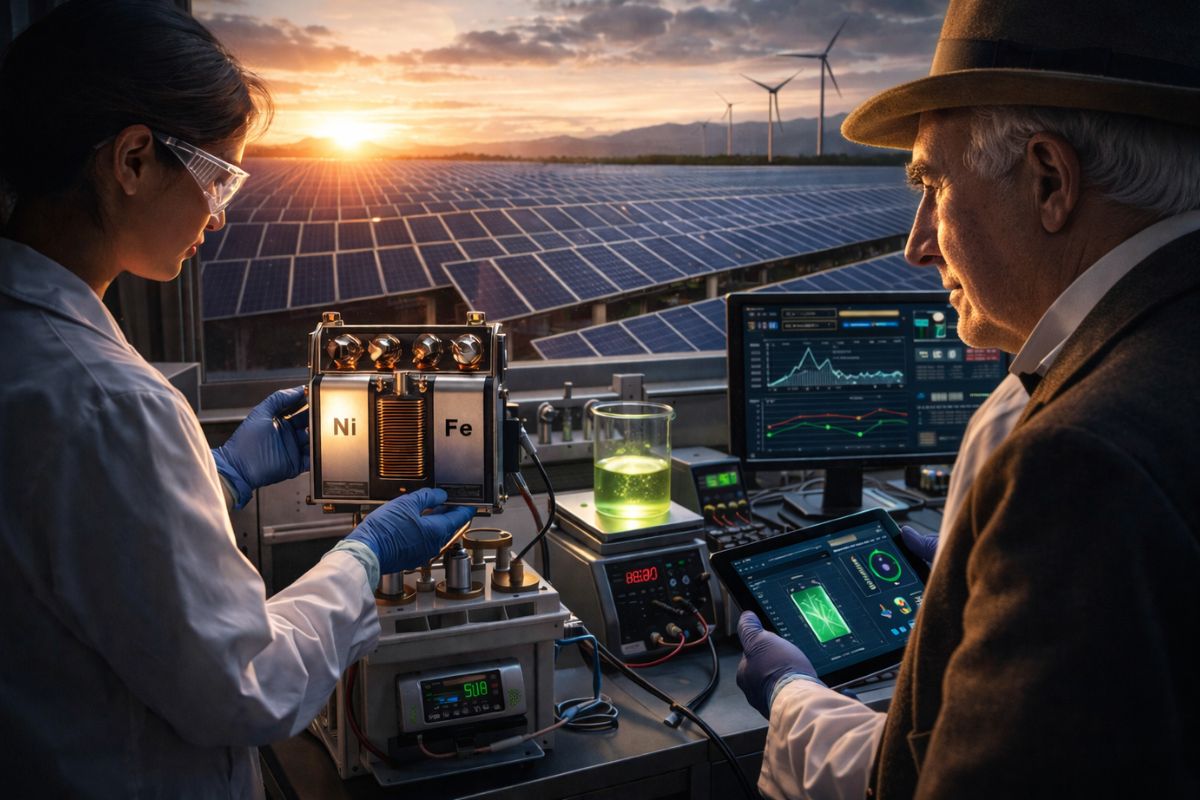


The Prediction Attributed to Thomas Edison Gains New Life with Researchers from the University of California in Los Angeles, Who Modernize the Nickel-Iron Battery to Store Electricity from Solar Panels and Try to Solve the Bottleneck of the Night Period, While Not Abandoning Common Materials and Durability with Faster Recharge Today.
The name Thomas Edison reappears in 2026 at a sensitive point in the energy transition: how to store solar energy when the Sun goes down. Researchers from the University of California in Los Angeles have revived the nickel-iron battery from 1901 and adapted it for storage, targeting precisely the most difficult time for consumers and networks, at night.
The promise is simple to understand and difficult to execute: taking solar energy from peak hours and pushing some of it to after sunset, without trading sustainability for dependence on rare materials. On paper, the modernized nickel-iron battery attempts to reconcile efficiency, lifespan, and viability, but still needs to prove performance outside the lab.
From 1901 to 2026: Why Thomas Edison Is Being Cited Again
In the early 20th century, Thomas Edison tried to solve a problem similar to today’s, only with a different target: energy storage for electric vehicles.
-
Motorola launched the Signature with a gold seal from DxOMark, tying with the iPhone 17 Pro in camera performance, Snapdragon 8 Gen 5 that surpassed 3 million in benchmarks, and a zoom that impresses even at night.

-
Satellites reveal beneath the Sahara a giant river buried for thousands of kilometers: study shows that the largest hot desert on the planet was once traversed by a river system comparable to the largest on Earth.

-
Scientists have captured something never seen in space: newly born stars are creating gigantic rings of light a thousand times larger than the distance between the Earth and the Sun, and this changes everything we knew about stellar birth.

-
Geologists find traces of a continent that disappeared 155 million years ago after separating from Australia and reveal that it did not sink, but broke into fragments scattered across Southeast Asia.
The nickel-iron battery was born in this context, but ended up being swallowed by the dominance of gasoline engines and by technical limits that, at the time, restricted its commercial appeal.
In 2026, the motivation changes form, not essence. The conversation revolves around solar energy, not mobility, and the central challenge is the same: storing energy safely and predictably.
The nickel-iron battery returns because the pressure for renewables is increasing and because nighttime storage remains a bottleneck that hinders projects and raises costs.
What Was Updated in the Nickel-Iron Battery in 2026
According to the project description, researchers in Los Angeles sought to accelerate recharge times and improve durability, using current technologies to modernize an old architecture.
The idea is to transform a battery seen as forgotten into a functional option for solar energy systems, with more predictable behavior in repeated cycles.
This update is presented as a bridge to expand the adoption of renewables, but it is important to separate intention from result.
A battery does not become a global solution just because it is robust, and the very proposal recognizes challenges in large-scale production and manufacturing costs, points that usually decide the fate of any energy technology.
Nighttime Storage: The Knot That Solar Energy Still Cannot Untie
Solar energy grows when the Sun is available, but significant consumption continues to exist outside that interval.
This is where night comes in as a stress test for solar systems: without storage, daytime excess becomes waste, and peak demand continues dependent on other sources.
The modernized nickel-iron battery appears as an attempt to fill this gap with a straightforward logic: capture energy throughout the day and release energy afterward, reducing fluctuation.
The goal is to unlock the continuous use of solar energy, not just in demonstrations, but in projects that need to bridge the night without improvisation.
The 12,000 Cycles and the Prudence That Engineering Demands
The released material claims that the updated battery can withstand more than 12,000 charge and discharge cycles, even though that number is not widely verified.
In practical terms, these kinds of claims aim to sell longevity, one of the major pain points of energy storage in daily use applications.
However, without broad validation, the number becomes a point of attention, not celebration. Declared cycles need to be proven cycles, under comparable conditions and with transparency regarding degradation, time, temperature, and usage profile.
The battery may indeed be promising, but the market tends to punish promises that do not survive when leaving a controlled environment.
Sustainability, Common Materials, and the Cost Barrier
One of the central arguments is the use of common materials, such as nickel and iron.
In theory, this would help avoid dependencies and keep sustainability as part of the package, especially in a scenario where energy storage needs to grow alongside solar energy, and not become a new environmental problem.
Even so, the math does not add up on its own. Large-scale production and cost remain cited as barriers, and it is here that ambition meets industrial reality.
To accelerate the global adoption of renewables, technology needs to fit within budgets and the production chain, in addition to delivering energy reliably during the night, repeatedly, without surprises.
The story of Thomas Edison makes headlines because it touches on a modern anxiety: the feeling that solar energy has already proven its value but still stumbles when night falls.
The updated nickel-iron battery in 2026 tries to fill this void with an old design, common materials, and the promise of durability, while facing the toughest test: cost and scale.
Would you trust a battery inspired by Thomas Edison to hold solar energy in your home overnight? What weighs more for you, price, durability, or the idea of using a technology from 1901 updated in 2026?








Eu já uso energia solar sem baterias. Obviamente, à noite o fornecimento vem da concessionária. A vantagem disto é clara, o excedente que produzo e forneço à concessionária foi o suficiente para reduzir uma conta que beirava os R$ 500 no início de 2022 à tarifa básica. Não houve um único mês deste então que paguei além disto. Não esperem bateria, coloque fotovoltaica hoje.
Difícil será ter aval de politicos que tem suas campanhas pagas pela industria do petroleo.
Gênio e gênio.