





 Portuguese
  English
  Spanish
  4 min of reading
  0 comments


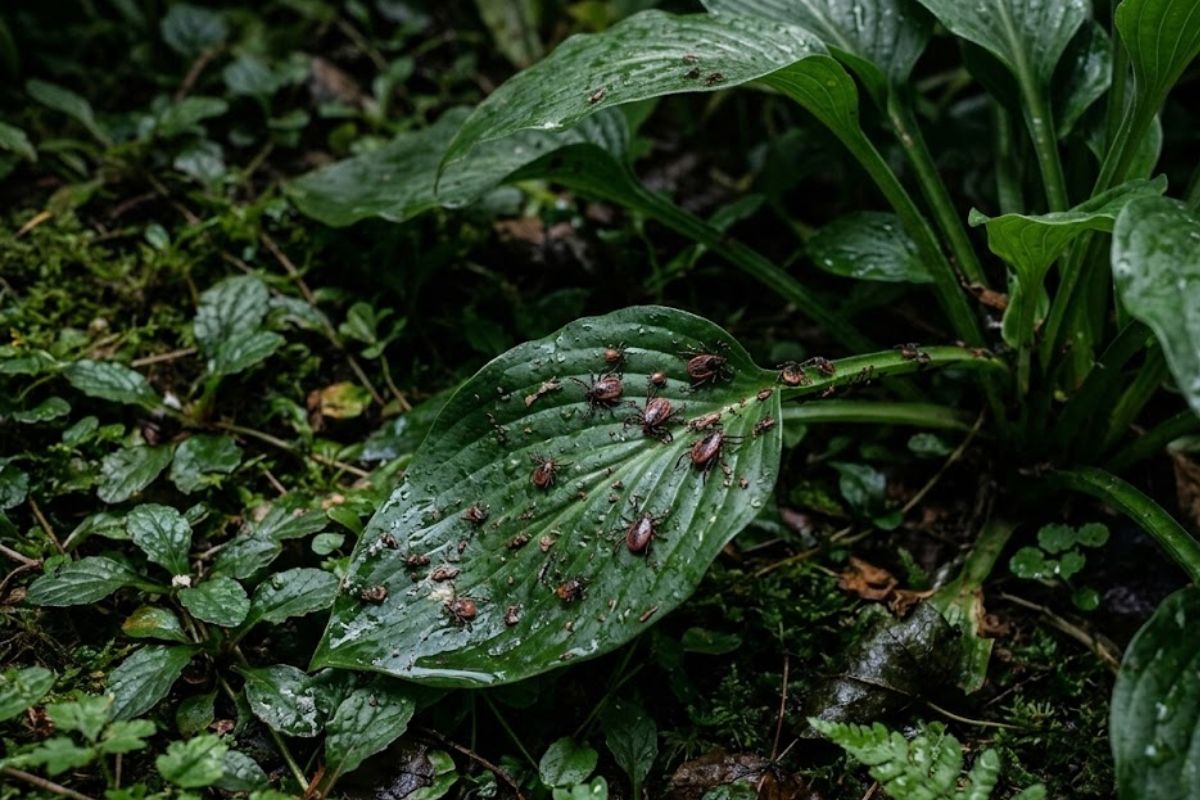
Ticks Like Microclimates: When Grass Grows Too Much, Dense Groundcover Holds Water, Shrubs Get Bulky and the Hedge Becomes a Barrier, the Garden Loses Sun and Wind. With Poor Drainage and Little Pruning, the Soil Stays Moist and the Infestation Finds Shelter and Spreads Where Dry Leaves Accumulate.
Ticks have a simple “radar” in the yard: constant shade, retained moisture, and dense vegetation. When the garden begins to offer this set of conditions, the parasite finds a sheltered place to stay, making it difficult for users of the outdoor area and increasing concerns about pets.
The key point is that often the problem arises from the landscape design and maintenance: it’s not just the plant, but the way it occupies the space. Understanding where ventilation is blocked, where the sun does not reach, and where water gets “trapped” completely changes how to organize flowerbeds, lawns, shrubs, and hedges.
The “Address” of Ticks Comes from the Garden Microclimate
Ticks tend to favor areas that function as a small natural “roof”: leaves and branches form a canopy, the soil below is less exposed to heat, and moisture takes longer to evaporate.
-
Friends have been building a small “town” for 30 years to grow old together, with compact houses, a common area, nature surrounding it, and a collective life project designed for friendship, coexistence, and simplicity.

-
This small town in Germany created its own currency 24 years ago, today it circulates millions per year, is accepted in over 300 stores, and the German government allowed all of this to happen under one condition.

-
Curitiba is shrinking and is expected to lose 97,000 residents by 2050, while inland cities in Paraná such as Sarandi, Araucária, and Toledo are experiencing accelerated growth that is changing the entire state’s map.

-
Tourists were poisoned on Everest in a million-dollar fraud scheme involving helicopters that diverted over $19 million and shocked international authorities.


The denser the greenery, the more stable this microclimate becomes, creating a convenient shelter for the parasite to protect itself and stay.
In practice, the “where” tends to be predictable: edges of very dense flowerbeds, areas under bulky shrubs, spots protected by compact hedges, and points of the lawn where the grass grows tall and shades the soil itself. If landscaping does not consider spacing, sunlight, and air circulation, ticks gain a continuous green corridor to remain in the garden.
Tall Grass, Dense Groundcover, and Bulky Shrubs: When Green Becomes a Hideout

Tall grass is not just an aesthetic issue: it creates a thicker layer over the soil, reduces direct light incidence, and helps retain moisture near the surface. In this scenario, ticks find more protection and less exposure, especially when the lawn becomes uneven and with more “closed” spots throughout the area.
The same reasoning applies to very dense groundcovers and bulky shrubs. Dense groundcover can keep the soil constantly moist, while unpruned shrubs reduce ventilation and expand shaded areas.
When these elements accumulate in the same spot, the garden begins to function like a magnet: not by directly “attracting” but by offering ideal conditions for shelter and persistence for ticks.
Compact Hedges and Little Ventilation: The Barrier That Maintains Shade and Moisture
Hedges are widely used for privacy and delineation, but when they become too compact, they can turn into a green wall blocking wind and sun. This creates a side effect: neighboring areas have compromised ventilation and prolonged shade, and the soil tends to dry more slowly after irrigation or wet periods.
Over time, the garden develops “cold” and stuffy zones where air circulation does not renew and moisture remains. Ticks benefit from this poor balance because the environment becomes less hostile.
You don’t need to “change everything” to reduce the risk: adjusting the density, spacing, and pruning of the hedge already helps restore sunlight and ventilation to critical areas.
Drainage, Irrigation, and Cleaning: The Trio That Defines “How Much” the Risk Grows
When drainage is poor, water tends to accumulate, and the soil can become waterlogged in specific spots, maintaining the moisture that sustains the favorable microclimate.
Adding to this, uncontrolled irrigation reinforces the problem because the garden receives water when it has not completely dried out. Ticks benefit when the soil remains moist longer than necessary.
Cleaning is also a decisive factor: accumulation of dry leaves and organic matter on the ground increases the “cover” of the soil, reduces ventilation at ground level, and helps conserve moisture.
Preventive maintenance, with regular pruning, well-manicured lawns, irrigation control, and attention to drainage, significantly reduces the conditions that favor ticks and keeps the outdoor area more functional for people and pets.
To Tighten the Net in the Backyard Without Losing the Beauty of Landscaping
A balanced garden is usually one that “breathes”: it has spaces between plants, receives light at different times of the day, and does not rely on excessively dense vegetation to look beautiful. Organization and maintenance are not details: they are part of the project.
By observing where there is constant shade, where the vegetation is compact, and where water takes time to drain away, it becomes easier to prioritize simple and continuous adjustments.
Now I want to understand your case because every backyard has a different pattern of shade and moisture: at what point in your garden do you notice more moisture and less wind near the lawn, shrubs, or hedge?
And in your maintenance routine, what tends to “get postponed”: pruning, lawn height, cleaning dry leaves, or care with drainage?










-

-

-

4 pessoas reagiram a isso.