






 Portuguese
  Spanish
  4 min of reading
  1 comment


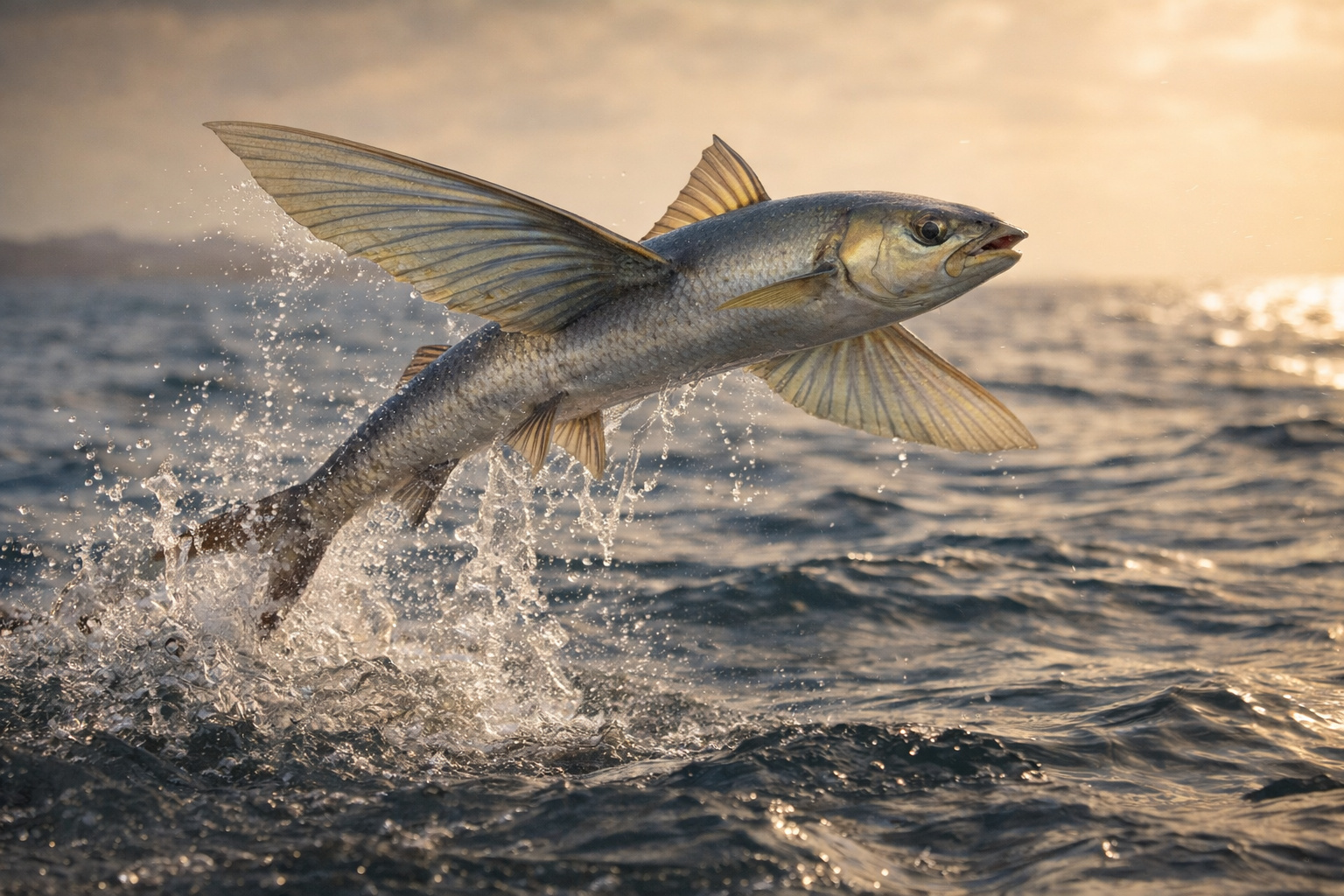


Thoracopteridae: The Triassic Fish That Glided Out Of Water With Natural “Wings,” Anticipating Millions Of Years The Evolution Of Flight In Vertebrates.
Few people imagine, but long before birds took flight or insects dominated the air as we know it today, a Triassic fish was already testing the idea of “flying” underwater and coming out of it. We are talking about the Thoracopteridae, a group of bony fish from the Late Triassic (approx. 235–201 million years ago) that developed such unusual anatomy that allowed aerial gliding above the surface, in a behavior analogous to that of the current flying fish of the genus Exocoetidae – but millions of years earlier.
Recent research published in PNAS and Nature Scientific Reports confirms that these fish not only jumped above the water but had extremely elongated and rigid pectoral fins, with bone rays designed to provide aerodynamic lift, allowing for short-duration aerial movement.
The Geological And Ecological Scenario Of The Triassic: Turbulent Seas And Fast Predators
The Thoracopteridae lived in a world radically different from today. In the Late Triassic:
-
The owner of Facebook, Mark Zuckerberg, opened his wallet and paid the equivalent of R$ 72.9 billion, or US$ 14.3 billion, to hire a 28-year-old and put him in charge of Meta’s new superintelligence.

-
They wanted artificial intelligence, but they drained the water from a village in Mexico: the water consumption of data centers caused a hepatitis outbreak, and big tech companies Amazon, Microsoft, and Google were forced to halt billion-dollar projects.

-
System created to save lives in disasters turned ‘against’ Brazilians overnight: a hacker attack sent out a false alert from Civil Defense with the word “misantropia” that went off on the phones of half the country, even in silent mode, and took down the Cell Broadcast.
-
In the cold desert of Ladakh, where it hardly rains, engineer Sonam Wangchuk created the ice stupa, a tower that freezes winter water and stores it for irrigating crops in the spring, a simple engineering feat that mimics nature.




- The oceans were dominated by fast fish and ammonites;
- Large marine predators, such as ichthyosaurs and nothosaurs, reigned at the top of the food chain;
- The Earth was a single supercontinent, Pangaea;
- The climate was warm, with no polar ice caps and strong coastal variation.
This context favored escape innovations. What we now call “flight” or “gliding” emerged as a predatory escape strategy, and the fossils of the Thoracopteridae clearly show this.

The Anatomy Of Flight: How Did A Triassic Fish “Fly”?
The fossils reveal a unique set of adaptations:
- Enlarged and Rigid Pectoral Fins: Based on fossil records of Thoracopterus and Potanichthys, the fins had a triangular and elongated shape, with proportions similar to the wings of a miniature airplane.
- Reinforced Spine And Bones: The base of the fins was supported by strong pelvic and pectoral bones, essential for withstanding the impact of the water.
- Compressed Heterocercal Tail: The tail acted as a launch motor, extremely efficient in propelling the fish out of the water.
- Specialized Hydrodynamics: The skull and torso were laterally compressed, reducing drag during underwater sprints.
These features allowed for two types of aerial locomotion, the vertical escape jump and low-altitude horizontal gliding. Aerodynamic studies suggest that these fish could cover several meters in the air, enough to evade predators.
Comparison With Modern Flying Fish
Today, the most famous group with similar behavior is the Exocoetidae, found in tropical seas and able to glide up to 200 meters in documented cases.
The main difference is temporal: The Thoracopteridae achieved this feat over 200 million years earlier, which makes them the first known example of vertebrates practicing aerial “flight” in a marine environment. Other interesting parallels:
| Feature | Thoracopteridae (Triassic) | Modern Flying Fish |
|---|---|---|
| Age | 235–201 million years | Holocene |
| Environment | Triassic Seas | Tropical Seas |
| Function | Predator Evasion | Predator Evasion |
| Glide Distance | Short (estimated) | Long (up to 200 m) |
| Fins | Bone “Wings” | Flexible “Wings” With Membranes |
This evolutionary convergence is one of the most fascinating points in paleontology: two different groups reached the same evolutionary solution, separated by millions of years.
Scientific Discoveries: The Fossils That Changed Understanding Of Flight Evolution
The best-preserved fossils were found in China and Europe, mainly in marine deposits of limestone facies, with excellent preservation of bone tissues. A key study published in Nature (2012) described the genus Potanichthys, which features:
- Pectoral fins wide like wings;
- Auxiliary pelvic fins (like rear “flaps”);
- Asymmetrical heterocercal tail;
- Clear evidence of adaptation for gliding.
This confirmed that aquatic flight is not a recent invention of nature, but rather an ancient evolutionary experiment.

Predators, Evolutionary Pressure And Why Flight Appeared
The key question is: why fly?
The Late Triassic Had:
- Fast ichthyosaurs;
- Nothosaurs specialized in ambush;
- Larger predatory fish.
By jumping out of the water, a fish gained:
- Extra Seconds To Escape;
- Sudden Change Of Environment;
- Visual Confusion To The Predator.
This behavior is identical to that observed today in modern flying fish, which reinforces the adaptive convergence.
The Legacy Of The Thoracopteridae: An Almost Unknown Chapter Of Evolution
Even among scholars and the general public, the Thoracopteridae are little known, as they are not dinosaurs, pterosaurs, or birds — categories that dominate popular imagination. Nevertheless, their scientific value is immense:
- They Anticipated Flight In Vertebrates
- Demonstrated Hydrodynamic And Aerodynamic Adaptation
- Showed Anti-Predatory Innovation On An Evolutionary Scale
The discovery of these fossils has rewritten part of our understanding of when and how vertebrates conquered the air.





O que muita gente não sabe é que o INÍCIO dos seres, foi na ÁGUA DO MAR … É verdade, na nossa evolução, já vivemos na água …