





 Portuguese
  English
  Spanish
  5 min of reading
  1 comment


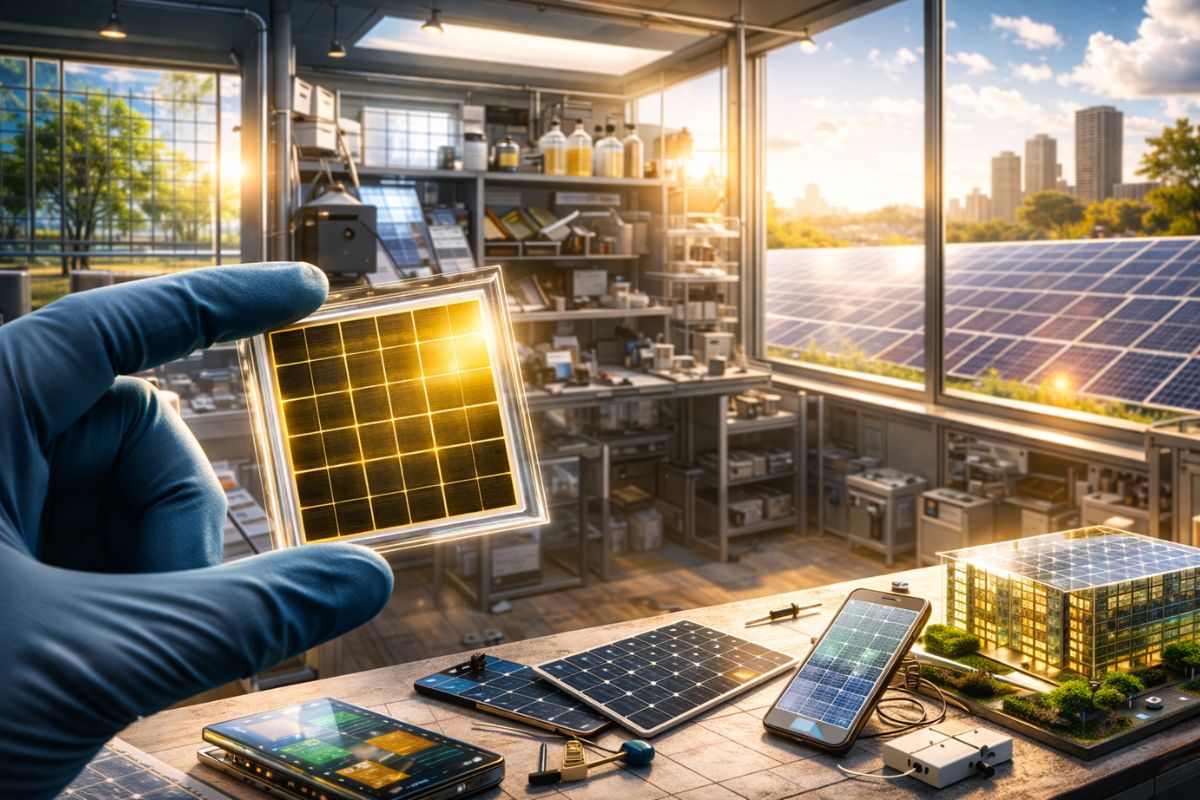


Engineers Elevate Antimony Chalcogenide to 10.7% Certified Efficiency, Set World Record, and Point to Cheaper Panels, Transparent Solar Windows, and Self-Sufficient Internal Electronics.
Engineers from the University of New South Wales (UNSW) have taken a decisive step in the race for new solar cells by establishing a world record efficiency for antimony chalcogenide, an emerging material for photovoltaic energy. In the lab, the new cell achieved 11.02 percent efficiency, with 10.7 percent independently certified, the best performance ever recorded for this compound anywhere in the world.
The achievement is not just about the number. In addition to entering the International Solar Cell Efficiency Tables for the first time, the work shows that engineers have managed to understand the chemical mechanism that limited the material since 2020, paving the way for further improvements and applications ranging from tandem cells in panels to energy-generating windows and internally powered devices relying on ambient light.
How Engineers Achieved the 10.7 Percent Record
The team led by Professor Xiaojing Hao, from UNSW’s School of Photovoltaic and Renewable Energy Engineering, had been exploring antimony chalcogenide as a candidate for a top cell in tandem architectures with silicon.
-
Motorola launched the Signature with a gold seal from DxOMark, tying with the iPhone 17 Pro in camera performance, Snapdragon 8 Gen 5 that surpassed 3 million in benchmarks, and a zoom that impresses even at night.

-
Satellites reveal beneath the Sahara a giant river buried for thousands of kilometers: study shows that the largest hot desert on the planet was once traversed by a river system comparable to the largest on Earth.

-
Scientists have captured something never seen in space: newly born stars are creating gigantic rings of light a thousand times larger than the distance between the Earth and the Sun, and this changes everything we knew about stellar birth.

-
Geologists find traces of a continent that disappeared 155 million years ago after separating from Australia and reveal that it did not sink, but broke into fragments scattered across Southeast Asia.
Researchers worldwide are seeking this type of combination, in which two or more solar cells are stacked, each absorbing a different range of the solar spectrum to extract more electricity from the same sunlight.
The UNSW engineers identified that antimony chalcogenide had promising characteristics but was hitting an efficiency barrier that had not exceeded 10 percent since 2020.
The new study published in Nature Energy shows how this barrier was overcome and why the material, previously viewed with skepticism, is back at the center of discussions about next-generation solar technology.
Why Antimony Chalcogenide Excites Solar Engineers
Antimony chalcogenide offers a package of advantages that catches the attention of engineers working with photovoltaics. It is made from abundant and relatively cheap elements, which reduces dependence on rare and expensive metals found in some high-performance solar materials.
Additionally, it is an inorganic material, which provides greater stability over time compared to certain newer technologies that can degrade easily. Another critical point is the high light absorption coefficient.
A layer just about 300 nanometers thick, roughly one thousandth the thickness of a human hair, is sufficient to capture sunlight efficiently.
The engineers also highlight that the material can be deposited at low temperatures, which reduces energy consumption in manufacturing and facilitates large-scale production at potentially lower costs.
The Energy Barrier That Held Back Efficiency

Even with so many qualities, the performance of antimony chalcogenide had stagnated. In the new research, UNSW engineers discovered that the problem lay in the uneven distribution of sulfur and selenium during the production of the absorber layer.
This imbalanced distribution created an energy barrier within the material, making it difficult for the electric charge generated by sunlight to reach the cell contacts.
The first author of the study, Dr. Chen Qian, compares the situation to driving a car up a steep hill: it takes much more fuel to reach the same point than it would on a flat road.
When the internal distribution of elements becomes more uniform, the charge can move much more easily through the absorber, preventing electrons from getting trapped and increasing the fraction of solar light converted into useful electricity.
The Chemical Solution That Unlocked the Material’s Potential
The solution found by the engineers was relatively simple from a process standpoint but powerful in result. They added a small amount of sodium sulfide during manufacturing, stabilizing the chemical reactions that form the layer that absorbs sunlight.
This fine-tuning allowed for better control of the local composition of sulfur and selenium, reducing the energy barrier that strangled charge flow.
The result was an antimony chalcogenide cell that achieved 11.02 percent energy conversion efficiency in the lab, with 10.7 percent certified by CSIRO, one of nine internationally recognized independent photovoltaic measurement centers.
For the engineers involved, the efficiency gain is significant in itself, but more importantly, there is now a clear path for new improvements, based on chemical understanding rather than just empirical attempts.
Solar Windows and Self-Sufficient Internal Devices
The implications go beyond future tandem solar panels. Due to the ultra-thin thickness, semitransparency, and high bifaciality of about 0.86, antimony chalcogenide is particularly interesting for transparent solar windows, capable of generating energy without completely blocking the view.
A spin-off company called Sydney Solar is already working to scale production of a type of “solar adhesive” for windows, leveraging precisely this combination of thin thickness, partial transparency, and good light response.
In this scenario, engineers envision entire building facades contributing to electricity generation without radically altering the aesthetics of cities.
Another promising front is in internal solar applications. The so-called bandgap of the material matches well with the spectrum of artificial light found indoors.
This makes antimony chalcogenide a strong candidate for powering smart badges, electronic paper displays, self-sufficient sensors, and internet-connected devices, where security, stability, and performance in low light are more critical than maximum efficiency in sunlight.
Engineers’ Next Target: Reach 12 Percent
Despite the record, UNSW engineers recognize that there is still work to be done. The next step is to reduce the internal defects of the material through passivation processes, chemical treatments that neutralize imperfections that steal charge and hinder efficiency.
Dr. Qian states that the team considers it realistic to aim for efficiencies around 12 percent in the near future, tackling the remaining challenges incrementally.
For the engineers involved, each fraction of a percentage point gained means more power in less area, greater competitiveness against other technologies, and more options for hybrid architectures with silicon and special applications.
Meanwhile, antimony chalcogenide transitions from being merely a name in academic papers to being among the real candidates to form the next generation of solar cells, in panels, windows, Internet of Things devices, and electronics that require minimal recharging.
Knowing that engineers can now extract 10.7 percent efficiency from this emerging material, are you more excited about the idea of windows generating energy at home or about internal devices functioning independently, solely powered by ambient light?







Ojalá consigan mas eficiencia y se pueda masificar