





 Portuguese
  English
  Spanish
  8 min of reading
  0 comments


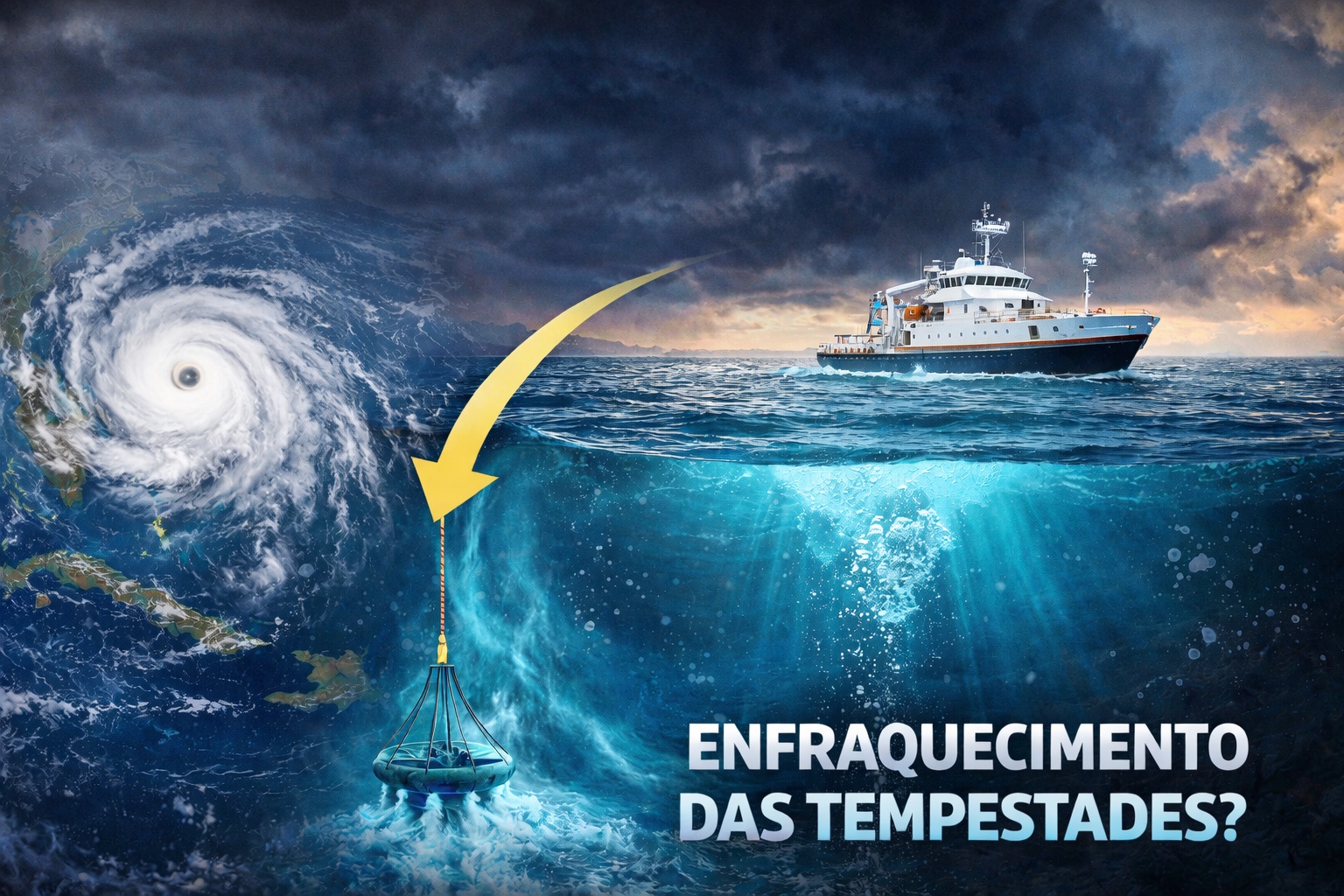
Proposals for Artificial Ocean Cooling Attempt to Reduce Hurricane Energy. Study in Communications Earth & Environment Calculates That Giant Areas Would Be Needed for Limited Effect.
A hurricane does not “live” only on wind. It lives on fuel, and that fuel exists in the ocean, in the form of heat accumulated in the surface layers. That is why sea surface temperature and, especially, the ocean heat content appear as one of the most monitored factors when it comes to intensification. The NOAA explains that the ocean absorbs more than 90% of the excess heat from the climate system associated with global warming, and that the upper ocean heat content has significantly increased in recent decades.
This physical link has led, over time, to a recurring question in research and private projects: if hurricanes “pull” energy from warm waters, what would happen if the sea surface were artificially cooled before the storm arrives? The idea, in general terms, is to “bring cold water from below up” — through pumps, vertical mixing, or bubbling systems — to lower the surface temperature and reduce the flow of heat and moisture from the ocean to the atmosphere.
How Ocean Cooling Enters the Hurricane Intensity Equation
The physical basis is simple: hurricanes extract energy from latent and sensible heat flows at the ocean-atmosphere interface. When the sea surface is warmer, there tends to be more evaporation and a greater availability of energy to maintain deep convection in the core of the system.
-
Motorola launched the Signature with a gold seal from DxOMark, tying with the iPhone 17 Pro in camera performance, Snapdragon 8 Gen 5 that surpassed 3 million in benchmarks, and a zoom that impresses even at night.

-
Satellites reveal beneath the Sahara a giant river buried for thousands of kilometers: study shows that the largest hot desert on the planet was once traversed by a river system comparable to the largest on Earth.

-
Scientists have captured something never seen in space: newly born stars are creating gigantic rings of light a thousand times larger than the distance between the Earth and the Sun, and this changes everything we knew about stellar birth.

-
Geologists find traces of a continent that disappeared 155 million years ago after separating from Australia and reveal that it did not sink, but broke into fragments scattered across Southeast Asia.

However, what matters is not just a “number” of temperature on the surface. The thermal structure below it also matters: the mixed layer depth (MLD) and how much warm water exists before encountering cooler waters (thermocline).
The deeper this “warm reservoir,” the harder it is for the hurricane itself to cool the surface. This is relevant because hurricanes already produce a natural effect: as they pass, they mix the water and can create a “cold wake,” reducing the temperature behind the system.

This mechanism is exactly what a recent study in Communications Earth & Environment (Nature Portfolio), from 2022, builds its analysis on: it compares the “theoretical limit” (when ideal cooling is assumed) with more realistic simulations, which include mixing dynamics and the fact that cooling a large ocean area at the right time is not trivial.
What It Means to “Inject Cold Water” into the Ocean in Practice
In project and patent language, “injecting cold water” typically means forcing the rise of sub-surface (colder) water closer to the surface, or vertically mixing the ocean to reduce the surface temperature.
Among the documented proposals, one of the most cited at technical conferences involves wave-powered upwelling pumps.
In 2008, a presentation at the American Meteorological Society (AMS) meeting described the idea of using arrays of wave-powered upwelling pumps to cool the upper ocean layer “by a few degrees Celsius,” reducing the evaporative energy available to the hurricane and, in mathematical models, decreasing maximum winds in a cited range of 5% to 20%.
The proposal from this presentation also describes a deployment design: the pumps would start at depths around 250 meters and would be distributed over an area of approximately 150 km wide along coastal regions (Gulf and East Coast of the U.S.), with the intention of intercepting typical hurricane paths.
This type of proposal is different from “controlling” a hurricane. It tries to reduce ocean energy along a corridor within the few days when trajectory and intensity forecasts allow for some operational planning.
What Science Measured: “How Much Ocean Needs to Be Cooled” to Change a Hurricane
The critical part of the issue arises when trying to turn the idea into numbers.
The study “Targeted Artificial Ocean Cooling to Weaken Tropical Cyclones Would Be Futile,” published on August 19, 2022, in Communications Earth & Environment, is based on the fact that proposals for artificial ocean cooling have been discussed for years, including patents, but without demonstrating success in the field.
The authors evaluate two paths:
- A theoretical framework with “maximum potential intensity” adapted to consider ocean mixing (a kind of ceiling of what would be possible if ideal cooling existed).
- More realistic mesoscale numerical simulations (using the WRF model), in which the hurricane encounters “cool patches” with finite dimensions and specific conditions.
In the article’s summary, there’s a result that provides a measure of the challenge’s size: in the most “favorable” simulation within the tested set, the largest artificially cooled area considered would have a volume of 2.1 × 10⁴ km³ and an area of 2.6 × 10⁵ km².
Even so, the weakening achieved was about 15% in intensity two days before landfall, and this “only under the most ideal atmospheric and oceanic conditions.”
These numbers are the heart of the issue because they translate the idea of “cooling the ocean” into a scale comparable to the actual size of a cyclone and the ocean environment that feeds it. The area of 2.6 × 10⁵ km², for example, is larger than many countries — and the volume of water involved rises to tens of thousands of cubic kilometers.
Why the “Theoretical Limit” Does Not Yield Real Results
The same article points out an important contrast: when using a maximum potential theory with “instantaneous” and homogeneous cooling, scenarios arise where cooling could, in theory, cause a significant reduction in intensity, especially in environments with high SST, deep mixed layer, and fast-moving hurricanes (less residence time of the wind over the same point in the ocean).

However, this is the “ceiling,” and the study argues that it is a non-achievable ceiling in practice, because the ocean is not homogeneous, currents redistribute water, and, more importantly, the hurricane does not “appear” instantaneously within a perfectly cooled pool: it gradually traverses a region with complex dynamics.
The realistic simulations in the article are designed exactly to test this: cool patches with defined widths and progressive contact with the storm. The summary’s result is that it would be necessary to cool “massive” regions to obtain only moderate weakening, and even then in ideal conditions.
The Piece That Many Projects Try to Explore: “Ocean Heat Content”
The reason why several proposals focus on vertical mixing is that when the upper layer of the ocean is loaded with heat, the hurricane’s passage itself may not cool the surface enough to limit growth, especially in areas of very warm waters and with a deep mixed layer.
The NOAA, when explaining ocean heat content, highlights that the heat gains in the upper layers have been large and sustained over the past decades, presenting average global rates of heat gain for 1993–2024 in the range of approximately 0.66 to 0.74 W/m², when energy is distributed across the planet’s surface.
This context is relevant because “cooling the surface” by a few tenths of a degree in a small area does not necessarily mean reducing the fuel of a system passing through an ocean with a large reserve of thermal energy.
What “Testing” May Mean: From Conferences to Private Projects and Public Debate
In addition to academic literature, this topic periodically reappears in public debate, usually when very intense hurricanes approach densely populated areas.
The Associated Press, for example, reported that, despite the recurrence of speculations about “controlling” or “weakening” hurricanes, scientists emphasize that there is no technology capable of reliably controlling storms of this kind; the article recalls historical attempts (such as Project STORMFURY) and physical/ethical limitations.
STORMFURY is particularly useful as a reference for “real history”: it was a research program (1962–1983) that attempted to modify hurricanes through silver iodide seeding; the NOAA describes that the project ended up being discontinued when evidence indicated that the hypothesis was weak (hurricanes had too much natural ice and little supercooled water) and that changes seen in “seeded” storms also occurred naturally in unseeded storms.
This historical comparison often appears in modern articles to show why new proposals require rigorous quantification of scale and effect — exactly what the 2022 article does for ocean cooling.
What the Numbers from the 2022 Study Really Imply About “Cooling the Atlantic”
The most-citable data from the study (area of 2.6 × 10⁵ km² and volume of 2.1 × 10⁴ km³ for 15% weakening in an ideal scenario) is not just a large number: it establishes an order of magnitude for any operational proposal.
To put it in ocean engineering terms, “cooling” is not just about lowering the surface temperature with equipment. It is:
- displacing or mixing water masses on a gigantic scale;
- doing this quickly enough (days) before landfall;
- ensuring that the cooling remains in place despite currents and winds;
- and, in the article’s realistic scenario, accepting that the hurricane may still weaken only moderately even after this effort.
The article also emphasizes that the theoretical framework offers an “upper-bound” limit that cannot be reached even with vast resources, because the necessary assumptions to reach the ceiling (instantaneous, uniform cooling without dynamics) do not hold up under realistic conditions.
Where Proposals Such as Wave-Powered Upwelling Pumps Come In
The AMS presentation in 2008 is an example of how engineering projects tried to translate the concept of vertical mixing into a practical arrangement: pumps powered by wave energy, distributed in arrays, intending to reduce the temperature of the upper ocean layer by a few degrees and, consequently, reduce intensity.
This type of proposal is consistent with the basic mechanism (mixing colder water up), but more recent literature poses the question in quantitative terms: what would be the area and the volume effectively cooled, for how long, and how would this compare to the kind of cool patch that, in a realistic simulation, produces a specific weakening.
The 2022 study does not “test” the AMS device; it tests the physical concept of cooling the upper layer in defined patches and measures the effect on intensity, resulting in the giant numbers in the summary.
Can Ocean Cooling Work?
Artificial ocean cooling to weaken hurricanes appears in technical proposals and in weather modification literature for decades, including ideas for vertical mixing/upwelling with equipment powered by ocean energy.
However, when the concept is quantified with mesoscale simulations in peer-reviewed studies, the results indicate that it would be necessary to cool huge ocean regions — in the most extreme tested case, 2.6 × 10⁵ km² of area and 2.1 × 10⁴ km³ of volume — to achieve a weakening of around 15% only under ideal conditions and two days before landfall.
This debate occurs in parallel with the fact that the ocean has been accumulating heat on a global scale, with documented increases in heat content in the upper layers, reinforcing the ocean’s role as a “fuel” for intense storms.








Seja o primeiro a reagir!