





 Portuguese
  English
  Spanish
  3 min of reading
  0 comments


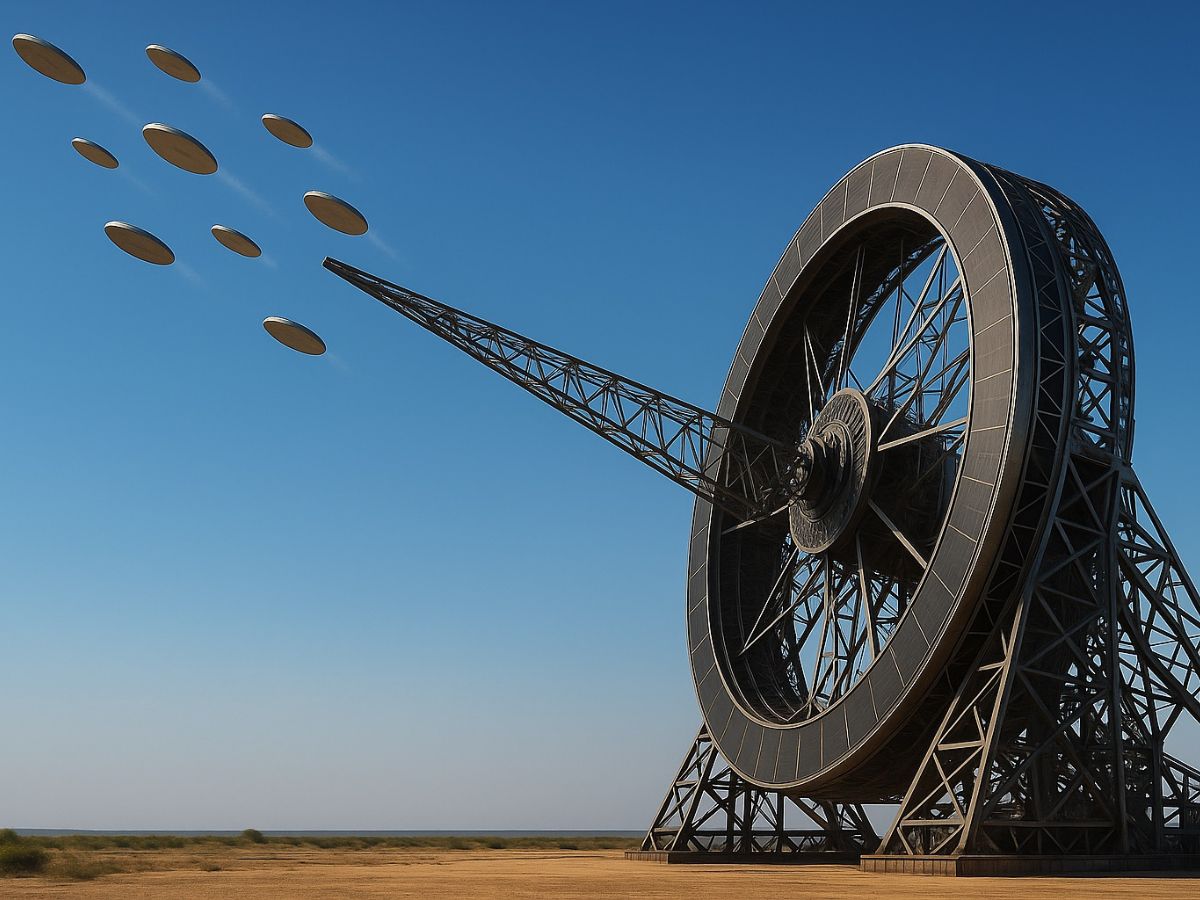
American Startup Surprises with Centrifugal Launch System That Sends Stacked Mini Satellites to Space at Low Cost and Without Rockets, Challenging Traditional Models and Triggering Warning Signs Among Competing Powers
In June 2025, the American startup SpinLaunch conducted new tests with its high-speed rotating cannon, capable of launching hundreds of satellites into low Earth orbit. The system, which replaces rockets with centrifugal propulsion, has drawn attention from countries like China, which issued a real-scale alert regarding the impacts of this innovation on global strategic balance.
The rotating cannon developed by the California-based SpinLaunch utilizes a vacuum-sealed chamber and rotating arms to accelerate objects to speeds exceeding 8,000 km/h. Instead of fossil fuel or boosters, the system spins satellites until they reach enough force to be fired into the upper atmosphere.
As a result, the so-called “pancake satellites” — flat disks approximately 2.3 meters in diameter and 70 kg — are stacked like in a “launch bus” and ejected in series. This compact format reduces the total volume and enables multiple launches, promising up to 20 times more efficiency compared to conventional rockets.
-
ZCC 11000 crane lands at the port of Vitória and heads to Ceará in a convoy with 64 trailers: Zoomlion, founded in 1992, builds a monster that lifts over 600 compact cars to 93 m.
-
The biggest drama of being born on Mars is not breathing: Rice biologist says that colonists’ children may cease to be Homo sapiens, shaped by low gravity, radiation, and isolation that divides humanity.

-
With no separate outdoor unit and designed to fit in the window, monoblock air conditioners used in Japan emerge as an alternative for those who cannot install a split system in a rented apartment.

-
China prepares a 78,000-ton pilotable floating island for deep-sea research: it accommodates 240 people for months, withstands category 17 typhoons and 9-meter waves, and uses metamaterials that dissipate nuclear explosions.
SpinLaunch estimates that the launch cost per kilogram could range between US$ 1,250 and US$ 2,500 — a fraction of the price charged by major operators like SpaceX. Additionally, since the system does not rely on fuel combustion, the operation is considered carbon zero, which reduces the environmental impact of missions.
Revolution in Satellite Launching
Another advantage of the project is scalability. The company plans to build a larger version of the orbital cannon, capable of conducting up to five commercial launches per day. If realized, this system could allow the formation of communication megaconstellations in record time.
This model also promises to generate less space debris, as there are no disposable stages or additional orbital engines. However, the speed at which the technology can place dozens or hundreds of objects into orbit raises concerns among space agencies and astronomical observatories.
With the increasing density of satellites in low orbit, risks of collisions and interference in communications and scientific observations arise. The alert issued by Chinese authorities even mentions the possibility of orbital saturation and long-term military and commercial impacts.
International Reaction and Next Steps
China characterized the innovation as a “disruptive technological leap” and warned of the need for international norms regarding mass launches. Chinese military sources expressed concerns about the dual-use of the technology, which could also serve as a platform for defense or surveillance payloads.
In the United States, the Department of Defense has already conducted tests with the technology in partnership with SpinLaunch. Although the project has a civil and commercial focus, the strategic potential of the innovation is still under assessment by national security entities.
The first constellation planned by the company, named Meridian Space, will have applications in low-latency telecommunications. The first orbital-scale launches are expected in 2026, with ambitious goals for global coverage in less than three years.
The SpinLaunch project has been highlighted in specialized publications such as TechCrunch and Space.com, as well as technical reports released by the company itself in 2024 and 2025. The Chinese alerts were reported by agencies such as South China Morning Post and Global Times, with additional coverage in institutional defense and science channels.







-

Uma pessoa reagiu a isso.