





 Portuguese
  English
  Spanish
  5 min of reading
  0 comments


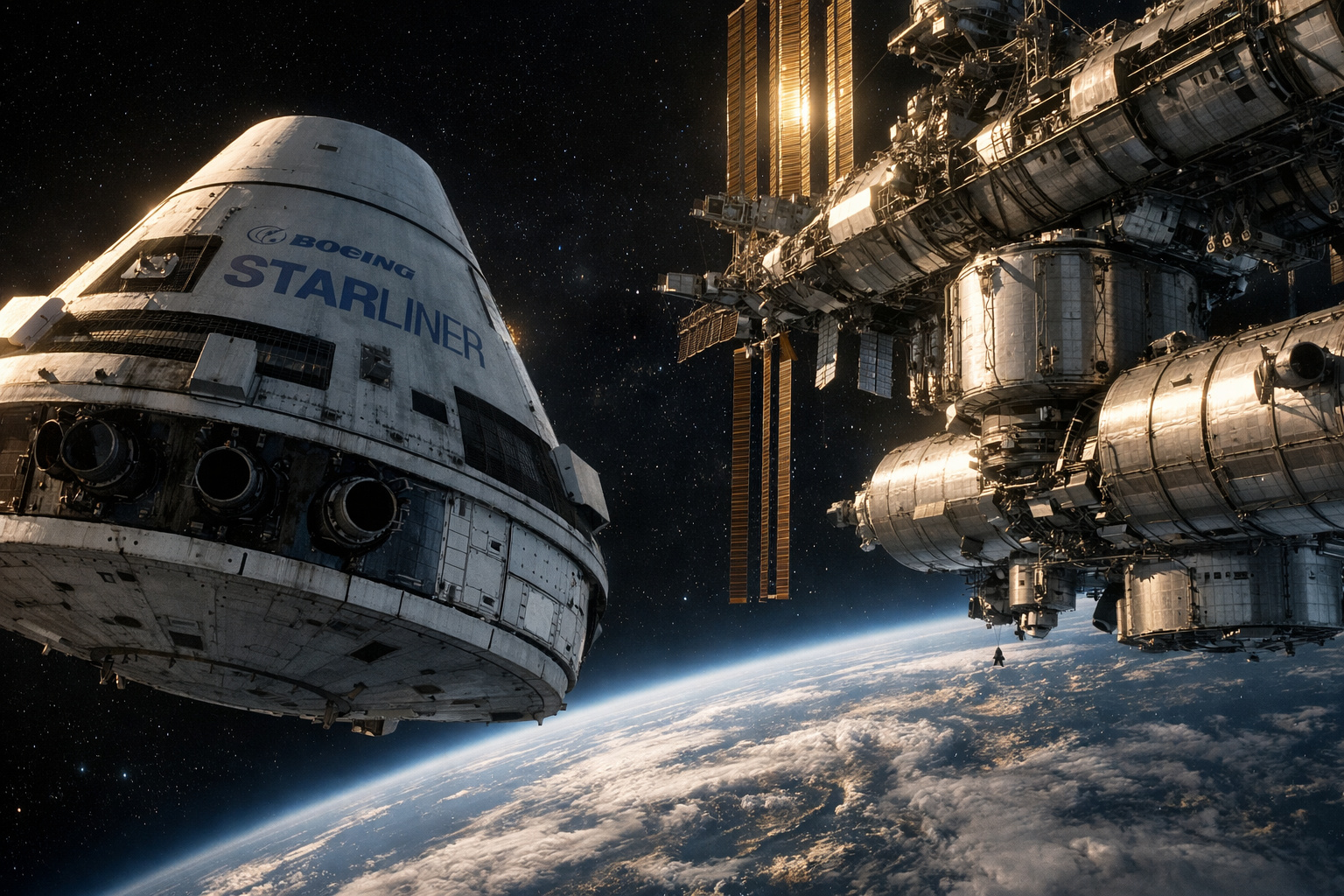
The Decision of the United States Space Agency Reignites Debates About Technical Failures, Underestimated Risks, and Leadership Decisions After the Boeing Craft Experienced Serious Problems During Manned Mission to the International Space Station
The space industry believed it was witnessing a new chapter in human exploration beyond Earth. After all, the mission of Boeing’s Starliner promised to prove that commercial crew transport had reached a new level of safety and reliability. However, what seemed to be just another successful test quickly turned into a major alert within the aerospace community.
On June 5, 2024, American astronauts Barry Wilmore and Sunita Williams were launched into space aboard the Boeing Starliner, on a mission planned to last only eight days. The flight was part of the spacecraft’s third test and aimed to demonstrate that the vehicle was capable of safely transporting crews to the International Space Station (ISS).

However, despite an apparently controlled start, problems began to arise even before docking. During an hour of manual flight demonstrations, the craft responded as expected. However, on the second day of the mission, a sequence of technical failures completely changed the course of the operation.
-
Motorola launched the Signature with a gold seal from DxOMark, tying with the iPhone 17 Pro in camera performance, Snapdragon 8 Gen 5 that surpassed 3 million in benchmarks, and a zoom that impresses even at night.

-
Satellites reveal beneath the Sahara a giant river buried for thousands of kilometers: study shows that the largest hot desert on the planet was once traversed by a river system comparable to the largest on Earth.

-
Scientists have captured something never seen in space: newly born stars are creating gigantic rings of light a thousand times larger than the distance between the Earth and the Sun, and this changes everything we knew about stellar birth.

-
Geologists find traces of a continent that disappeared 155 million years ago after separating from Australia and reveal that it did not sink, but broke into fragments scattered across Southeast Asia.

Cascading Failures and Loss of Control During ISS Approach
According to reports directly from orbit, the crew faced a progressive degradation of the craft’s control system. Wilmore explained that initially, one of the jets from the Reaction Control System (RCS) failed. Then, another jet malfunctioned, drastically reducing the spacecraft’s maneuverability.
“We lost one RCS jet, then another. It was clear that the thrust and control were degraded. The piloting characteristics were no longer the same,” the astronaut stated in June 2024 while aboard the space station.
As a direct consequence, the craft temporarily lost the so-called six degrees of freedom, which is essential for controlling orientation and movement in space. Even so, thanks to the collaborative efforts of the crew and ground controllers, partial control was regained, allowing the Starliner to dock safely at the ISS.
Still, the situation was far from ideal. What should have been a short stay ended up extending for nine months, during which Wilmore and Williams remained at the station while engineers attempted to understand the origin of the failures. Given the uncertainties, the final decision was clear: the Starliner would return to Earth without a crew.
NASA Classified the Incident as “Type A”, the Most Severe Possible Category
This information was released by NASA during a press conference accompanied by the publication of a detailed technical report. According to the agency, the episode was officially classified as a “Type A Mishap”, the highest severity level within NASA’s incident classification system.
To fall into this category, an event must result in mission failure, crew loss, loss of the craft, or an unexpected loss of flight control, situations historically associated with tragedies such as the disasters of Challenger and Columbia.
The NASA administrator, Jared Isaacman, was straightforward in acknowledging the seriousness of the incident. In an official statement, he said that while Boeing developed the craft, the ultimate responsibility for the flight lay with the agency itself, which authorized the launch of astronauts even in the face of risks that had not been fully understood.
According to Isaacman, broader programmatic objectives — such as the need to maintain two independent suppliers capable of transporting crews to space — ended up influencing critical technical and operational decisions, particularly during and immediately after the mission.
Old Problems, Underestimated Risks, and Leadership Failures
In addition to the failures observed during the manned flight, NASA’s report revealed that similar problems had arisen in previous tests of the Starliner. In the first uncrewed orbital test, conducted in December 2019, a timing error in the mission prevented the orientation software from correctly calculating the orbital insertion burn.
This error triggered excessive thruster firings, high fuel consumption, incorrect orbital insertion, and led to the declaration of failure of ten thrusters. At that time, the episode was treated as a “near miss of high visibility,” but according to the current investigation, its impacts were underestimated.
The report concludes that the Commercial Crew program accepted risks in the propulsion systems of the service module and the crew module that were not fully understood before the manned flight. Although there were no hidden technical concerns during the mission approval, there was a collective underestimation of the likelihood of new failures in the thrusters.
In an internal letter, Isaacman was even more emphatic, stating that while the Starliner presents design and engineering deficiencies that need to be corrected, the most concerning aspect revealed by the investigation is not the hardware, but rather the decision-making and leadership, which can create a culture incompatible with manned spaceflight if not corrected.
The Future of Starliner and the Impact on Space Exploration
Currently, it is unclear how much space Boeing will still have in the regular transport of crews to the International Space Station, especially considering that the station is scheduled to be deorbited in 2031, with a controlled descent in the region known as Point Nemo, in the Pacific Ocean.
Despite this, NASA does not rule out the use of Starliner in future missions, provided all failures are properly corrected and tested. For now, new investigations are ongoing to identify the exact causes of the problems faced by the craft.
As the agency’s administrator himself pointed out, mistakes can happen even in the most successful programs. What defines the future of space exploration, according to him, is the ability to learn from these failures, promote real improvements, and ensure transparency and accountability at all levels.
Source: Iflscience







Seja o primeiro a reagir!