





 Portuguese
  English
  Spanish
  6 min of reading
  0 comments


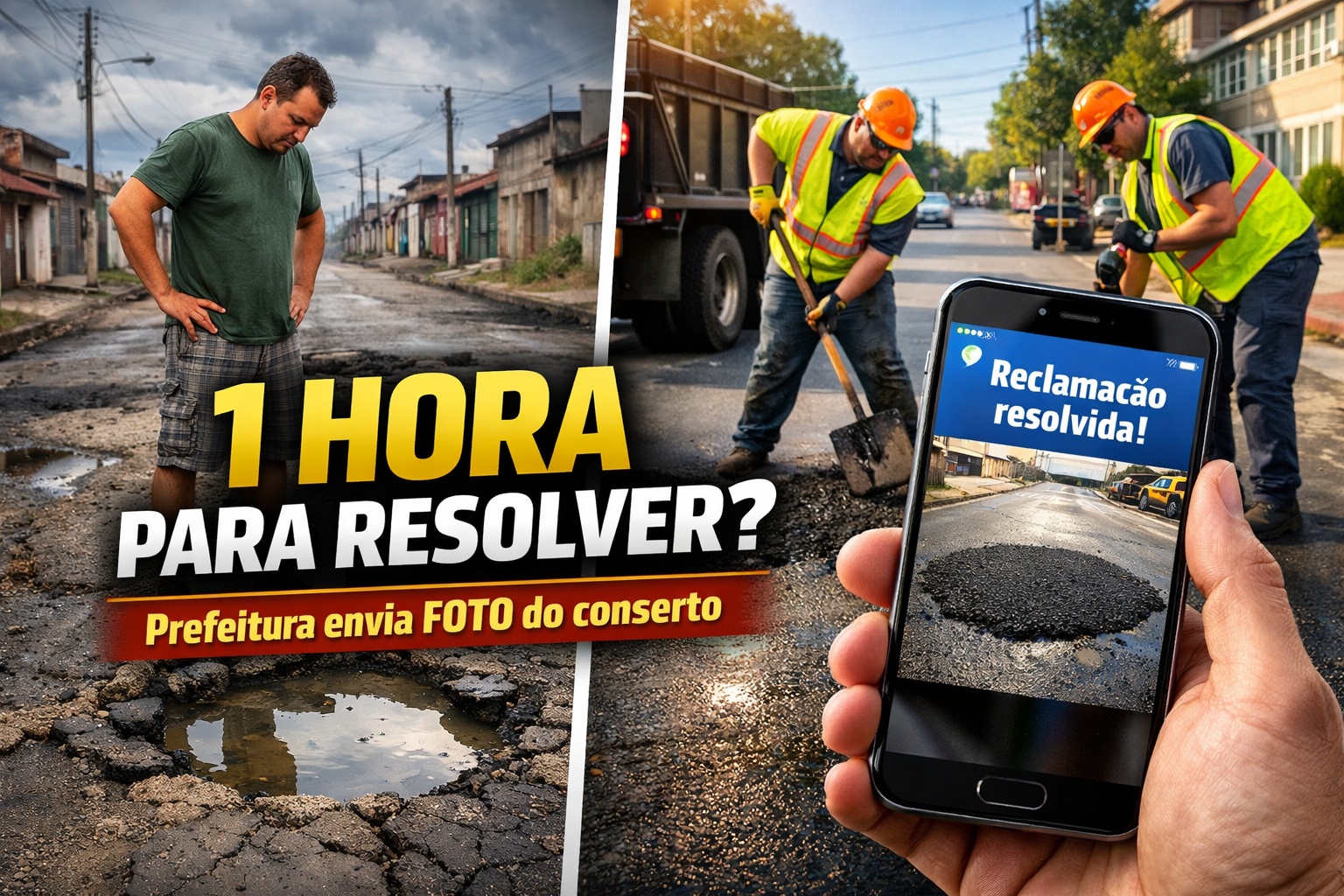
While In Several Regions Of Brazil An Open Hole In 2023 Remains Unsolved, In Boston The Same Problem Was Resolved In Just 36 Hours Via Official App; Understand The Contrast In Urban Management.
Maria Silva, a resident of the South Zone of São Paulo, filed a complaint in the city hall’s 156 system in March 2023. The hole in front of her house had already damaged two tires on her car. In February 2026, nearly three years later, the hole remains there, now bigger, deeper, and more dangerous. On the other side of the world, in Boston, USA, James Magee was cycling down Boston Street when he photographed a dangerous hole on the bridge over I-93. He opened the BOS:311 app on his phone, took a picture, marked the location, and submitted the complaint. It was 10 AM on a Wednesday in April 2024.
By 10 PM the next day, 36 hours later, James received a notification on his phone. The hole had been fixed. But that wasn’t all: the city hall sent four photos showing the workers actively repairing the hole and then highlighting the final product.
“Wow, I hadn’t even seen that later, but they actually responded with photos of the crew”, James said, laughing, while reviewing the request in a recent interview with the Dorchester Reporter.
-
Friends have been building a small “town” for 30 years to grow old together, with compact houses, a common area, nature surrounding it, and a collective life project designed for friendship, coexistence, and simplicity.

-
This small town in Germany created its own currency 24 years ago, today it circulates millions per year, is accepted in over 300 stores, and the German government allowed all of this to happen under one condition.

-
Curitiba is shrinking and is expected to lose 97,000 residents by 2050, while inland cities in Paraná such as Sarandi, Araucária, and Toledo are experiencing accelerated growth that is changing the entire state’s map.

-
Tourists were poisoned on Everest in a million-dollar fraud scheme involving helicopters that diverted over $19 million and shocked international authorities.


The Chasm Between Two Worlds
The difference between Boston and Brazil is not just in the speed of the repair, it’s in everything that comes after.


In Boston, it generally takes two business days to fill a hole, but the system is so transparent that when a case is closed, users can learn more about the city team that did the work; in some cases, they can see a photo of the team and, in a limited number of cases, even a photo of the completed work, like a filled hole.
In São Paulo, the largest city in Brazil, the average response time for pothole requests decreased from 121 days in 2017 to about seven days, an achievement celebrated by the city hall as historic. But even so, seven days is an eternity compared to Boston’s 36-48 hours.
And the Brazilian reality is often much worse than the official statistics suggest.
The Brazilian Saga Of The Eternal Hole
Potholes on public roads are among the top complaints from residents to the Ombudsman of São Paulo. From January to September 2022, the 156 service received 115,452 complaints and requests for resurfacing, which means one request every two minutes.
But complaining is just the first step of a long and frustrating journey.
First, you need to figure out who is responsible for the hole. Was it a utility company (water, gas, telecommunications) that opened and did not close it? Then you call the company, note the protocol number, and wait. And wait. And wait.
If the hole was not caused by a utility company, you call the city hall’s 156. Or try to use the website. Or the app. Send photos. Fill out forms. Note another protocol number that will probably never be consulted again.
After that? Nothing. Silence. You receive no notification. You receive no update. You definitely do not receive a photo of the smiling team that (theoretically) fixed the hole.
What you get is a bigger hole after each rain until it turns into a crater that swallows entire car wheels.
The Silent Revolution Of Boston
The BOS:311 app was launched in 2009, during the tenure of the late Mayor Thomas Menino, originally called Citizens Connect, in response to the growing popularity of smartphones. The goal was simple: empower residents to help take care of their communities.
Residents report non-emergency issues directly from their smartphones, which are sent to the city’s work order management system, which then forwards them to the right person at City Hall. In 2010, reports from the app represented 6% of all service requests. By 2014, the app accounted for about 28% of all service requests.
But the real differentiator is not the app; it’s the philosophy behind it.
Back at City Hall, a dedicated 311 team processes complaints, forwards them to appropriate departments, and tracks resolution (including photos of completed work!). Before the 311 system, the city relied on citizens vocalizing complaints to distinct departments, used analog systems to track resolution and costs, and had no channel to communicate results to the affected party.
“I think 311 really recognized that maintaining urban common goods can and should be a collaboration between the community and the government”, explained a urban technology expert to Boston.com. “And that requires the government to become accessible and transparent.”
Radical Transparency: Every Hole Has A Story
Between January 1 and October 4, 2024, 32,177 requests were sent in Dorchester, representing 14% of all problems reported across Boston, which is the largest share among any neighborhood in the city.
Each of these requests is publicly available. Anyone can see a live map of all reported holes in the city, when they were reported, when they were fixed, and how long it took.
This creates invisible but powerful pressure. When everyone can see that the hole on Street A was fixed in 24 hours, but the hole on Street B has been open for two weeks, someone needs to explain why.
For most requests, the city has an SLA (service level agreement) or a target date and time by which it plans to resolve the issue. If the ticket is closed after the deadline, it is marked as late.
In Brazil, there is no SLA. There is no public deadline. There is no transparency. There is just the hole—and the increasingly distant hope that someday, maybe, someone will come to fix it.
The Real Cost Of Inefficiency
Donato Aparecido Fernandes, a taxi driver for 15 years in São Paulo, knows exactly where it was. “At the corner of Barra Funda and Lopes Oliveira streets. I’ve fallen there so many times, but the last time I heard the sound of the shock absorber”, he says. “Fixing this will cost at least R$ 500.”
That’s R$ 500 that Donato doesn’t have. That’s R$ 500 that represents days of work. That’s R$ 500 that the city should reimburse, but the process to request compensation is so bureaucratic and time-consuming that most people don’t even try. And Donato is just one among millions.
How many flat tires? How many broken shock absorbers? How many damaged suspensions? How many motorcycle accidents? How many bicycle falls?
Brazil doesn’t have those numbers. But Boston does.
Why Boston Works And Brazil Does Not?
It’s not money. São Paulo has a budget. It’s not technology. Brazil has apps, websites, digital systems.
It’s not labor. São Paulo has maintenance teams.
What São Paulo and Brazil as a whole—lacks is accountability. Responsibility. Transparency.
The work of 311 is made publicly available through datasets and a live feed of open and closed service tickets. With 311, people can connect better with representatives at City Hall to report non-emergencies and help allocate resources where they are most needed.
“We have as many municipal workers as there are, but we’re not out in the field walking through every neighborhood and every street, so we don’t know exactly what’s going on unless constituents who are moving around and walking the streets call and report those issues to us”, said a Boston city hall official.
The Dream Of Maria Silva
Back in São Paulo, Maria Silva looks at the hole that continues to grow in front of her house. She has already called the 156 seven times. She has opened four different protocols. She has sent photos, location, detailed description.
Nothing. She thinks of James Magee, in Boston, receiving photos of the smiling crew next to the fresh asphalt.
“It must be nice”, she sighs, “to live in a place where the city hall treats you like you matter.”
The hole, of course, does not respond. It just keeps there, growing with each rain, swallowing tires, breaking suspensions, hurting motorcyclists.
Waiting. Always waiting. Because in Brazil, holes have no deadlines to be fixed. Only citizens have deadlines to give up.










-

2 pessoas reagiram a isso.