





 Portuguese
  English
  Spanish
  5 min of reading
  0 comments


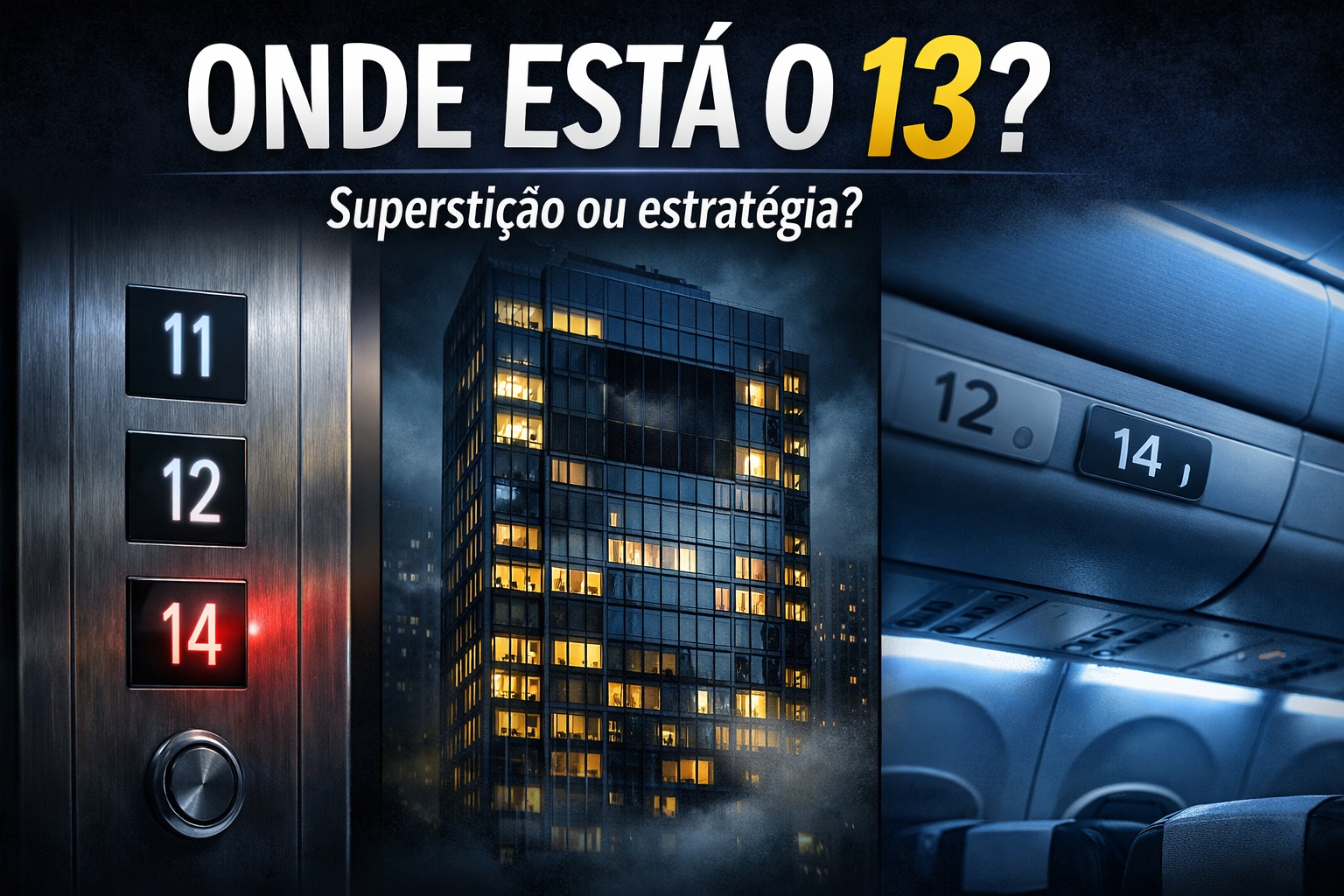
Triskaidekaphobia Explains Why Buildings Skip the 13th Floor and Airplanes Avoid Row 13 to This Day.
When entering a hotel or commercial building elevator, many people have noticed something curious: after the 12th floor, the panel jumps directly to the 14th. The 13 simply does not appear. The same happens with several airlines, which avoid numbering row 13. This practice is not a coincidence or a technical error. It has a name and a historical origin: triskaidekaphobia, the irrational fear of the number 13.
The word comes from Greek: “tris” (three), “kai” (and), “deka” (ten), forming thirteen, plus “phobos,” which means fear. The term has come to be used in psychology to describe the persistent and disproportionate aversion to the number 13. Although it seems like a harmless superstition, the cultural impact has been significant enough to shape architectural, commercial, and even marketing decisions in the 21st century.
The Symbolism of 12 and the “Intruder” 13
To understand why 13 has become the target of distrust, it is necessary to observe the symbolic weight of the number 12 in human history.
-
Friends have been building a small “town” for 30 years to grow old together, with compact houses, a common area, nature surrounding it, and a collective life project designed for friendship, coexistence, and simplicity.

-
This small town in Germany created its own currency 24 years ago, today it circulates millions per year, is accepted in over 300 stores, and the German government allowed all of this to happen under one condition.

-
Curitiba is shrinking and is expected to lose 97,000 residents by 2050, while inland cities in Paraná such as Sarandi, Araucária, and Toledo are experiencing accelerated growth that is changing the entire state’s map.

-
Tourists were poisoned on Everest in a million-dollar fraud scheme involving helicopters that diverted over $19 million and shocked international authorities.


The 12 has always represented order and completeness. There are 12 months in a year, 12 zodiac signs, 12 hours on a traditional clock, 12 tribes of Israel, and 12 apostles of Jesus. The number 12 appears repeatedly in religious, astronomical, and cultural systems as a closed and balanced structure.


When the 13 appears, it disrupts this sense of perfect cycle. It is the number that surpasses the established order. In various cultures, this “excess” has come to be interpreted as imbalance. The negative association was strengthened mainly by two symbolic landmarks.
In Christian tradition, Judas Iscariot, the disciple who betrayed Jesus, is often identified as the 13th at the table during the Last Supper. The scene has become one of the most reproduced images in Western history, reinforcing the idea that the presence of the 13 brings rupture and tragedy.
In Norse mythology, the number is also linked to chaos. At a banquet of the gods in Valhalla, Loki is said to have arrived as the unexpected 13th guest. His presence is said to have caused conflict and resulted in the death of Balder, one of the most beloved figures in the Norse pantheon. The myth reinforced the association between the 13 and tragic events.
These narratives have traversed centuries, been reinterpreted, and incorporated into the collective imagination of Europe and North America.
From Superstition to Urban Architecture
The cultural fear of the number 13 migrated to everyday practice, especially following the growth of modern cities in the 20th century. With the popularization of skyscrapers in the United States, developers began to notice that some buyers and tenants avoided units on the 13th floor.
To avoid commercial resistance, many buildings simply stopped numbering that floor as 13. Instead, after the 12th, the 14th appears. Technically, the 13th floor still exists in the physical structure, but its designation is altered.
This practice became common in hotels, hospitals, and corporate buildings. In some cases, the number is replaced with 12A or M, with M being the 13th letter of the Latin alphabet.
Airlines have also adopted similar strategies. Numerous international companies do not use row 13 in their seating arrangements. The decision is not related to operational safety but to passenger perception. Even if only a portion of customers is influenced by superstition, the cost of renumbering rows is considered small compared to the potential psychological discomfort.
The measure, therefore, is commercial and cultural, not technical.
Psychology of Numeric Fear
From a psychological perspective, triskaidekaphobia can range from mild discomfort to intense anxiety. In extreme cases, individuals avoid commitments on the 13th or refuse contracts signed on that date.
There is also a specific form called paraskevidekatriaphobia, a term used to describe the fear of Friday the 13th.
Academic research indicates that the strength of these beliefs is linked to human cognitive bias. The brain tends to identify patterns and reinforces negative associations when bad events coincide with dates considered “unlucky.” If something negative happens on the 13th, the memory tends to fix this coincidence as confirmation of the superstition. Over time, this symbolic repetition strengthens the cultural narrative.
Invisible Economic Impact
Although it is difficult to quantify accurately, some studies suggest that the fear of the number 13 influences financial decisions and consumer behavior. There are historical reports of a drop in hotel bookings on Friday the 13th in certain markets, although the impact varies by region.
In the United States, where superstition is particularly widespread, it is estimated that billions of dollars may stop circulating annually due to cancellations or postponements associated with the date. Although these figures are debated, the fact that companies adopt structural changes demonstrates that the fear has a practical effect.
Modern architecture, therefore, has incorporated a millennia-old superstition without altering its structural engineering. The concrete remains the same. What changes is the number displayed on the panel.
13 in Other Cultures
Interestingly, the negative view of the number 13 is not universal. In some cultures, it does not carry significant negative connotation. In Italy, for example, the number traditionally associated with bad luck is 17. In parts of Asia, the 4 is considered problematic due to its phonetic similarity to the word “death” in languages like Mandarin and Japanese.
This demonstrates that the meaning of a number is not intrinsic but culturally constructed. The fear of 13 has consolidated mainly in Western tradition, influenced by Christianity and European mythologies.
Superstition Across Centuries
Even in a world dominated by technology, artificial intelligence, and precision engineering, the absence of the number 13 in elevators reveals something deeper: cultural beliefs continue to shape practical decisions.
There is no scientific basis supporting any real effect associated with the number 13. The engineering of a building does not change because of numbering. Air navigation systems do not depend on the sequence of rows.
Still, the simple fact that the 13 is often “erased” indicates the power of symbolic narrative over human behavior.
Between religion, mythology, and psychology, triskaidekaphobia has become one of the most enduring superstitions in modern history. The number continues to exist mathematically. It appears in calendars, contracts, and financial calculations. But, in many elevators and airplanes around the world, it remains invisible.
This invisibility reveals how an ancient fear can still influence concrete decisions in the 21st century.










Seja o primeiro a reagir!