





 Portuguese
  English
  Spanish
  5 min of reading
  2 comments


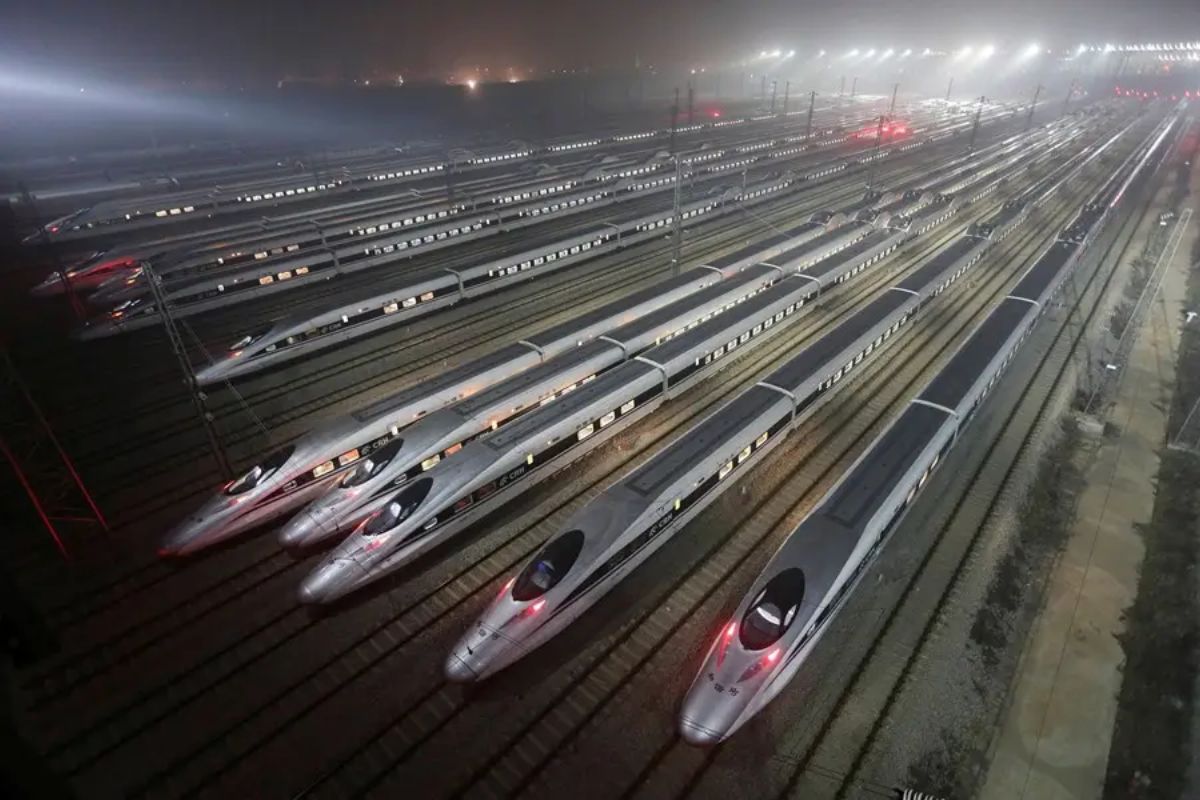


With Lunar New Year Accelerating Movements, High-Speed Rail Transitions from Logistic Solution to Symbol of Internal Integration: From Shanghai to Chongqing, Stations That Receive Tens of Millions of People Support Journeys of Over 30 Hours in a 40-Day Window Without War, Famine, or Borders
The high-speed train has taken on a central role in the largest human migration on the planet by transforming a family ritual into a continuous mobility operation. In a country with over 1.4 billion inhabitants, movement does not depend on crossing borders but on connecting cities, work, and origin within a few days.
In 40 days, the expectation is for around 9.5 billion displacements, accumulating round trips that were previously concentrated in a shorter period. In the process, it is not just the volume that changes, but also how people choose to travel, with a direct impact on price, time, and experience.
What Triggers Migration and Why It Lasts 40 Days

Lunar New Year, celebrated from February 17, serves as a collective trigger for mass displacements, especially from urban centers to hometowns.
-
Friends have been building a small “town” for 30 years to grow old together, with compact houses, a common area, nature surrounding it, and a collective life project designed for friendship, coexistence, and simplicity.

-
This small town in Germany created its own currency 24 years ago, today it circulates millions per year, is accepted in over 300 stores, and the German government allowed all of this to happen under one condition.

-
Curitiba is shrinking and is expected to lose 97,000 residents by 2050, while inland cities in Paraná such as Sarandi, Araucária, and Toledo are experiencing accelerated growth that is changing the entire state’s map.

-
Tourists were poisoned on Everest in a million-dollar fraud scheme involving helicopters that diverted over $19 million and shocked international authorities.


The Spring Festival, traditionally associated with 15 days of celebration, turns into a larger logistical corridor when journeys accumulate before and after the holiday, creating the 40-day window.
In this scenario, it is not just the worker who moves: although it is a phenomenon often seen as isolated, the reverse travel is starting to become more frequent, with parents going to the city where their children work.
This detail helps to explain who makes up the flow and why it is not uniform, with peaks, congestion, and last-minute decisions, especially regarding ticket purchases.
When Flying Becomes Expensive, Rail Becomes the Practical Choice
The competition between modes of transport appears directly in the wallet. In a travel account from Shanghai to Longkou, the choice of train gains strength when the price of flying triples, pushing millions of people towards the alternative that maintains predictability and scale.
For those facing journeys of over 30 hours and distances exceeding 2,000 kilometers, the comparison ceases to be abstract and becomes a calculation of cost and feasibility.
At this point, the high-speed train consolidates itself not as a “luxury,” but as an infrastructure capable of absorbing extreme demand without stopping the country.
Instead of depending on a few airports and volatile fares, the rail network allows the flow to be spread across stations and schedules, reducing the risk of collapse at a single point, even with inevitable lines and overcapacity.
Stations as Movement Factories: Shanghai, Guangzhou, and Chongqing
Shanghai exemplifies the scale of investment: the southern station, with a completely circular design, is expected to receive 15 million people per year, while the central station reaches about 60 million annually and connects to the busiest metro service in the world.
It is not just a platform, it is an urban gear that mixes metro, train, and access to different regions in the same circuit.
Guangzhou, in turn, has held the title of the busiest station, with 170 million people per year and an average of 600 trains per day, in addition to an estimate of almost half a million people circulating there.
Then comes Chongqing, where a station was inaugurated a few months ago, presented as the largest in the world: five times larger than New York’s Grand Central Station and with the capacity to transport 16,000 passengers per hour.
This figure draws attention not only for the number but also for the context: it was built on land where buildings began to grow around it, indicating that the city and the station are shaping together.
From Unknown Novelty to the Largest Network in the World
In the early 2000s, high-speed trains were described as something practically unknown in the country.
Today, China has, by far, the largest rail network in the world, which changes the logic of mobility on a continental scale: when millions need to leave and return almost simultaneously, the infrastructure stops being just transport and becomes internal cohesion policy.
The consolidation is not just explained by the extent but by the “package” that accompanies the experience.
There are mentions of robots acting as flight attendants, in addition to carriages that have gained preference over airplanes due to allowing an enviable data connection.
In periods of massive migration, comfort, connectivity, and routine on board become part of the reason passengers accept trading absolute speed for regularity and cost.
Speed, Testing, and the World’s View on a Difficult Standard to Achieve
The country also relies on records and tests to maintain technological leadership, with trains described as the fastest in the world and experiments aimed at breaking records and reducing times.
This ambition is not limited to Chinese territory: Spain’s Minister of Transport, Óscar Puente, cited Chinese trains as technological vanguards and key to operating a train between Madrid and Barcelona at 350 km/h.
The most symbolic contrast appears when even Japan, historically associated with bullet trains, is portrayed as unable to come close to the current standard.
At this point, the high-speed train stops being just a domestic solution for Lunar New Year and becomes treated as an international reference for operation, scale, and continuous evolution, even though each country has different realities and needs.
In the end, China reveals a simple idea with difficult-to-ignore numbers: in 40 days, billions of displacements become manageable only when transport can handle volume, time, and repetition without relying on crisis, scarcity, or borders.
And when a station supports 16,000 passengers per hour, the debate shifts from “if it works” to for whom it works, where it works, and at what social and urban cost.
Would you undertake a journey of over 30 hours to return to your hometown if the train was the most predictable option? If airfare tripled for the holiday, what would be your time limit to switch from air travel to rail? And, looking at Brazil, which travel corridor during festive dates would most need a true high-speed train?










Sobre o assunto: ” Trem de Velocidade”, aqui no Brasil, já se passou da hora de termos ligações interestaduais, utilizando esses trens, em substituições aos aviões e ônibus. As nossas rodovias, sucateadas, nossos meios de transportes muito atrás de outros países desenvolvidos. Enquanto no Brasil se joga dinheiro pelos ralos, atoa, pensar em trens de alta velocidade, cairia bem, mas muito bem aos nossos deslocamentos.
#AcordaBrasil cadê nosso trem…