





 Portuguese
  English
  Spanish
  4 min of reading
  2 comments


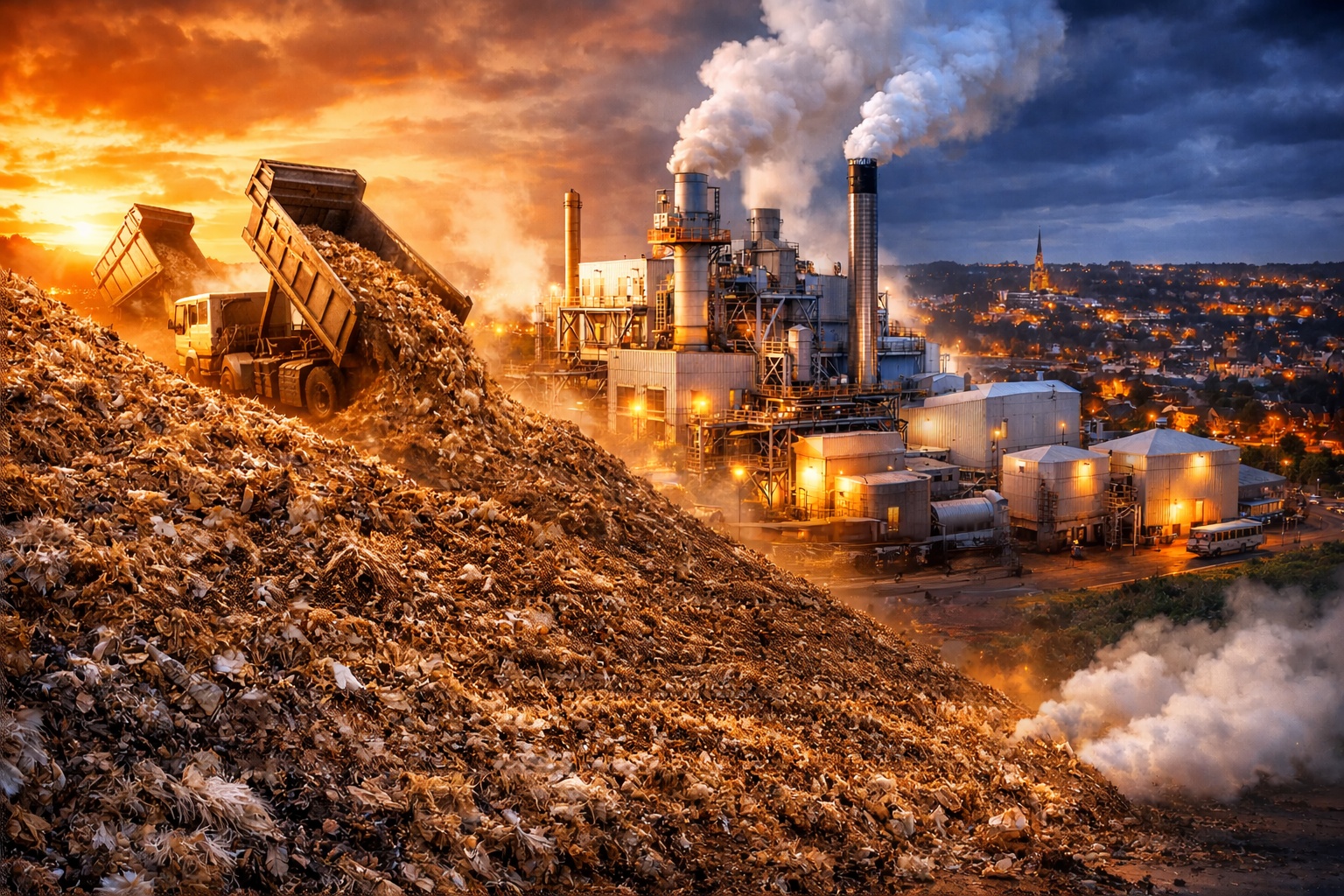


British Power Plants Of Up To 40 MW Convert Chicken Waste Into Electricity, Supplying Tens Of Thousands Of Homes.
In 2000, an unusual energy model began operations in the UK that would turn an environmental problem of poultry farming into a stable source of electricity. Fibrowatt developed and operated power plants fueled by “poultry litter”, a technical term for the mix of manure, sawdust, and organic waste accumulated on chicken farms. Each unit had an installed capacity of up to 38 to 40 megawatts, sufficient power to supply tens of thousands of homes.
The project was implemented in regions with a strong concentration of poultry production, such as Eye (Suffolk), Thetford (Norfolk), and Westfield (Scotland). The goal was to solve two problems simultaneously: the environmentally sensitive disposal of poultry litter and the need for renewable electricity generation within the British energy matrix.
The Environmental Challenge Of Poultry Litter In The United Kingdom
The United Kingdom has one of the most established poultry industries in Europe. Intensive chicken production generates large volumes of organic waste. Poultry litter contains nitrogen, phosphorus, and potassium, but when applied excessively to the soil, it can contaminate groundwater and waterways.
-
Motorola launched the Signature with a gold seal from DxOMark, tying with the iPhone 17 Pro in camera performance, Snapdragon 8 Gen 5 that surpassed 3 million in benchmarks, and a zoom that impresses even at night.

-
Satellites reveal beneath the Sahara a giant river buried for thousands of kilometers: study shows that the largest hot desert on the planet was once traversed by a river system comparable to the largest on Earth.

-
Scientists have captured something never seen in space: newly born stars are creating gigantic rings of light a thousand times larger than the distance between the Earth and the Sun, and this changes everything we knew about stellar birth.

-
Geologists find traces of a continent that disappeared 155 million years ago after separating from Australia and reveal that it did not sink, but broke into fragments scattered across Southeast Asia.

In the 1990s, the accumulation of this waste began to raise environmental concerns, especially in areas with high densities of poultry farms. The alternative found was to use it as biomass for energy generation.
The logic was clear: instead of discarding the waste, convert it into solid fuel for dedicated power plants.
How Electricity Generation From Chicken Waste Works
The industrial process starts with the collection of poultry litter directly from farms. The material is transported to the plant and undergoes drying and moisture control to ensure efficient combustion.


The biomass is then fed into specially designed boilers to burn material with high mineral content and the presence of nitrogen compounds. The combustion generates high-pressure steam that drives turbines connected to electrical generators.
The installed capacity of up to 40 MW refers to the maximum continuous generation capacity of the plant. In practical terms, a plant of this scale can provide power for approximately 40,000 to 50,000 homes, depending on average consumption.
In addition to electricity generation, the system produces ashes rich in phosphorus and potassium, which can be repurposed as mineral fertilizer, partially closing the production cycle.
Applied Technology And Emissions Control
The burning of poultry litter requires strict control of atmospheric emissions. The waste contains nitrogen and sulfur compounds that, without proper treatment, could generate pollutants.
The Fibrowatt plants incorporated particle filtration systems, nitrogen oxide (NOx) control, and fly ash capture. The design of the boilers was also adapted to handle the high mineral content of the biomass, reducing fouling and corrosion.
Another technical differential was the adaptation of the combustion chambers to cope with variations in fuel composition, as poultry litter can vary according to the diet and management of the farms.
The model was recognized as a renewable source within British energy policy, as it utilizes biogenic waste that, theoretically, is part of the short carbon cycle.
Scale, Numbers And Economic Impact
Each plant operated consuming hundreds of thousands of tons of waste per year. This volume represents a significant share of the regional poultry litter production.
It is important to differentiate installed capacity from effective annual generation. The capacity of up to 40 MW indicates the maximum potential of electricity generation under continuous operation. Annual production depends on factors such as fuel availability and maintenance.

The economic impact included local job creation, reduced environmental costs for poultry producers, and contributions to British renewable energy targets.
The model also influenced similar projects in the United States, especially in Pennsylvania, where there is a high concentration of poultry production.
Technical Challenges And Controversies
Despite the advantages, the model was not without controversies. Local communities raised concerns about emissions and waste transportation.
Furthermore, economic viability depended heavily on government incentives and power purchase agreements. Changes in energy policy impacted the financial sustainability of some operations.
From a technical standpoint, burning biomass with high mineral content can accelerate equipment wear and increase maintenance costs.
Nonetheless, the project demonstrated that agricultural waste can be integrated into the energy matrix in a structured and industrial way.
By operating power plants of up to 40 MW fueled by chicken waste, Fibrowatt’s model proved that a byproduct of poultry farming can become fuel for electricity generation on an urban scale.
The project combined environmental solution and energy production, converting tons of poultry litter into enough electricity to supply entire cities in the UK.
More than a technical curiosity, this is a concrete example of circular economy applied to agroindustry. Rather than treating waste as a liability, British engineering transformed it into a strategic energy asset.
The case shows that in the modern agribusiness, even what was once considered a problem can become a source of energy when combined with technology and industrial planning.








Porque o erro de estar escrita a palavra “cama” ao invés da correta, que seria “carne”, se repete tanto?
Uma revisão antes da publicação é indispensável…
Trabalho na avicultura, e o texto deixa bem claro que se trata de cama aviária, podendo conter também carcaças de aves que são depositadas nas composteiras onde se usa também cama aviária para acelerar a decomposição.