





 Portuguese
  English
  Spanish
  5 min of reading
  0 comments


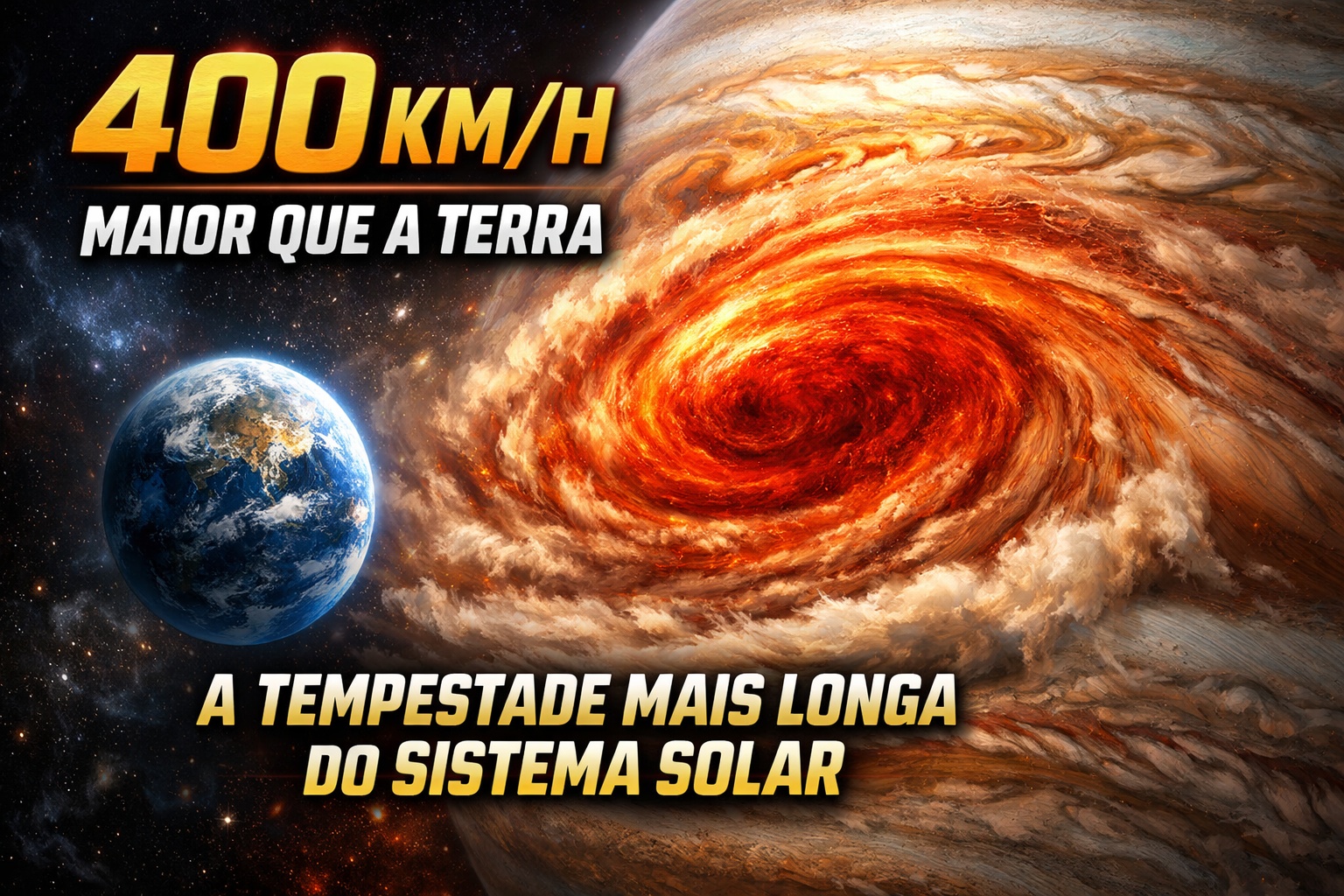
Greater Than Earth And With Winds Over 400 Km/H, The Great Red Spot Of Jupiter Is The Longest-Lasting Storm Ever Recorded.
The Great Red Spot of Jupiter has been continuously observed since at least 1831, with historical records that may date back to the 17th century. Recent data from the NASA Juno missions confirm that this atmospheric structure maintains winds exceeding 400 km/h, possibly reaching approximately 430 km/h at its outer edges. With current dimensions of about 16,000 kilometers in width, it is still large enough to engulf the entire Earth, although it has been shrinking over the past few decades. Measurements are monitored by ground observatories and NASA, which publishes periodic updates based on spectroscopic data and high-resolution images.
What makes the phenomenon extraordinary is not just its size, but its longevity. It is the longest-lasting storm ever observed on any planet in the Solar System.
The Giant Storm On Jupiter That Exceeds Earth Scale
The Great Red Spot is an anticyclone, meaning it is a system of high atmospheric pressure that rotates counterclockwise in Jupiter’s southern hemisphere. Unlike hurricanes on Earth, which last for days or weeks, this storm has been around for centuries.
-
Motorola launched the Signature with a gold seal from DxOMark, tying with the iPhone 17 Pro in camera performance, Snapdragon 8 Gen 5 that surpassed 3 million in benchmarks, and a zoom that impresses even at night.

-
Satellites reveal beneath the Sahara a giant river buried for thousands of kilometers: study shows that the largest hot desert on the planet was once traversed by a river system comparable to the largest on Earth.

-
Scientists have captured something never seen in space: newly born stars are creating gigantic rings of light a thousand times larger than the distance between the Earth and the Sun, and this changes everything we knew about stellar birth.

-
Geologists find traces of a continent that disappeared 155 million years ago after separating from Australia and reveal that it did not sink, but broke into fragments scattered across Southeast Asia.

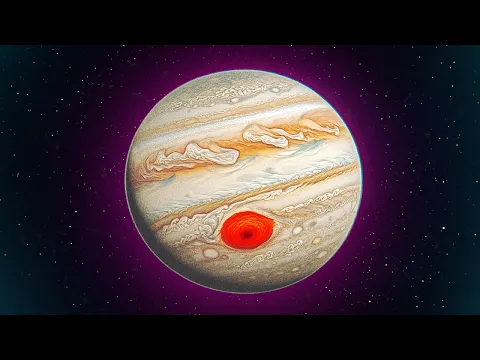

By the end of the 19th century, the spot measured approximately 40,000 kilometers in width. Today, according to recent measurements from NASA, it is about 16,000 kilometers. This indicates that the system is gradually shrinking but remains colossal.
For comparison, Earth’s diameter is approximately 12,742 kilometers. In other words, even reduced, the Great Red Spot still surpasses the size of our planet.
How Extreme Winds Over 400 Km/H Work
The winds of the storm reach speeds exceeding 400 km/h in the upper layers of the atmosphere. Data from the Juno mission indicate that the storm extends vertically for hundreds of kilometers below the visible clouds.
Jupiter is mostly composed of hydrogen and helium. There is no solid surface like on Earth. The planet’s atmosphere is marked by bands of clouds in constant motion, driven by temperature differences and extremely rapid rotation.
Jupiter completes a rotation in about 10 hours, generating intense Coriolis force. This rapid rotation contributes to the formation of extremely stable atmospheric currents.
Unlike Earth, where friction with the surface reduces storm energy, there is no such dissipation on Jupiter. This allows systems like the Great Red Spot to persist for centuries.
Why The Great Red Spot Lasts So Long
On Earth, hurricanes rely on warm water as an energy source. When they hit land, they lose strength. On Jupiter, the storm is powered by the planet’s internal energy.
Jupiter emits more energy than it receives from the Sun. Part of this energy comes from the continuous gravitational compression of the planet, a phenomenon known as the Kelvin-Helmholtz mechanism.
This internal thermal energy fuels the atmospheric currents and helps sustain the stability of the Great Red Spot.
Additionally, observations show that the storm absorbs smaller systems around it. Small vortices are captured and incorporated, temporarily reinforcing its intensity.
The Reddish Color And Chemical Mysteries Of The Atmosphere
The reddish coloration of the storm is not yet fully understood. Spectroscopic studies indicate that phosphorus compounds, sulfur, or complex organic molecules may react with solar ultraviolet radiation, producing reddish hues.
The intensity of the color varies over the years. During some periods, the spot appears more intensely colored; at others, it becomes paler.
NASA monitors these variations through the Juno mission and ground-based telescopes equipped with specific filters for chemical analysis.
Is The Storm Disappearing?
In recent decades, observations indicate a reduction in the diameter of the Great Red Spot. By the end of the 19th century, it was three times wider than it is today.
Although it is shrinking, recent measurements show that the rate of reduction has slowed. Some researchers suggest that the storm may eventually dissipate or transform into a smaller vortex, but there is no scientific consensus on when this could occur.
The Juno mission revealed that the structure extends deep below the clouds, suggesting that its base is more robust than previously thought.
Scientific Impact And Importance For Atmospheric Physics
The Great Red Spot is a natural laboratory for studying fluid dynamics on a planetary scale.
Atmospheric models developed from data on Jupiter help scientists better understand:
The Stability Of Giant Vortices
The Interaction Between Deep Atmospheric Layers
The Dynamics Of Gas Giants
The Formation Of Atmospheric Systems In Exoplanets
The study of this storm also contributes to advances in extreme weather modeling on Earth, even though in very different physical contexts.
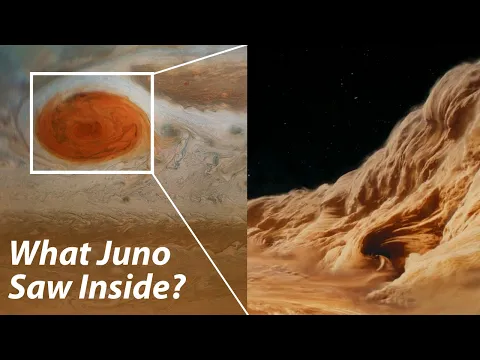
What The Juno Mission Revealed About The Internal Structure Of The Storm
Launched in 2011 and entered into orbit around Jupiter in 2016, the Juno probe allowed for precise gravitational measurements.
The data indicate that the Great Red Spot has an estimated depth of about 300 to 500 kilometers below the visible clouds.
This means that the system is not just superficial; it has a complex three-dimensional structure.
Juno also recorded local variations in the gravitational field caused by the mass concentrated in the storm.
A Phenomenon That Challenges Human Scale
If the Great Red Spot were on Earth, it would cover almost all of North America. Its winds exceed the speed of many maximum-category terrestrial hurricanes.
And, unlike terrestrial storms, it does not rely on liquid oceans or water evaporation.
It is a structure sustained by atmospheric physics on a planetary scale.
A System That Remains Active After Centuries Of Observation
Since telescopes began recording its presence, the Great Red Spot has remained one of the most fascinating phenomena in the Solar System.
Even with gradual size reduction, it continues to be the longest-lasting storm ever observed.
The combination of accelerated rotation, absence of solid surface, and intense internal energy creates unique conditions for its existence.
As telescopes and probes continue to monitor Jupiter, the Great Red Spot remains a reminder that atmospheric physics can operate on scales far beyond human experience.








-

-

-

-

-

-

600 pessoas reagiram a isso.