





 Portuguese
  English
  Spanish
  9 min of reading
  4 comments


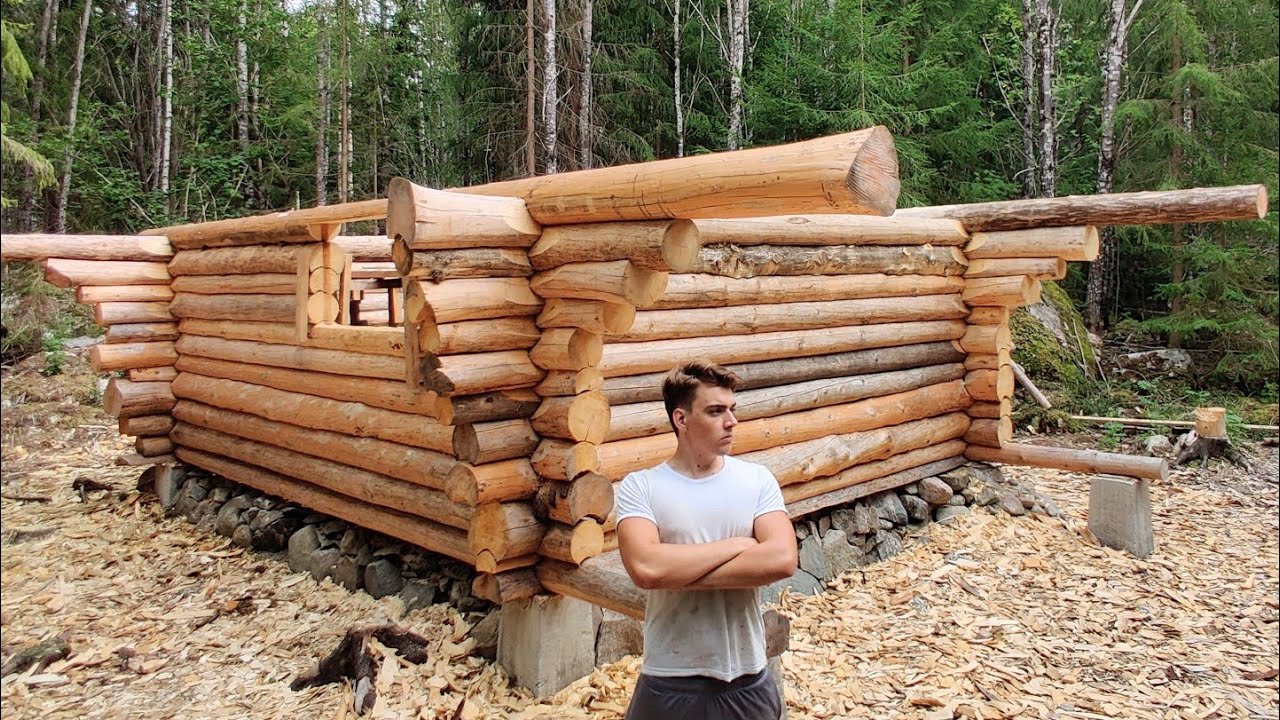


At 18, Erik Grankvist Went Alone to the Swedish Forest, Built a Cabin from Scratch with Hand Tools, and Went Viral with 35 Million Views.
At 17, Erik Grankvist felt lost. He lived in Stockholm, the capital of Sweden, had friends, attended school, and followed the typical routine of a teenager. But inside, something didn’t fit. He describes that period as a constant restlessness, a feeling of disconnection and lack of purpose. “I couldn’t connect with people. I was searching for something bigger in life,” he recalled years later, reflecting on what preceded the decision that would transform his path.
One night in 2017, Erik watched the documentary Alone in the Wilderness, which tells the story of Dick Proenneke, an American who built a cabin alone in Alaska in the 1960s and lived there for decades, filming his daily routine with a 16mm camera. What was for many just an interesting film became an obsession for Erik. He spent months imagining and planning: what if he tried to replicate that in Sweden, with his hands, without shortcuts, without relying on power tools?
The Decision to Live in Isolation
At 18, after finishing high school in 2019, Erik made the decision that most would consider reckless. He packed a backpack with basic hand tools, grabbed a tripod and a camera, bid farewell to his family, and set off alone to the mountainous forests of Sweden, on a plot of land owned by his grandparents.
-
Friends have been building a small “town” for 30 years to grow old together, with compact houses, a common area, nature surrounding it, and a collective life project designed for friendship, coexistence, and simplicity.

-
This small town in Germany created its own currency 24 years ago, today it circulates millions per year, is accepted in over 300 stores, and the German government allowed all of this to happen under one condition.

-
Curitiba is shrinking and is expected to lose 97,000 residents by 2050, while inland cities in Paraná such as Sarandi, Araucária, and Toledo are experiencing accelerated growth that is changing the entire state’s map.

-
Tourists were poisoned on Everest in a million-dollar fraud scheme involving helicopters that diverted over $19 million and shocked international authorities.


The detail that makes the story even more improbable is simple and brutal: Erik had no experience in construction. He had never cut down a tree. He had never built a wall. He had never done anything remotely similar to what he was about to try.

For about three years, he lived almost alone in the forest. He chopped down trees with an axe and hand saw. He peeled logs in the summer heat. He built walls log by log, working with traditional joinery. He constructed the roof with birch bark, installed windows, and organized the interior with basic furniture made by himself.
And he filmed everything alone, with the camera on the tripod, repeating frames, going back and redoing movements to capture different angles.
When he published the video “One Year Alone in Forest of Sweden – Building Log Cabin Like Our Forefathers” on YouTube, the story crossed borders. The video reached 35 million views and turned the young Swede into a global phenomenon. Today, he has over 1.6 million subscribers, sells handmade wooden products, partners with outdoor brands, and maintains a routine that, for millions, seems a rare mix of old discipline and contemporary internet aesthetics.
The Documentary Alone in the Wilderness and the Influence of Dick Proenneke
In 1967, Dick Proenneke set off alone to the Twin Lakes area in Alaska, with hand tools and a camera. He built a complete log cabin, documented each step, and lived in isolation for decades, fishing, hunting, and facing extreme weather. The footage became the documentary Alone in the Wilderness, which still circulates as a cultural reference about simple living and self-sufficiency.
When Erik watched the film in 2017, he saw more than just adventure: he saw method, discipline, and a kind of freedom that seemed impossible within the modern urban world. He was neither a trained survivalist nor did he have a rural background. He was a teenager from Stockholm in search of meaning.
From there, he dove into research. He read books on traditional Scandinavian building techniques, consumed videos on traditional carpentry, spoke extensively with his grandfather, and studied frames from the documentary, trying to understand cuts, joints, and sequences of work.
- Grandfather Åke Nilsson and Ancient Swedish Carpentry Techniques
Erik didn’t enter the forest completely in the dark. His maternal grandfather, Åke Nilsson, was a central figure. A traditional carpenter, Åke mastered techniques that were common before the electrification and mechanization of the countryside.
For months, he taught Erik how to choose appropriate trees, safely chop them down with an axe and saw, peel logs while preserving the integrity of the wood, and produce joints that lock logs together precisely, reducing dependence on nails.
It was also his grandfather who introduced the technique of roofing with birch bark, a historical Scandinavian resource that, when well executed, creates a naturally waterproof layer. Erik always recognized this point: the foundations came from his grandfather; the rest was learned through practice, making mistakes, and repeating.
Summer of 2019 and the Real Start of the Cabin Construction
Erik graduated high school in June 2019. While classmates planned for university, travel, and jobs, he prepared his backpack with the essentials: axe, hand saw, chisel, plane, hammer, shovel, tripod, camera, tent, food for the first weeks, and clothes for unstable weather.
What he didn’t bring was part of the project: no power saw, no generator, no power tools.

The choice of location required criteria. He was looking for relatively flat land, secure drainage, proximity to water, and an abundance of useful wood nearby. He found a natural clearing, surrounded by pines and spruces, with a stream of clean water.
There, the heavier work began: chopping down trees. To build a log cabin, he needed dozens of sturdy pieces. Each tree took hours. Then came peeling the log, preparing, and transporting it to the site, all alone.
The foundation was treated as a critical step. He dug, positioned large stones as a base, and carefully leveled the perimeter, because any mistake there would compromise the entire structure. Only then did the walls begin to rise, log by log.
How Erik Filmed Everything Alone with a Tripod
Filming is one of the elements that makes the story stronger for the internet. There was no hidden crew. There was no camera operator. The tripod was the constant “companion” . The method was repetitive: set up the tripod, adjust the frame, walk to the worksite, execute the task, walk back to turn off, reposition, repeat.

This multiplied the execution time. For each short segment that appears in the final video, there were hours of preparation, re-recording, and changing angles. At certain moments, he filmed the same action two or three times, just to obtain a clearer visual sequence. During the times he visited his grandparents to restock supplies, he edited material and published on YouTube, returning afterward to the forest.
In the early months, hardly anyone watched. Erik continued because the project was personal, not a strategy for fame.
The First Swedish Winter and the Decision Not to Risk Survival
The first winter was the practical limit of the experiment. Temperatures fell to around twenty degrees below zero. Snow accumulated and the wind made work dangerous. The cabin was still not entirely sealed, without final insulation and all internal solutions ready. Remaining there, at that stage, would be risking hypothermia and death.

Therefore, he returned to his grandparents’ house during the harshest months. This point generated criticism online, but Erik never denied it. He explains that absolute and continuous isolation is a romantic fantasy: even Proenneke received supplies; even Thoreau had connections.
The core of the story is not about “never leaving,” but about the volume of work, the daily solitude, and the process of building with one’s own hands over years.
In winter, he planned stages, studied techniques, edited videos, and waited for spring.
Spring of 2020 and the Acceleration of the Project
When spring arrived in 2020, the pace changed. Erik returned stronger physically and more efficient technically. With greater mastery of the process, he began to transform the structure into a livable space. He installed ready-made windows, because he recognized practical limits. He made a solid wood door with iron hinges.
He built the floor with hand-planed boards. He produced a bed, table, and benches. He installed a wood stove, essential for heating and preparing food.
The construction of the roof with birch bark became one of the most striking scenes of the project. It’s a traditional method that requires correct overlapping, material preparation, and care with sealing. He worked ten to twelve hours a day in favorable weather, sleeping exhausted and resuming at dawn.
Summer of 2021 and the Completed Cabin of 24 m²
In the summer of 2021, after three years of work distributed according to the seasons, the cabin was completed. The final dimensions were around 4 meters by 6 meters, about 24 m². Small by urban standards, but functional for minimalist living.
The structure impresses with its solidity: stacked logs with traditional joints, a gable roof with birch bark and moss integrating the construction into the environment, a solid hand-planed wood floor, windows that allow light, a well-fitted door, and a wood stove as the center of thermal comfort.

He also created complementary elements: a small subterranean cellar to store food at a more constant temperature, an outdoor fire pit area, a wood storage shed, and a simple rainwater collection system, complementing the nearby stream.
At times, for very heavy logs, he used a vintage Ferguson TE20 tractor from 1946 to drag pieces. Erik has always been transparent about this, saying he preferred a horse, but he had no access.
The Video That Went Viral and the Hypnotic Effect of Manual Labor
The video that compiled a year of work was published with a different aesthetic from the internet standard: little talking, few effects, focus on the sounds of nature and the repetitive rhythm of the axe, the saw, and the wind. The change of seasons becomes part of the plot. The result is almost therapeutic for viewers.
In 2021, the material exploded. It circulated in forums, social media, and simple living pages. Views scaled to tens of millions. Comments described the experience as “the best thing ever” and “an antidote to digital chaos.” What went viral wasn’t just the cabin, but the contrast: a young man alone, in silence, building something real in a world saturated with quick content.
What Erik Does Today and How the Project Became Work
Today, at 25, Erik maintains a channel with 1.6 million subscribers, publishing videos about life in the forest, traditional carpentry techniques, improvements to the cabin, and routines by season. He also created Grankvist Outdoors, an online store for wooden products made by him, such as cutting boards, shelves, and custom-made artisan pieces.
He also acts as a brand ambassador for outdoor products and monetizes the channel. Public estimates vary, but the central point is that income began to exist as a consequence of the story, not as a starting point. He often emphasizes that the goal was the life he wanted, not fame.
Why Millions Connected with Erik Grankvist’s Story
Erik receives messages from people saying that the videos helped with anxiety, stress, and feelings of lack of purpose.
Part of the appeal is simple: the content shows a long, real, and physical process, in which progress is visible. Instead of promising instant transformations, it shows repetition, mistakes, attempts, and slow construction.
He doesn’t sell expensive courses and doesn’t make miraculous promises. The narrative that remains is that of someone who started without experience and transformed an impractical project into something concrete.
The story of Erik Grankvist is not about convincing everyone to leave the city. It’s about demonstrating, with visual evidence and accumulated work, that experience is not a prerequisite to start. He picked up an axe, chopped down the first tree, and repeated the process for years until a cabin existed where there had once just been forest.
What went viral wasn’t just the cabin. It was the feeling of seeing, in real time, that a big dream can be built with small repeated actions, day after day, log after log, until it becomes reality.










Nesta foto tem coisas desenquadradas com a linda história. Primeiro os troncos estão todos cortados de forma uniforme o que revela maquina tipo motosserra e não um machado ou machada! Segundo, o tronco de cima terá um peso em verde entre os 500kgs e os 800kgs, e não estou vendo este jovem a cortar e o carregar para cima! Também nunca adoeceu, e não foi picado por mosquitos ou insetos vários. Linda história para o clicbite
Como eles recarregavam a câmera e o celular?
Engraçado que eles derrubam a floresta deles e depois vem cobra o Brasil pra preservar a sua kkk