





 Portuguese
  English
  Spanish
 6 min of reading
  0 comments


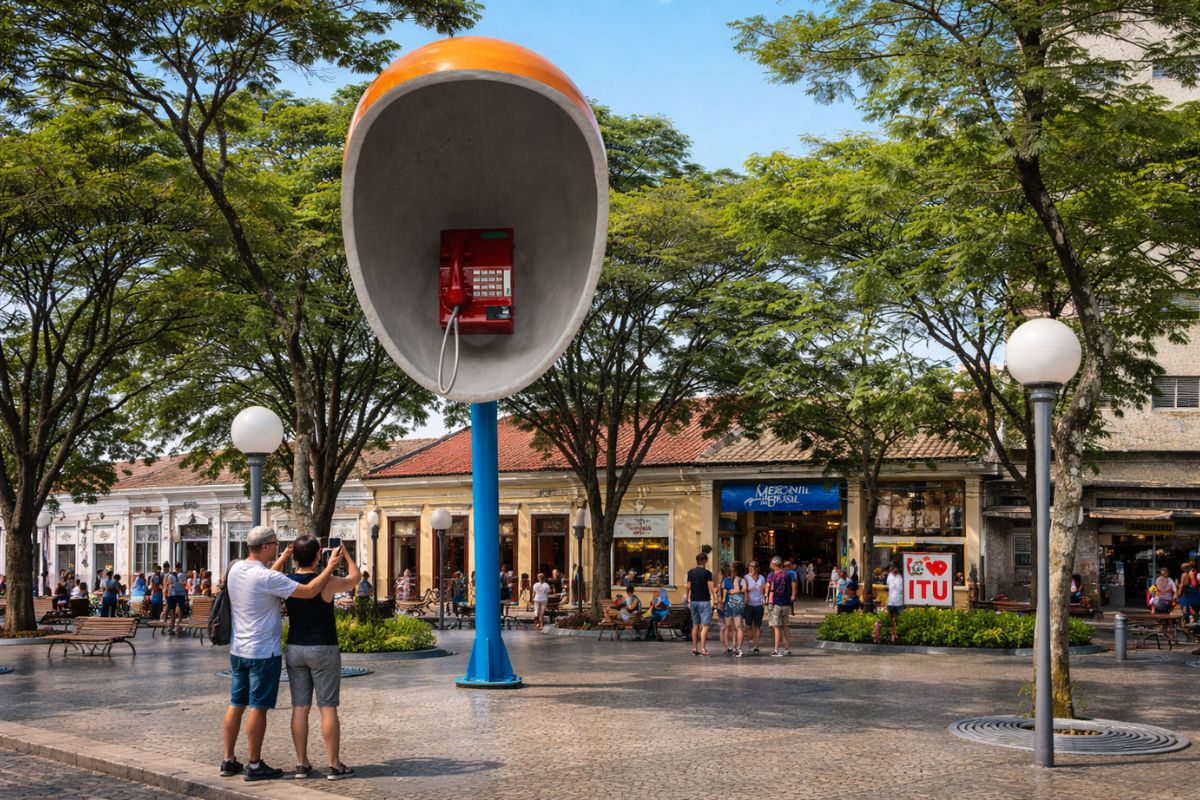
In The Matriz Square In Itu, The 7-Meter Giant Phone Booth Became A Landmark When The City Embraced Exaggeration As Identity. Now, With ANATEL Ending Concessions And Deactivating Public Phones In Thousands Of Locations, The Monument Remains, A Mix Of Humor And Heritage, And Provokes A Debate On Collective Urban Memory.
In The Center Of Itu, 98 Km From São Paulo, The 7-Meter Giant Phone Booth Dominates The Matriz Square And Draws Attention Just As Public Phones Are Disappearing From Daily Life. The Concrete Piece, More Than A Terminal, Became A Physical Sign Of An Era That Is Being Turned Off At An Accelerated Pace.
ANATEL Ended Fixed Telephone Concessions And This Sealed The Fate Of About 38,000 Points In Brazil, According To The Count Mentioned In The Local Survey. In Itu, However, The Logic Changes: The Monument Remains, Organizes The Visitor’s Gaze, And Becomes A Test Of How Cities Deal With Urban Memory When Technology Disappears From The Sidewalks.
The Monument That Stayed When The Network Shrunk

The Deactivation Of Public Phones Conducted By ANATEL Has A Simple Practical Effect: Fewer Terminals, Less Maintenance, Less Use.
-
Friends have been building a small “town” for 30 years to grow old together, with compact houses, a common area, nature surrounding it, and a collective life project designed for friendship, coexistence, and simplicity.

-
This small town in Germany created its own currency 24 years ago, today it circulates millions per year, is accepted in over 300 stores, and the German government allowed all of this to happen under one condition.

-
Curitiba is shrinking and is expected to lose 97,000 residents by 2050, while inland cities in Paraná such as Sarandi, Araucária, and Toledo are experiencing accelerated growth that is changing the entire state’s map.

-
Tourists were poisoned on Everest in a million-dollar fraud scheme involving helicopters that diverted over $19 million and shocked international authorities.


In Many Streets, The Removal Is Almost Invisible Because The Equipment Was No Longer Sought After, But The Landscape Changes, Even If Quietly.
When A Service Disappears, The Problem Stops Being Technical And Becomes Urban: Who Decides What Goes Away, What Stays, And What Gains Another Function?
There Are Places Where The Removal Means Just Freeing Up Space, And There Are Places Where The Object Becomes A Mark Of Identity, Even Without Its Original Use.
In Itu, The 7-Meter Giant Phone Booth In The Matriz Square Escapes This Logic Because It No Longer Functions Only As A Phone.
It Has Consolidated As A Landmark Of The Landscape, A Photo Spot, A Meeting Point, And A Piece Of Memory For Those Who Experienced The Phase When Public Phones Were Basic Infrastructure.
Exaggeration As Identity And As An Urban Project
The 7-Meter Giant Phone Booth Was Inaugurated In The 1960s And Originated From The Fame Of “The Land Where Everything Is Big,” Attributed To The Comedian Simplício.
The Joke Stopped Being Just A Joke And Started Guiding Scene Choices, With Sculptures And Enlarged Objects Becoming A Local Signature.
In Practice, Exaggeration Becomes A Communication Method: It’s Easy To Recognize, Easy To Remember, And Easy To Turn Into A Tour.
The City Creates A Circuit Where Scale Is Language, And The Visitor Quickly Understands The Invitation: Walk, Compare Sizes, Register, And Move On To The Next Point.
This Transformation Helps Explain Why The Matriz Square Doesn’t Treat The Monument As An Afterthought.
Instead Of Removal, The City Incorporated Exaggeration As Tourist Language, And The Result Is An Open-Air Park That Keeps The Visitor Switching Between Curiosity, Humor, And Urban Heritage.
Itu Beyond Humor: Historical Center And The Cradle Of The Republic
There Is An Easy Risk Of Reducing Itu To The Size Route, But The Municipality Carries Layers That Don’t Depend On Sculpture.
Founded In 1610, The City Is Associated With The Title “Cradle Of The Republic” Because Of A Political Episode That Happened There.
In 1873, The Republican Convention Took Place In One Of The Historic Mansions Of The Municipality, A Decisive Landmark For Brazilian Political History.
This Memory Coexists With Exaggeration In The Same Circulation Area, Creating A Rare Combination: Humor And History Walking On The Same Sidewalk, Starting From The Matriz Square.
This Coexistence Also Helps Explain Why The 7-Meter Giant Phone Booth Became More Than A Tourist Object.
For Those Passing Through The Center, The Monument Serves As An Entrance Portal To Other Narratives: A City That Jokes With Size, But Also Carries Concrete Records Of A Political Debate That Marked The Country.
What The Visitor Finds In The Surroundings Of The Matriz Square
The Route Cited In The Local Survey Gathers Equipment And Points That Reinforce The Idea Of Layered Urban Memory.
The Republican Museum Appears As A Collection Focused On National Politics, And The Historical Center Offers Mansions And Streets That Help To See The City Beyond Humor.
There Is Also The Varvito Geological Park, Described As A Natural Monument With Rocks Formed In Glacial Eras.
In A Scenario Where Exaggeration Dominates The Imagination, The Varvito Functions As A Counterpoint: It Is Not Bigger Than The World, But It Reminds Us That The Landscape Can Also Tell Very Old Stories.
And, In The Circuit Of Exaggerations, The Matriz Square Itself Continues As An Axis, With Sculptures Like Ants And Chess Games In Unusual Proportions.
Together, These Stops Sustain The Identity Of Itu And Make The Center A Space Where Humor Becomes Walking Guidance.
When The Phone Disappears, The Object Becomes A Document
The Removal Of Public Phones Creates A Paradox: The Fewer They Are, The More They Become A Memory For Those Who Depended On Them.
In Cities Without A Clear Preservation Project, The Transition Is Often Silent, With Removal And Replacement Without Debate.
This Change Also Creates A Generational Difference.
Those Who Have Used The Service See A Piece Of Routine That Has Disappeared, While Those Who Grew Up In The Cellphone Era Begin To View The Equipment As Curiosity, Almost Like An Outdoor Museum Piece.
The Case Of Itu Contrasts Because The Symbol Was Already Consolidated Before The Recent Cycle Of ANATEL Deactivation.
The 7-Meter Giant Phone Booth In The Matriz Square Functions As A Urban Document: It No Longer Serves To Make Calls, But It Serves To Tell That There Once Was A Network Of Public Phones And That The City Chose To Preserve This Memory On A Monumental Scale.
Gastronomy In Scale And The Logic Of The Souvenir
The Logic Of Size Also Comes To The Table.
The Bar Do Alemão Is Highlighted As A Known Stop, With The Filé À Parmegiana Treated As A Disproportionate Serving, Capable Of Feeding More Than One Person Comfortably, In A Tradition That Resonates With The Local Imagination.
Food, In This Case, Is Not Just A Meal, It Is A Narrative.
The Large Serving Functions As A Continuation Of The Urban Route: The Visitor Finds Exaggeration In The Matriz Square And Recognizes The Same Pattern On The Plate, As If The City Repeated Its Signature In Different Languages.
In The Confectioneries Nearby, Items Like Chocolate Pencils And Giant Lollipops Appear, Sold As Edible Souvenirs.
It Is A Complement That Closes The Circuit: The Visitor Leaves The Matriz Square With A Photo Of The 7-Meter Giant Phone Booth And Realizes That, In Itu, The Scale Is Narrative Also Outside Of Architecture.
What This Phone Booth Says About City, Technology, And Memory
The Permanence Of The Monument In Itu Does Not Hinder The Structural Change That ANATEL Is Leading, But It Exposes A Sensitive Point: Modernization Does Not Always Preserve Traces Of What It Replaces.
When Public Phones Disappear, A Piece Of Landscape And Habit Also Vanishes, And The Matriz Square Ends Up With Fewer Signs Of What Was Once Routine.
By Keeping The 7-Meter Giant Phone Booth, Itu Makes A Symbolic Choice.
It Is Not A Defense Of The Return Of The Service, It Is A Defense Of Public Remembrance, That Urban Memory That Is Seen Without Having To Enter A Building, As If The City Left A Permanent Caption In The Space.
For Those Passing Through Itu, The Question Is Personal And Concrete: When Was The Last Time You Saw Public Phones Functioning In Your City, And Would You Advocate For Preserving A Landmark Like This If ANATEL Took The Last One Away, Or Do You Think The Landscape Should Move On Without Keeping Those Signs?










-

-

2 pessoas reagiram a isso.