





 Portuguese
  English
  Spanish
  4 min of reading
  0 comments


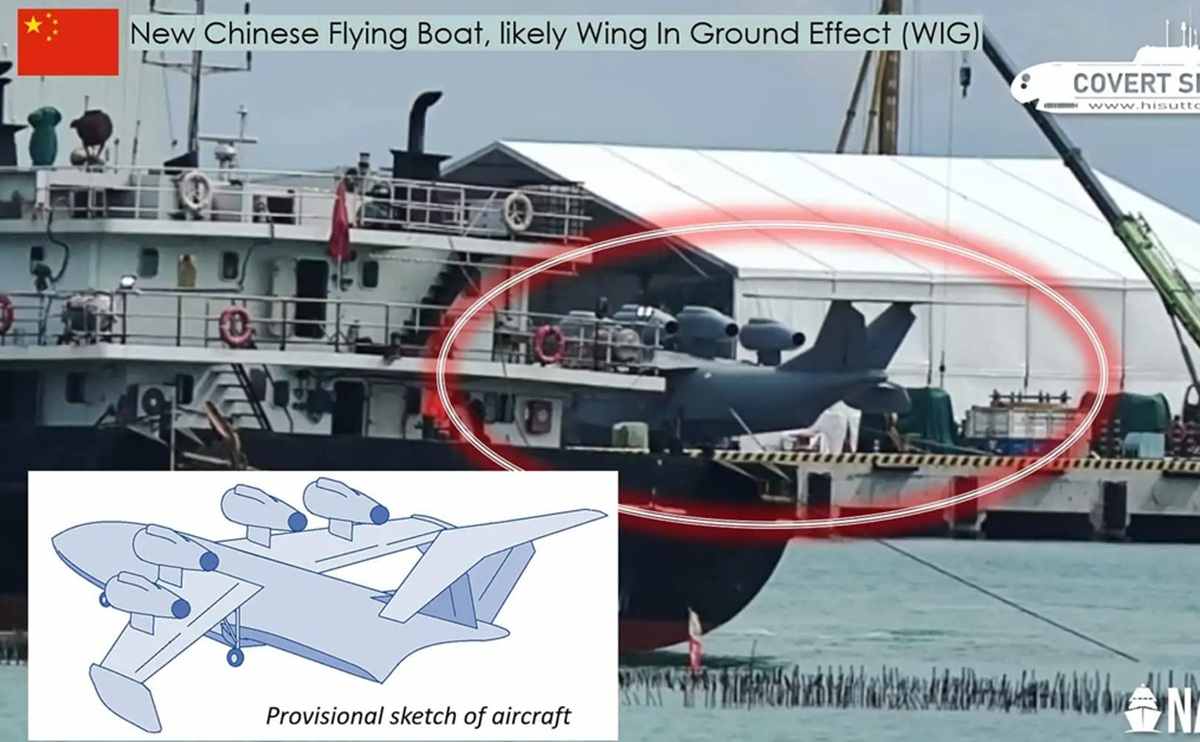
With Imposing Appearance and Adapted Soviet Technology, New Chinese Ekranoplan Could Change Military Strategy Over Calm Seas and Disputed Areas.
A blurred photo posted on Chinese social media this month caught the attention of defense experts worldwide. The image shows what appears to be the most ambitious Ekranoplan built in decades.
The vessel was spotted at an undisclosed Chinese coastal facility.
Analysts claim this is the biggest advance in the development of wing-in-ground effect (WIG) aircraft since the Cold War.
-
Motorola launched the Signature with a gold seal from DxOMark, tying with the iPhone 17 Pro in camera performance, Snapdragon 8 Gen 5 that surpassed 3 million in benchmarks, and a zoom that impresses even at night.

-
Satellites reveal beneath the Sahara a giant river buried for thousands of kilometers: study shows that the largest hot desert on the planet was once traversed by a river system comparable to the largest on Earth.

-
Scientists have captured something never seen in space: newly born stars are creating gigantic rings of light a thousand times larger than the distance between the Earth and the Sun, and this changes everything we knew about stellar birth.

-
Geologists find traces of a continent that disappeared 155 million years ago after separating from Australia and reveal that it did not sink, but broke into fragments scattered across Southeast Asia.

At that time, the Soviet Union created giants of the type that flew low over the Caspian Sea, resembling flying warships.
Now, China seems to have brought back this type of hybrid technology, with objectives that are still unclear.
The Return of Ekranoplans and Their Strategic Advantages
Ekranoplans are vehicles that fly just a few meters above the water, using the aerodynamic effect of an air cushion between the wings and the sea. This allows for high speed with fuel efficiency. The low altitude also offers another advantage: these vehicles can evade traditional radar.
During the Cold War, the Soviets created gigantic models, such as the famous Caspian Sea Monster and the Lun class. They were hybrids between aircraft, boats, and hovercraft. However, after the collapse of the Soviet Union, these projects were abandoned due to a lack of resources. Over time, the concept almost disappeared.
Now, China is reviving the project with a modern version. The new vessel, visibly real, is painted in matte gray and features four jet engines mounted on short wings. The “T” shape with two vertical stabilizers indicates that the focus is not on high flights but on stability over water.
According to the website Naval News, this is a new type, never reported before. Although it resembles previous models seen in China, it is much larger and clearly military.
Soviet Technology and Recruitment of Russian Specialists
The motivation to revive this technology may be linked to strategic interests. With the growth of the Chinese navy and the focus on Taiwan, China may be seeking new forms of rapid and stealthy transportation over the sea.
Moreover, according to documents obtained by The New York Times, China has been recruiting former Soviet engineers with experience in ekranoplans.
A report from Russia’s Federal Security Service (FSB) states that there is a focus on former employees of factories and institutes related to this type of technology. Especially those dissatisfied with the end of the Soviet program or in financial difficulties.
This movement shows that China is not only recovering old designs but trying to attract the specialists who created them. This could further accelerate the advancement of Chinese projects.
Tactical Advantages and Limitations of the New Vehicle
Ekranoplans offer hard-to-match advantages. They combine speed, low consumption, and stealth. This makes them ideal for quick troop or cargo transport missions, going unnoticed by surveillance systems.
The People’s Liberation Army Navy (PLAN) already uses hovercrafts. Now, this technology provides another option.
However, there is an important limit: these vehicles only work well in calm waters, with waves of up to 1.25 meters. In other words, they are not ideal for all conditions.
Even so, analysts such as those from ChinaTalk believe that the Taiwan Strait could be crossed by an ekranoplan on calm days — outside of typhoon season.
Expansion of Chinese Interest in Wing-in-Ground Effect Vehicles
The Bohai Sea Monster is not the only project. Beijing has been testing other smaller models for years, such as the DXF-100 and the Albatross-5.
These versions carry between 15 and 20 passengers. Additionally, China is also investing in WIG drones — unmanned vehicles that use the same principle of low-level flying over water.
Drones of this type can be used for surveillance, supply delivery, and even transportation of armaments. The first signs of Chinese military projects involving WIG drones emerged in 2017 and were announced by state media.
The publication suggests that the project has support from high-ranking officials.
These hybrids require mastery of both aerodynamics and hydrodynamics. Therefore, engineers with this training are valuable for various other sectors of the Chinese military industry.
Other Countries Also Show Interest
Besides China, countries like Poland and Denmark have begun developing their own WIG drone models. Applications vary from commercial to military use. However, none of these initiatives seem to have reached the technical level and investment that Beijing currently demonstrates.
The size and design of the Chinese Ekranoplan suggest that it could serve as a fast attack vehicle. It can transport troops or light vehicles to the enemy coast more quickly than conventional aircraft. This would be useful in scenarios such as a potential operation over Taiwan.
Another possibility would be its use in transporting heavy cargo or resupplying bases on islands.
China is already working on developing another maritime aircraft, the AVIC AG600, aimed at rescue missions. The new ekranoplan could work in conjunction with this project, with different objectives.








-

-

-

3 pessoas reagiram a isso.