





 Português
  Inglês
  Espanhol
  11 min de leitura
  3 comentários


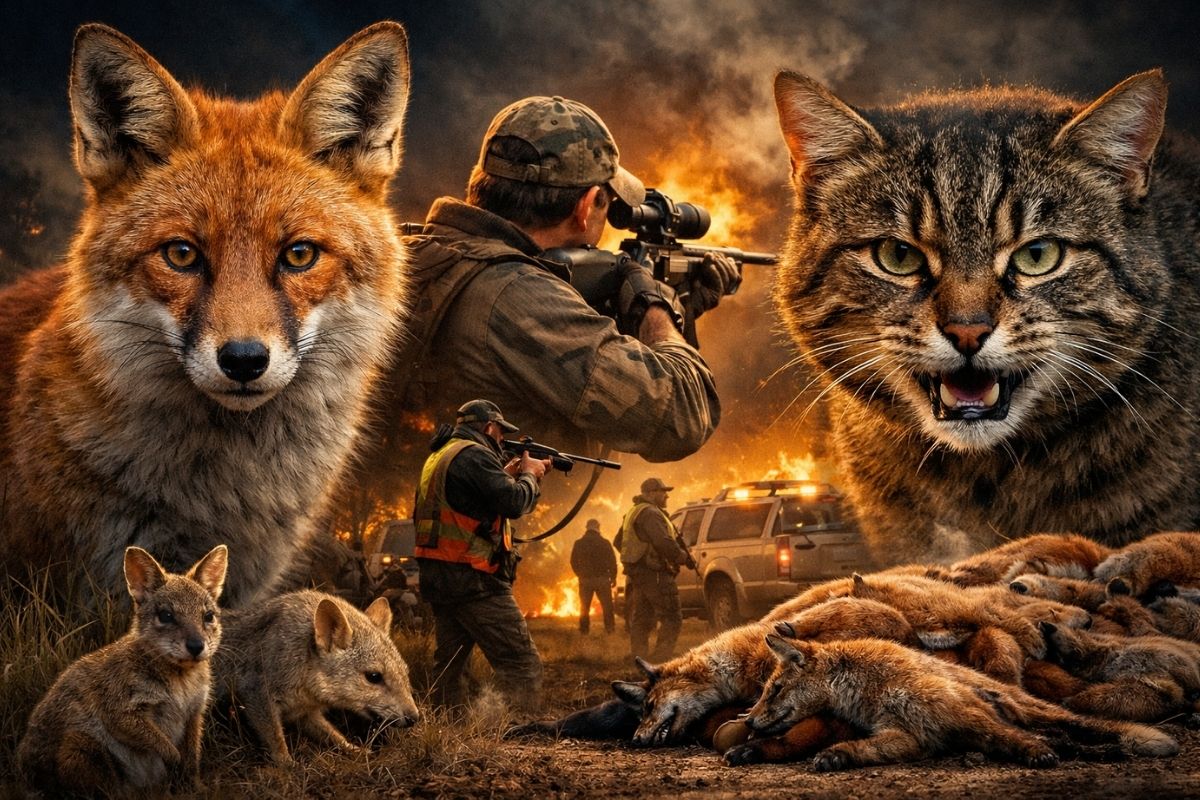


In Australia, Invasive Fox Control Has Turned into a Permanent Campaign: In Victoria, More Than 400 Thousand Animals Have Been Killed at a Cost of Over 4 Million Dollars. However, Studies with 1,232 Camera Points Show That Where the Fox Falls, the Feral Cat Grows Up to 3.7 Times Again
In Australia, the war against the invasive fox has moved from paper to state routine. Authorities offer rewards, mobilize hunters and farmers, promote armed actions, and try to reduce a plague that has spread across almost the entire continent, including near cities like Melbourne and Sydney in Victoria.
The problem is that Australia faces a real ecological dilemma: killing the fox may create room for a surge of feral cats, another introduced predator, now present in over 99.9% of the territory, including islands. In certain forests, the removal of the fox has already been associated with increased density and behavioral changes in cats, posing a direct risk to native nocturnal mammals.
Why Australia Has Become a Battleground Against Foxes

Australia did not reach this point by accident. Foxes are not native to the country: they were brought by European colonizers and introduced in 1845 in New South Wales, not out of economic necessity, but as an imported pastime: fox hunting.
-
Found in one of the most radioactive places on Earth, this Chernobyl fungus may be doing something with radiation that no one has been able to explain to this day.
-
A bright yellow mushroom imported from Asia escaped from a cultivation farm in the United States in 2010 and is now aggressively spreading across 25 states, destroying entire communities of native fungi in American forests.

-
Buried under China, a colossal machine weighing 20,000 tons began operating as the largest neutrino detector on the planet and, in just 59 days, surpassed results that science took half a century to achieve.

-
Iran enters the center of a climate alert after the war emitted 5.6 million tons of CO2 in two weeks, surpassing the annual pollution of entire countries.


Shortly thereafter, animals were released in the Melbourne area and within less than 20 years, the Victorian government was already forced to officially classify them as a pest.
In less than a century, their expansion became a settled fact. Foxes spread across almost the entire continent, traversing forests, farms, grasslands, and reaching suburban limits, where food and shelter are abundant.
Recent estimates suggest around 1.7 million foxes in Australia, distributed across more than 80% of the continent and at least 50 islands, being rare in northern Australia and Tasmania.
A Unique Ecosystem, Poorly Prepared for Predators Like the Fox
Australia has a peculiarity that makes each invasion more dangerous: over 80% of animal and plant species are endemic, meaning they exist only there.
Geographic isolation has shaped a continent with kangaroos, koalas, platypuses, and wombats, but with a low historical coexistence with predators like foxes, wolves, and lynxes.
This absence of co-evolution weighs on the behavior of prey. Many birds make nests on the ground, small mammals dig shallow burrows, and several species respond slowly, lacking a strong escape instinct in the face of a furtive predator.
The system, for millions of years, functioned with a different balance: small diggers kept the soil healthy, birds and mammals spread seeds, and insects were controlled naturally.
The “Predator Pit” and the Disappearance Post-Fire in Southern Australia
One of the most disturbing signs reported by biologists in southern Australia is the so-called “predator pit.”
Even after large-scale wildfires, some species were still seen in the early days, such as small digging mammals, including bandicoots and bettongs. But, after just one or two months, camera traps stopped recording any individuals.
With ground-nesting birds, the pattern was even more evident: the nests remained, but eggs and chicks completely disappeared, repeating season after season.
The central point is that it was not an immediate loss due to fire, but rather a subsequent disappearance associated with the pressure from introduced predators.
The Scale of the Damage and the Species That Count in Australia
The economic impact also appears in the estimates cited for Australia: an invasive species with this profile is associated with approximately 227.55 million dollars in annual losses and is classified as one of the most severe ecological threats in the country. However, the hardest damage to measure is ecological.
The fox, described as a direct threat to at least 14 bird species, 48 mammal species, 12 reptile species, and two amphibian species, comes into focus when the list of vulnerable species gains name and surname: orange-bellied parrot, night parrot, greater bilby, numbat, bettong, bandicoot, and the western swamp turtle.
Many of these species can no longer support populations on the mainland and survive only on small coastal islands or within reserves surrounded by predator-proof structures.
How the Fox Can Devastate Australia Without Being a “Super Predator”
Foxes do not need to be large to cause damage. In Australia, almost any animal weighing up to about 5 kg can become prey, including small mammals, ground-nesting birds, reptiles, large insects, and even koala joeys when the opportunity arises.
On average, a fox consumes about 400 g of food per night. Over the course of a year, this adds up to approximately 150 kg.
The detail that changes everything is the “excessive killing”: a fox can kill multiple animals in a single night and consume only a part, leaving the rest behind or burying it as stock. In ecosystems where prey did not evolve with such a hunting pace, the result is disproportionate.
There is also a component of range. The fox hunts on the ground, scours low vegetation, and has been recorded climbing trees up to about 4 meters high, enough to reach nests and young.
Trees, dense shrubs, and low branches, which for a long time served as refuges, lose value as protection when this predator settles in.
Numbers Attributed to Australia and the Scale of Annual Culling
The scale of the impact appears in estimates attributing to foxes in Australia the deaths of about 300 million native animals each year.
The breakdown of these numbers makes the situation even heavier: approximately 88 million reptiles, 111 million birds, and 368 million mammals would be killed annually by foxes.
Regardless of local variations, the message is the same: it is not a pinpoint damage; it is a continuous depletion.
At the described pace, entire regions enter a cycle of disappearance and increasingly difficult recovery, especially when predators find open areas and prey that do not recognize signs of risk.
The Uncomfortable Benefit: Foxes Also Attack Invasive Species That Have Already Dominated Australia
The Australian dilemma stems from the fact that the fox does not only hunt natives. In Australia, it also consumes invasive species like house mice and rabbits, as well as, in some cases, targeting young or weakened feral cats.
Estimates cited for this effect suggest about 259 million invasive animals consumed each year, mainly house rats and rabbits.
This creates a scenario where foxes become direct competitors of feral cats, which today occupy more than 99.9% of Australian territory, including islands.
When the fox disappears, competition decreases, and the highly adaptable cat tends to expand its territory and pressure on native prey.
What Cameras Revealed in Victoria About the Advance of Feral Cats

In Victoria, in the southwest of the state, research associated with the University of Melbourne investigated how conservation programs that control foxes may alter the game.
The work reported that, in dry forests, cats began to hunt at night when foxes were controlled, potentially increasing access to native nocturnal mammals.
The team also pointed out previous findings: after the removal of foxes, the density of feral cats increased in the wet forests of the Otway Ranges region.
In another area, the Glenelg region in southwestern Victoria, feral cat densities were described as often higher in forests with long-term fox control than in forests without that control.
To achieve these standards in Victoria, researchers and managers repeatedly installed monitoring cameras at 1,232 sites in two forest regions in the southwest of the state.
They then meticulously analyzed and tagged millions of photographs, identifying cats individually by their unique fur patterns.
The data showed that the density of feral cats was often higher where foxes were attracted with bait, ranging from a slight increase to 3.7 times greater.
Australia Has Controlled Foxes for Decades and Only Recently Treated Cats as Formal Invaders
The contrast in policies helps explain why Victoria is under pressure on two fronts. Fox control in some regions of the state has been occurring for decades, focusing on protecting vulnerable native fauna.
Feral cats, on the other hand, were only declared an established invasive species on Crown land in Victoria in 2018, and large-scale control programs are still described as very limited.
This delay opens a dangerous window: reducing foxes without reducing cats may only swap the dominant predator, maintaining fauna loss, but through a different agent that is, in some contexts, harder to contain.
Fox and Cat Together: The Combined Weight of Predation in Australia

There is an estimate cited for the combined weight of foxes and feral cats in Australia: about 2.6 billion mammals, birds, and reptiles killed each year, with a clear caveat that the calculations depend on the actual number of foxes and cats in each region.
Within this framework, one data point stands out: in the Otways area, in dense wet forests, approximately one feral cat per square kilometer was recorded, described as the highest number ever recorded for native forest on the continent.
In the dry forests of southwestern Victoria, the cited number was around 0.3 cats per square kilometer, although in some forests with fox control, cats appeared at densities twice as high.
The City as an Incubator for Foxes in Australia
While governments spend to reduce foxes, Australia is creating urban environments that favor the animal.
Comparative studies described for urban and wild areas in cities like Melbourne and Sydney point out that the density of foxes in cities can be 3 to 5 times higher than in wild areas.
The contrast even shows up in body size: a fox in the wild usually weighs around 5 to 6 kg, while urban foxes can reach 7 to 8 kg, with a longer body and wider skull, signaling adaptation to an environment with predictable food year-round.
Household waste, landfills, park trash cans, along with mice, rabbits, and urban birds, form a stable energy chain. Suburban areas, part forest and part residential, become ideal habitats with stormwater drains, parks, and abandoned lots providing shelter.
The result is a paradox: Australia invests millions to eliminate foxes and, at the same time, supports conditions for them to thrive within cities.
Dingoes, About 5,600 km and the Release of Smaller Predators
On the Australian chessboard, there used to be a natural brake above foxes: the dingo, a wild dog present as a top predator for thousands of years.
In central and northern Australia, where dingo populations remain stable, a consistent pattern appears: fox densities remain significantly lower, and small native mammals, especially marsupials weighing less than 5 kg, survive better.
What overturned this control was economic. The expansion of sheep farming turned the dingo into a direct threat to the sector, mainly due to lamb attacks, and the response was to eliminate it on a large scale.
The ultimate symbol was the construction of the dingo fence, a barrier approximately 5,600 km long, created to keep dingoes out of grazing areas in the southeast. However, there is a decisive detail: the fence does not stop foxes. They are smaller, dig better, and can pass through gaps.
With dingoes blocked and foxes roaming, dingoes almost disappeared within the fence, and the fox took space as the dominant predator. This is what ecology calls mesopredator release: when the top predator disappears, smaller predators expand and can cause even greater harm.
Why Australia Shoots, Offers Rewards, and Still Cannot Win
When Australia takes on the role of direct control, the method most used becomes shooting. Hunting usually occurs at night: hunters in trucks use spotlights to sweep pastures and forest edges, shooting when the eyes reflect the light.
In theory, it seems simple. In practice, concentrated campaigns can reduce the local population by about 30% to 50% in the first months, but the effect does not hold.
Older foxes learn quickly: they avoid artificial light, engine noise, change their activity schedules, and can travel kilometers to escape areas where pressure has been high. In many places, after 6 to 12 months, the density returns close to the original level.
Additionally, in many states, it is not a free act: participation requires a license and training in methods of shooting considered humane.
Even so, the scale of the operation in Victoria illustrates the escalation: in less than 3 years, the state spent over 4 million dollars to eliminate 400,000 foxes, yet many remained in the territory.
The engine of recovery is biological. Each female can give birth to four to six pups per year, meaning any “vacuum” in the territory is quickly filled.
Traps, Poisons, and the Social Cost of Controlling Foxes in Australia
When shooting fails as a long-term solution, traps and baits come into play, especially in urban and suburban areas where the use of firearms or poisons may be restricted. However, traps require labor, are costly, and depend on high skill levels.
There is another problem: foxes are extremely intelligent. There are reports of individuals avoiding traps and cameras for more than four years, even with repeated changes in system design.
The most sensitive risk is collateral: traps can accidentally capture threatened native species, leading governments to restrict use, further reducing the effectiveness on a large scale.
The most controversial method cited for Australia is the poison known as Compound 1080. It is described as colorless and tasteless, mixed into meat baits and distributed by hand or dropped from aircraft.
Foxes would be particularly sensitive to 1080, while some native species have greater tolerance because similar compounds occur naturally in certain plants.
In large-scale campaigns, initial results can be strong. In Tasmania, in the early 2010s, more than 3,700 baits were distributed over 120,000 hectares, covering hundreds of farms, aiming to eliminate foxes before they establish themselves.
Reports indicated initial reductions exceeding 80% to 90% in treated areas. But the effect does not last: after 1 to 2 years, foxes from neighboring regions begin to occupy the vacuum.
The social cost, however, weighs heavily: domestic dogs, especially working dogs on farms, have a mortality rate described as nearing 100% if they consume bait with 1080.
A mistake in warning, signage, or positioning can turn tragic for pets, fueling public pressure, petitions, and ethical debates.
Fumigation, Technology, and Guard Animals: Local, Not Continental Solutions
There are also more targeted methods, such as injecting carbon monoxide into identified burrows to eliminate litters.
The advantage is being highly specific, with minimal impact on other species and no prolonged residues in the environment.
The disadvantage is operational: one must find the burrow, time it well, and accept that each intervention affects a small group, insufficient for the scale of Australia.
When the response turns to technology, intermittent lights, ultrasound, laser systems, and devices with thermal and motion sensors emerge. In the field, they work initially because foxes avoid well-lit areas or those with signalers.
However, many return to normal behavior in 2 to 4 weeks upon realizing there is no real danger. To maintain the effect, it would be necessary to constantly vary locations and patterns, raising costs and efforts.
Guard animals, such as dogs and even alpacas, act as barriers against losses on farms, especially for lambs and birds.
This works on specific properties, but does not scale to millions of square kilometers of productive territory.
The Final Dilemma That Holds Australia Back: Save Natives Without Releasing the Next Predator
Australia has learned, the hard way, that controlling an introduced predator can trigger cascading effects.
Maintaining foxes means continuing the direct pressure on native birds, mammals, and reptiles that have not developed natural defenses.
Eliminating foxes without controlling cats may allow the latter predator to grow, become bolder, and alter hunting times, increasing risks for nocturnal species.
In Victoria, the evidence gathered with cameras at 1,232 sites and millions of images reinforces that the problem is not choosing one enemy only.
In your opinion, should Australia intensify simultaneous control of foxes and feral cats, even if it costs more and involves more controversial methods?







Lamentável, pela morte de animais raposa e gatos incentivar a matança é o ****mulo. A raposa é dócil igual a um cão muito carinhosa. Indignado por essa atitude. Desequilibram ecossistema e põe na conta dos pobres animais em seus habitat ele predam aves para alimentar-se não por dinheiro diversão. Como fazem esses sanguinário. Homo sapiens ” civilizados, racionais “.
Esses boçais australianos matam os bichinhos sem dó nem piedade. Gente rude e cruel! Tomara que a ilha afunde
Esses auatralianos boçais e ignorantes matam os bichos sem dó nem piedade. Tomara que a Ilha afunde!!!