





 Portuguese
  English
  Spanish
  4 min of reading
  0 comments


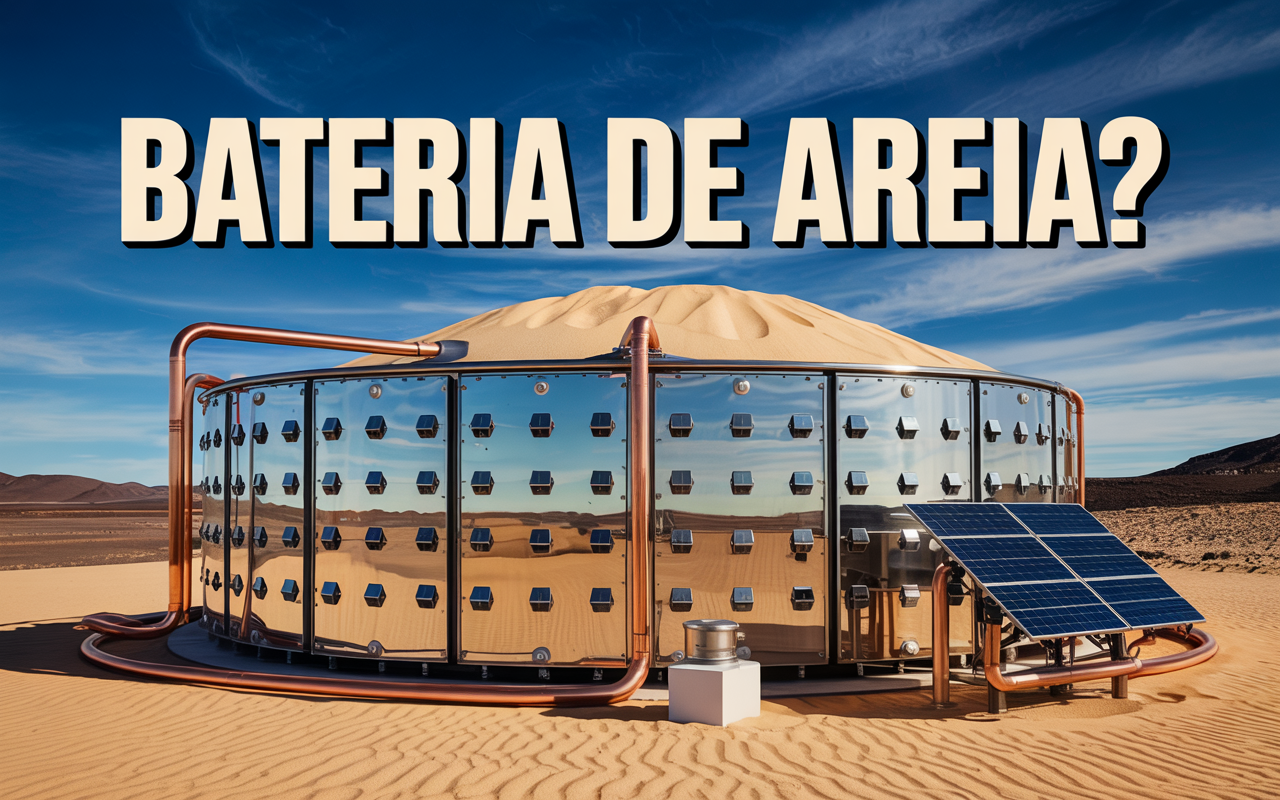
Simple And Efficient Technology Developed By A Finnish Company Stores Heat From Renewable Sources And Heats Thousands Of People During The Harsh Nordic Winter.
In the city of Kankaanpää, in western Finland, a cylindrical steel structure about seven meters tall and four in diameter heats homes, schools, and public buildings — and its secret lies within: about 100 tons of sand. This is the world’s first commercial sand battery system, developed by the startup Polar Night Energy, that uses heat stored in the sand to warm environments during the winter.
The Finnish project is considered one of the most promising thermal storage solutions for renewable energy, especially in countries where solar and wind resources are abundant but irregular. The technology already serves a local heating network and can be expanded to other cities in the country and in Europe.
How The Sand Battery Works
Unlike conventional lithium or lead-acid batteries, the sand battery stores energy in the form of heat. During months of higher solar or wind energy generation, the system converts this energy surplus into heat using electric resistors. This heat is transferred to the large volume of sand stored inside the insulated silo. The sand, in turn, can reach temperatures of 400 °C to 600 °C, retaining accumulated heat for several months, with minimal losses.
-
Renewable energy advances over protected areas in Brazil, and a survey by the Energy Transition Observatory reveals silent impacts that challenge environmental conservation and pressure sensitive traditional territories.

-
Rio Grande do Sul accelerates energy transition: State invests in renewable technologies and consolidates decarbonization strategies and pathways to attract billions in new industrial investments.

-
With 160,000 m² of collectors, an area larger than 20 football fields, Silkeborg, in Denmark, hosts a solar thermal plant that heats 19,500 homes and could become the largest solar heating plant in the world.

-
A study reveals the expansion of renewable energy procurement in Brazil and shows how companies are taking advantage of opportunities to reduce expenses, ensure energy efficiency, and strengthen strategic environmental commitments.



This heat is reused in the winter when the demand for urban heating increases. The thermal energy is transferred to urban heating systems (district heating), reducing dependence on fossil fuels such as natural gas and heating oil.
Why Use Sand?
The choice of sand as a thermal storage medium is not by chance. It is a cheap, abundant material that can withstand high temperatures without deterioration. In addition, its heat storage capacity is superior to that of water and other liquid or solid media commonly used in thermal engineering.
Another benefit of sand is environmental stability. The system does not rely on toxic components like heavy metals, nor does it require complex structures. This eases both installation and maintenance, extending the lifespan: it is estimated that the sand battery can operate for over 50 years, surpassing the average lifespan of electrochemical batteries by decades.
Capacity And Efficiency
The unit in operation in Finland has a thermal storage capacity of 8 megawatt-hours (MWh), with an output power of 200 kilowatts (kW). This energy is sufficient to serve an entire community during periods of high thermal demand.
According to data released by Polar Night Energy, the system’s efficiency — that is, the ability to maintain useful heat for long periods — can vary between 60% and 75%, depending on external conditions. In larger versions, the expectation is to achieve up to 90% utilization of stored energy.
Urban Applications And Expansion
The success of the Kankaanpää project has opened the door for new plans in other regions of Finland. The city of Pornainen, for example, is already studying the installation of a larger sand battery, aiming to serve schools, health centers, and public buildings.
The Finnish innovation has also attracted international interest. The startup responsible for the project received €7.6 million in investments to expand its technology and is already developing versions with a capacity of up to 10 megawatts, targeted at large-scale urban heating networks.
Furthermore, the model is being studied as an alternative for countries with high intermittency in renewable sources. Combined with solar panels and wind turbines, the system acts as a strategic energy reserve, capable of keeping buildings heated even during long cloudy periods or wind calms.
Comparison With Conventional Batteries
While traditional batteries, like lithium-ion ones, are effective for storing electrical energy, they have limitations: high costs, scarcity of materials, short lifespan, and chemical degradation. The sand battery avoids these problems, offering a cheaper, cleaner, and more durable solution.
Additionally, the thermal battery can be used complementarily to electrochemical batteries, providing stability to the national electrical system and avoiding consumption peaks during winter.
Renewable Energy Made Simple
The sand battery technology is an example of how simple solutions can transform the future of energy. Instead of relying on sophisticated components or complex processes, the innovation focuses on low-cost thermal storage to efficiently and sustainably provide heat.
The Polar Night Energy project reflects a growing trend: using surplus renewable energy for applications beyond electricity. By transforming heat into thermal comfort and energy stability, the Finnish sand battery may represent a new model of energy transition — with global replication potential.









Seja o primeiro a reagir!