





 Português
  Inglês
  Espanhol
  4 min de leitura
  21 comentários


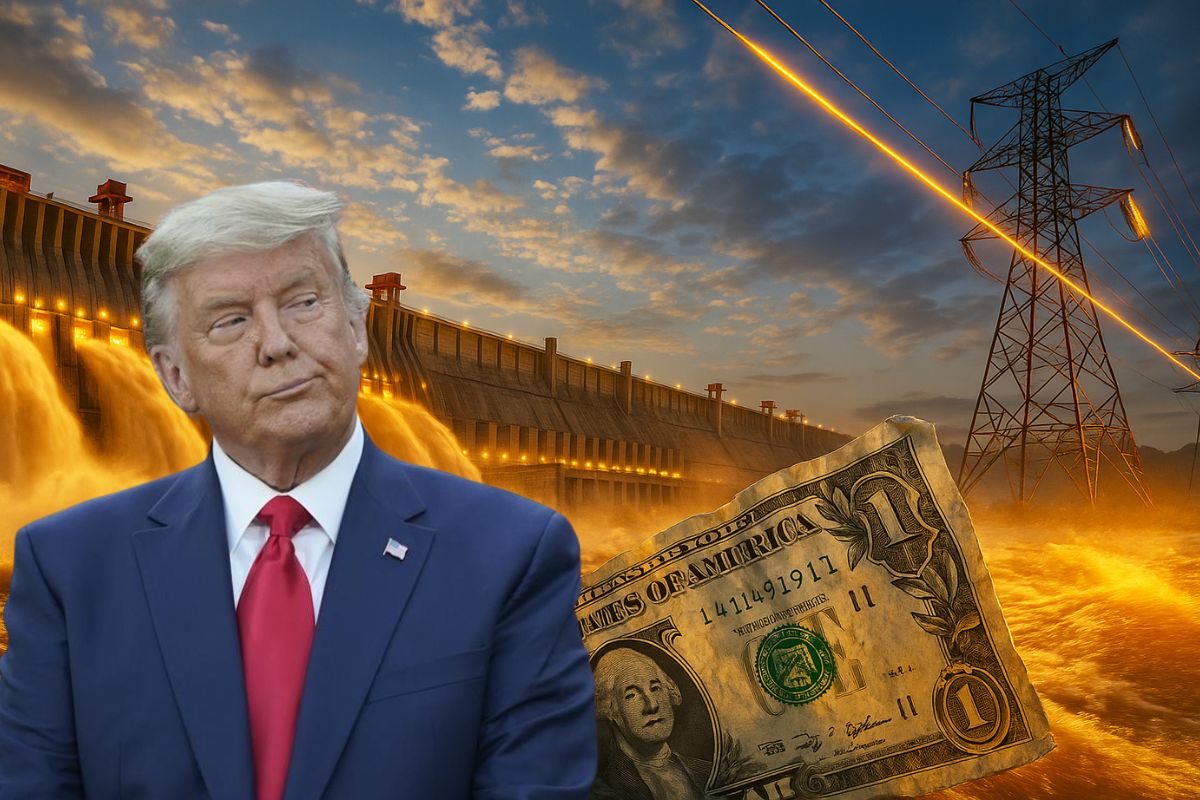


China Prepares Electricity-Backed Currency and Challenges 50 Years of Petrodollar Domination. Beijing Bets on Mega Plants and Hydroelectric Power to Transform Energy into Financial Asset and Weaken the U.S. Dollar.
China is planning a move that could change the global economy: to create a currency backed by electricity. The idea is to use its leadership in renewable energy as a basis to replace the petrodollar system, in place since the 1970s when the U.S. made an agreement with Saudi Arabia to sell oil exclusively in dollars. Analysts like Cyrus Janssen point out that if Beijing moves forward with this plan, it could structurally alter global financial governance.
In practice, the project consists of transforming electricity—increasingly essential for modern economies—into the new pillar of international transactions. As a result, electricity export contracts would be paid in yuan, forcing countries to hold reserves in the Chinese currency and reducing dependence on the dollar.
How the Petrodollar Worked and Why It Is Threatened
The petrodollar has been the foundation of U.S. economic power for the past five decades. Every country that needed to import oil was required to buy dollars to pay, which kept the American currency in high demand. This system sustained Washington’s influence not only in trade but also in international politics.
-
Brazilian city gains industrial hub for 85 companies that is equivalent to 55 football fields.

-
Peugeot and Citroën factory in Argentina cuts production by half and opens a layoff program for more than 2,000 employees after Brazil drastically reduced purchases of Argentine vehicles.

-
A Brazilian city gains a factory worth R$ 300 million with the capacity to process 200 thousand tons of wheat per year, a mill of 660 tons/day, silos for 42 thousand tons, and an industrial area of 276 thousand m².

-
Havan will leave the shopping mall in Blumenau to inaugurate something that the chain has never done before: a megastore in half-timbered style in the Historic Center of the city, which is expected to be completed in May and change the landscape of local retail.


Now, the landscape has changed. Oil Is Losing Ground to Renewable Energies, and electricity has become the universal source of the 21st century, driven by electric cars, artificial intelligence data centers, and global decarbonization goals. It is at this point that China, the world leader in renewable generation, sees the chance to set a new standard.
The Plan for the Electricity-Backed Currency
The proposal is simple: just as oil gave rise to the petrodollar, electricity could support the “eletriyuan.” China, responsible for some of the largest hydroelectric and solar power plants on the planet, would use its capacity for generation and transmission to transform energy into a financial asset.
International energy supply contracts would be settled in yuan, creating a predictable and stable market for electricity as a global commodity. This move, combined with infrastructure projects such as high-voltage transmission lines in Brazil, Africa, and Southeast Asia, would consolidate Beijing as the energy and financial hub of the emerging world.
The Contrast Between the U.S. and China in the Energy Race
While China multiplies power plants and invests in billion-dollar projects, the U.S. faces challenges in modernizing its power grid. The explosion of demand for AI and electric vehicles is putting pressure on the American system, which has not consistently grown since 2005. The difference in strategy is clear: Beijing Plans Decades Ahead, funding projects even without immediate returns, while Washington relies on short-term private investments.
This delay could be decisive. If the U.S. was a protagonist in oil, China is already a protagonist in electricity. From advanced nuclear plants to dams that produce more energy than entire countries, the numbers show an increasingly structural advantage.
Energy as a Geopolitical Weapon
The change is not limited to the economic field. Just as the petrodollar gave the U.S. political power, the eletriyuan would give China global influence. Countries that depend on Chinese energy or its infrastructure would be forced to negotiate directly in its currency. This amplifies the weight of the yuan in international reserves and accelerates the process of dedollarization.
According to Cyrus Janssen, “this could be the biggest financial transformation since the petrodollar agreement.” For the analyst, the project combines two of Beijing’s strengths: clean energy production capacity and long-term strategic planning.
The possible creation of a currency backed by electricity by China opens a new chapter in the competition for control of the global economy. If the petrodollar secured the U.S. half a century of power, the eletriyuan could usher in an era where Beijing sets the rules. What still seems distant could become reality as electricity replaces oil as the basis of modern life.
What do you think, do you believe that the eletriyuan can really replace the petrodollar and change the future of the U.S. dollar? Leave your opinion in the comments—we want to know how you see this competition for global power.









Eu acredito que sim vai desafiar,
Isto porque nos ja vimos uso de drones aboar milhares de kms e assim pode ser ignorados uso excessivo de energia .
Nesse caso então a China faz parte do brics apenas para manter negócios com o Brasil mas as intenções são outras.
Na China eu acredito mais se colocarem o Brasil co o PT, com certeza vai dar ****.