





 Portuguese
  English
  Spanish
  8 min of reading
  0 comments


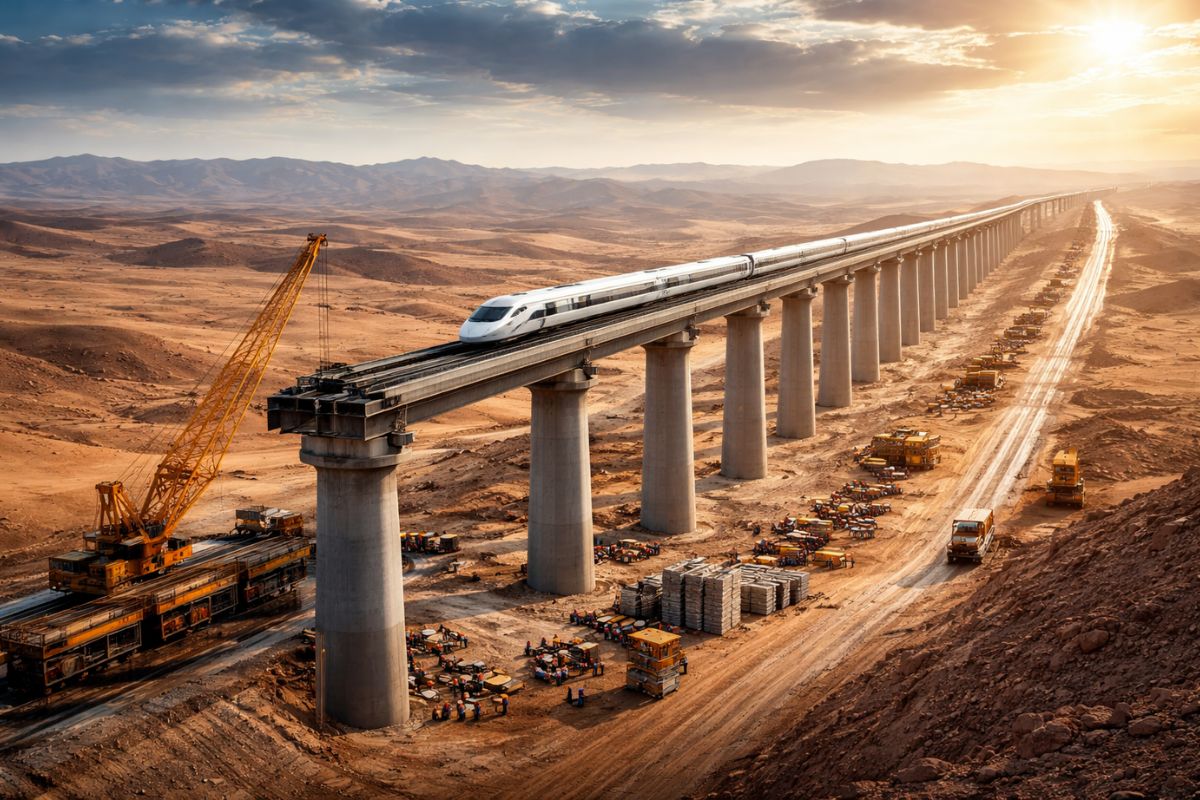
Designed To Cross The Gobi Desert In A Corridor Of Over 1,800 Km, The Elevated Railway On Pillars Connects The Erenhot Border To Mongolia And Heads Toward Russia, Standardizes The Gauge, And Promises To Transport Coal, Copper, And Rare Earths To Chinese Ports Without Stops At The Border.
The Gobi Desert has always been more than a void on the map: it is an extreme environment, with temperatures below -40°C in winter, above 50°C in summer, and terrain that changes behavior as the ground freezes and thaws. It is in this scenario that China plans to sustain an elevated railway for 1,800 km, transforming a natural barrier into a logistics corridor.
The ambition goes beyond engineering. When a construction starts to dictate the pace of coal, copper, and rare earths, it ceases to be just infrastructure and becomes an instrument of power, especially for a landlocked country, trapped between two neighbors and dependent on routes that currently hinder its economy.
What Makes The Gobi Desert An Adversary For Any Project
In the Gobi Desert, the problem is not just crossing distance. The difficulty begins with the climate and multiplies in the soil: aggressive thermal variation accelerates material fatigue and increases the chance of deformations, cracks, and settlements.
-
Friends have been building a small “town” for 30 years to grow old together, with compact houses, a common area, nature surrounding it, and a collective life project designed for friendship, coexistence, and simplicity.

-
This small town in Germany created its own currency 24 years ago, today it circulates millions per year, is accepted in over 300 stores, and the German government allowed all of this to happen under one condition.

-
Curitiba is shrinking and is expected to lose 97,000 residents by 2050, while inland cities in Paraná such as Sarandi, Araucária, and Toledo are experiencing accelerated growth that is changing the entire state’s map.

-
Tourists were poisoned on Everest in a million-dollar fraud scheme involving helicopters that diverted over $19 million and shocked international authorities.


In regions where the ground “works,” infrastructure must fight against time year-round, and the cost of this struggle shows up in constant maintenance and disruptions.
There is also the factor of ground freezing and the associated instability, which can turn a traditional solution into a series of patches.
Bridges and roads can suffer when permafrost starts to melt and then hardens again, creating cycles of expansion and contraction that disorganize alignments and foundations. For a cargo corridor, predictability is as important as speed.
Why Elevating The Tracks Changes The Logic Of Crossing

The central strategy is simple in idea and tough in execution: to remove the track from direct contact with the more unstable ground.
Instead of tracks resting on the ground, the proposal places the railway on concrete pillars anchored in a more solid base, below the layer that freezes and thaws. With the tracks suspended, the expansion and contraction of the ground cease to control the alignment of the line, reducing some of the effects that would destroy a structure at ground level.
This choice also reveals the type of priority of the project: operational continuity. About 60% of the planned route would be elevated, while the remaining would be on the ground where the terrain allows.
The logic is to use long viaducts in the most problematic areas of the Gobi Desert, without turning the entire route into a single rigid solution and, at the same time, without accepting the bottlenecks that the ground would impose.
The Corridor Design: From Erenhot To Mongolia And Toward Russia
The railway corridor starts in Erenhot, at the border with Mongolia, crosses approximately 1,000 km of the Gobi Desert within Mongolian territory, reaches the capital, and heads toward Russia, with the destination indicated for the city of Nausqu.
In total, the route adds up to over 1,800 km and is designed for high cargo capacity, with operation anticipated at up to 120 km/h.
In addition to the elevated structure, the project incorporates solutions for severe weather and operational safety: tunnels with ventilation and heating in colder sections, systems to prevent track freezing, real-time earthquake monitoring, and engineering adjustments to reduce failures in extreme environments.
The goal is not just to build but to keep functioning regularly, even when winter becomes a daily test.
Gauge And Bottlenecks: The Detail That Delays Weeks And Costs Dear
There is a technical obstacle that, for decades, has acted as a barrier to exports: the gauge, the distance between the tracks.
The network associated with the Soviet standard does not match the standard gauge used by China. In practice, this forces a transshipment: the cargo exits one train and enters another when crossing the border, which consumes time, increases operational costs, and heightens the risk of queues and delays.
This type of bottleneck does not just show up on the clock. It turns into financial costs and loss of competitiveness. A coal shipment that could traverse the country in a few days might be stuck for weeks waiting for transfer.
When transportation becomes unpredictable, the exporting country loses bargaining power, as the buyer prices in the risk and demands harsher conditions.
The Standardization That Changes The Flow And Shortens The Path To The Ports
The railway was designed to use standard international gauge, aligned with the Chinese standard. This tends to eliminate the need for train swapping at the border, allowing cargo to leave Mongolia’s mines and go straight to Chinese ports.
The change may seem technical, but it alters the economic geography: it shortens time, reduces handling, and decreases losses associated with transshipment and waiting.
This standardization also creates a less obvious consequence: it increases physical integration between Mongolian production and the Chinese industrial chain.
When the route becomes direct, those controlling logistics start to influence the rhythm of the market, because they control the “how much” and “when” of each batch that arrives for processing and export.
What Is Below The Surface: Why Coal, Copper, And Rare Earths Become The Project’s Axis
Mongolia holds reserves that change the country’s weight in the global scenario. The Oyu Tolgoi mine in the south is described as the third-largest copper mine on the planet. The Tavan Tolgoi region is associated with about 6 billion tons of coal.
These include relevant reserves of rare earths, including elements like neodymium and dysprosium, essential for permanent magnets used in electric motors and wind turbines.
Copper, in particular, stands out as a key input for electrification: solar panels, wind turbines, and electric vehicles consume large quantities, with the indicated projection being that global demand for the metal will double by 2035.
In this context, logistics is not a detail: it defines who delivers first, who delivers cheaper, and who sets the standard.
Why China Would Invest $50 To $80 Billion
The estimated cost of the corridor ranges from $50 to $80 billion, a level that usually requires clear justifications.
The first is economic: to transform a “locked safe” into a continuous flow of exports, reducing weeks of waiting to hours or a few days of travel.
The second is industrial: to transport raw materials quickly to processing, enhancing control over value chains.
The third is strategic. China already accounts for about 40% of global copper processing and dominates approximately 85% of global rare earth processing.
If the corridor shortens the distance between Mongolian reserves and Chinese processing, it reinforces this position. It is not just about buying ore, but reducing the chance of competitors disputing the route and supply.
The Geopolitical Component That Scares The West
The corridor fits into the China–Mongolia–Russia economic axis, associated with the Belt and Road Initiative, and creates the prospect of a direct land link from the Chinese coast to Russian territory.
This tends to reduce dependence on maritime routes and strategic bottlenecks, offering a northern logistical alternative in a scenario of tensions, sanctions, trade disputes, and competition for critical minerals.
For Western countries, the fear is not just the project itself, but the cumulative effect: more outflow capacity, more predictability, more integration, and potentially more influence over prices and availability of essential inputs for industry and energy transition.
When access to critical minerals becomes more concentrated, foreign policy starts to run alongside logistics.
Mongolia Between Two Powers: Real Opportunity And Proportional Risk
Mongolia is the largest landlocked country in the world and is surrounded by two neighbors, Russia to the north and China to the south.
This map already defines part of the fate: any infrastructure solution increases interdependence with one side, the other, or both. Part of society sees in the corridor a chance to break a historical blockade, transforming mineral wealth into development.
At the same time, there is a risk of excessive dependency. The country is often described as “a shrimp between two whales” because a decision that overly favors one side can provoke a reaction from the other.
The line can become a corridor of growth or a corridor of influence, depending on who controls the terms, and this cannot be solved only with concrete and tracks.
Debt, Concessions, And What Contracts Decide In The Long Term
The concern with the so-called “debt trap” accompanies large projects financed by powers.
The fear is that the partner accumulates obligations they cannot pay and, in response, is pressured to concede long-term control over strategic assets.
An example is the case of Sri Lanka, where a 99-year concession was granted over a port after repayment difficulties.
To reduce this type of risk, proposals for negotiation arise: equity participation of Mongolia in the railway, fixed tariffs in the contract, and clauses that prevent the loss of strategic assets in the event of default.
Still, the core of the story lies in the details: currency, guarantees, arbitration, usage targets, and review mechanisms. This is where projects of this scale tend to gain or lose legitimacy.
The Environmental Impact In The Gobi Desert And What Still Needs Clarification
The Gobi Desert is home to rare and endangered species, such as the wild Bactrian camel and the snow leopard.
An elevated railway can reduce some direct impacts on the soil, but does not eliminate effects like noise, vibration, habitat fragmentation, and pressure for auxiliary infrastructure, especially if the construction stimulates the opening of new mines and support routes.
There is also criticism that the environmental studies published so far may not be sufficient to measure all risks.
In fragile ecosystems, the “functioning” of the project is not the only criterion: how the region changes around it matters, including fauna, movement routes, spawning areas, and human access to previously isolated zones.
2035: What Would Change In The Speed Of Ore And Global Competition
In the most optimistic scenario, the start of operations is associated with 2035. If the railway delivers what it promises, the time leap would be enormous: coal that currently takes weeks to reach Chinese ports would be transported in less than 48 hours; the copper from Oyu Tolgoi could reach smelters in less than a day.
This tends to reduce costs, increase predictability, and pressure competitors to seek alternative supplies and processing.
But the consequence is ambiguous. The route can accelerate the energy transition by facilitating the flow of copper and rare earths, while at the same time boosting coal and expanding mining in the Gobi Desert.
The same track that shortens distances may extend dilemmas, because it places development, sovereignty, environment, and global competition on the same line.
In the end, the question is not only whether the pillars will withstand the Gobi Desert, but whether the agreements will bear the weight of what will be transported by them.
If You Were A Citizen Of Mongolia, What Would You Require To Support This Corridor?
Would You Prefer Tariffs And Equity Participation Guaranteed For Decades, Strict Environmental Limits With Independent Oversight, Or Total Priority For Rapid Growth Even With The Risk Of Dependency?
And, From The Outside, Do You See This Project As Necessary Infrastructure Or As A Piece Of Control Over Critical Minerals That The Whole World Needs?










-

-

-

-

18 pessoas reagiram a isso.