





 Português
  Inglês
  Espanhol
  3 min de leitura
  0 comentários



If Cloud Water Accumulates in the Sky, Why Doesn’t It Fall All at Once, Like a Waterfall? The Physics and Chemistry of the Atmosphere Explain This Natural Phenomenon!
Rain is an essential natural phenomenon for sustaining life on Earth. But why does it fall in small drops and not continuously?
This question leads us to a deeper understanding of the physics of water in the atmosphere and the water cycle, which is fundamental for maintaining the balance of our planet.
The Water Cycle and Cloud Formation
Water on Earth is in constant motion between oceans, rivers, the atmosphere, and soil. This cycle, known as the water cycle, involves processes like evaporation, condensation, and precipitation.
-
A bright yellow mushroom imported from Asia escaped from a cultivation farm in the United States in 2010 and is now aggressively spreading across 25 states, destroying entire communities of native fungi in American forests.

-
Buried under China, a colossal machine weighing 20,000 tons began operating as the largest neutrino detector on the planet and, in just 59 days, surpassed results that science took half a century to achieve.

-
Iran enters the center of a climate alert after the war emitted 5.6 million tons of CO2 in two weeks, surpassing the annual pollution of entire countries.

-
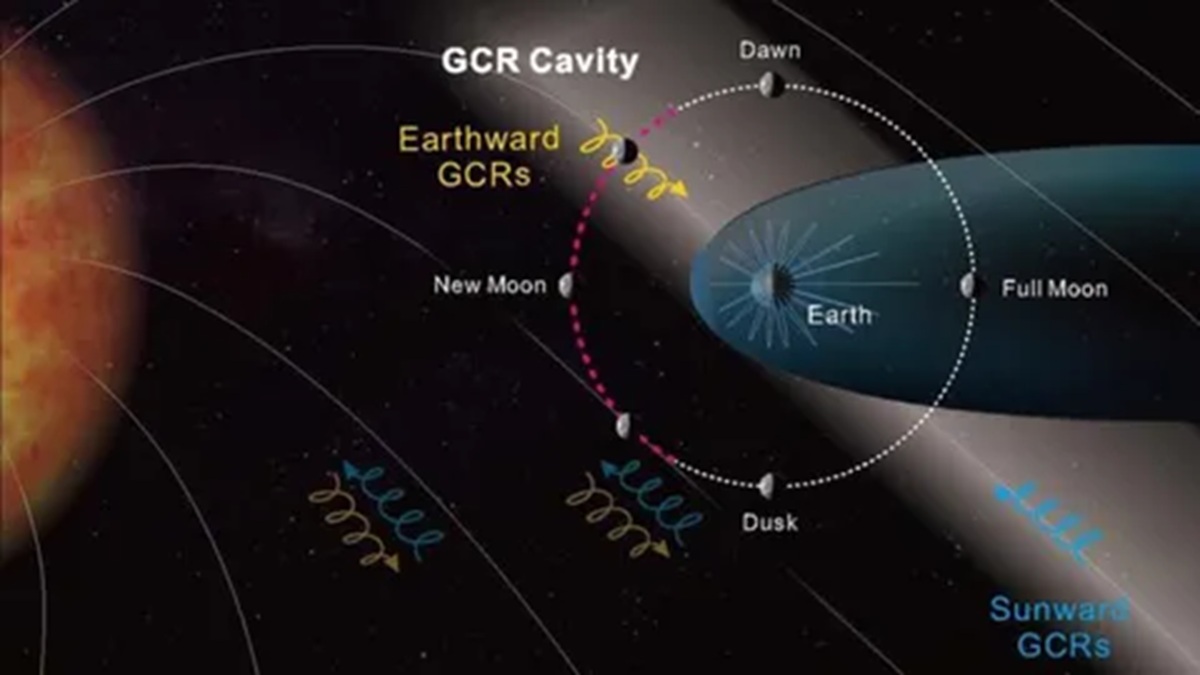
Lunar exploration may change after a Chinese probe finds a “cavity” of radiation that reduces the impact on astronauts by up to 20% at certain times on the Moon.

Evaporation transforms the liquid water from seas, lakes, and rivers into vapor, which rises into the atmosphere. This vapor cools and condenses when it encounters lower temperatures, forming tiny droplets that make up the clouds.
Clouds can be formed by ice crystals or water droplets, depending on altitude and air temperature.
Some of these clouds, like nimbostratus and cumulonimbus, are responsible for intense rainfall. But how exactly does the water in these clouds turn into raindrops?
The Role of Condensation Nuclei
For water vapor to transform into droplets, it needs surfaces to cling to. These surfaces are called condensation nuclei and can be composed of dust particles, pollen, or other aerosol particles suspended in the atmosphere.
These small particles allow the moisture in the air to aggregate, forming microscopic droplets that grow over time.
When these droplets reach a sufficient size and weight to overcome air resistance, they begin to fall toward the ground.
During this process, many smaller droplets merge with larger ones through a process called coalescence, becoming larger raindrops.
The Size and Shape of Raindrops
Raindrops can vary in size, but they rarely exceed 5 millimeters in diameter. This occurs because friction with the air causes larger drops to break into smaller ones. This phenomenon results from the balance between the surface tension of water and air resistance.
Surface tension is the force that keeps the droplets cohesive, preventing them from breaking apart easily. However, when a droplet reaches a critical size, air resistance becomes greater than this force, causing the droplet to split.
This explains why rain is composed of countless small droplets, rather than a single giant drop falling from the sky.
How Raindrops Fall
The fall of raindrops is not a random process. When a droplet starts to descend, it creates an air path in its trajectory, facilitating the descent of other droplets right behind it.
This phenomenon is similar to the wake left by boats in the water, where the movement generates a trail that influences the flow around it.
Additionally, the speed at which raindrops fall depends on their size. Smaller droplets fall more slowly and can be suspended in the air by rising currents, while larger droplets fall more quickly.
As they fall, some droplets merge with others, increasing in size, while others split due to impact with the air.
Another interesting factor is that raindrops do not always fall in a straight line. Strong winds and air currents can cause them to follow inclined or even upward trajectories before finally reaching the ground.
Electricity and the Union of Droplets
Research indicates that atmospheric electricity can influence the formation and behavior of raindrops.
When two electrically charged droplets meet, the attraction between opposite charges can facilitate their merging. This factor may explain why some droplets combine while others fragment along the way.
The Importance of Rain for the Planet
Rain plays an essential role in sustaining life on Earth. It replenishes rivers and lakes, irrigates crops, and regulates the planet’s temperature. Additionally, it helps clean the atmosphere by removing pollutants and suspended particles in the air.
With climate change, rainfall patterns are shifting, affecting ecosystems and communities around the world.
The increase in extreme weather events, such as intense storms and prolonged droughts, demands a greater understanding of atmospheric behavior and human influences on the climate.
With information from scienceabc.







-

-

-

-

5 pessoas reagiram a isso.