





 Português
  Inglês
  Espanhol
  7 min de leitura
  0 comentários


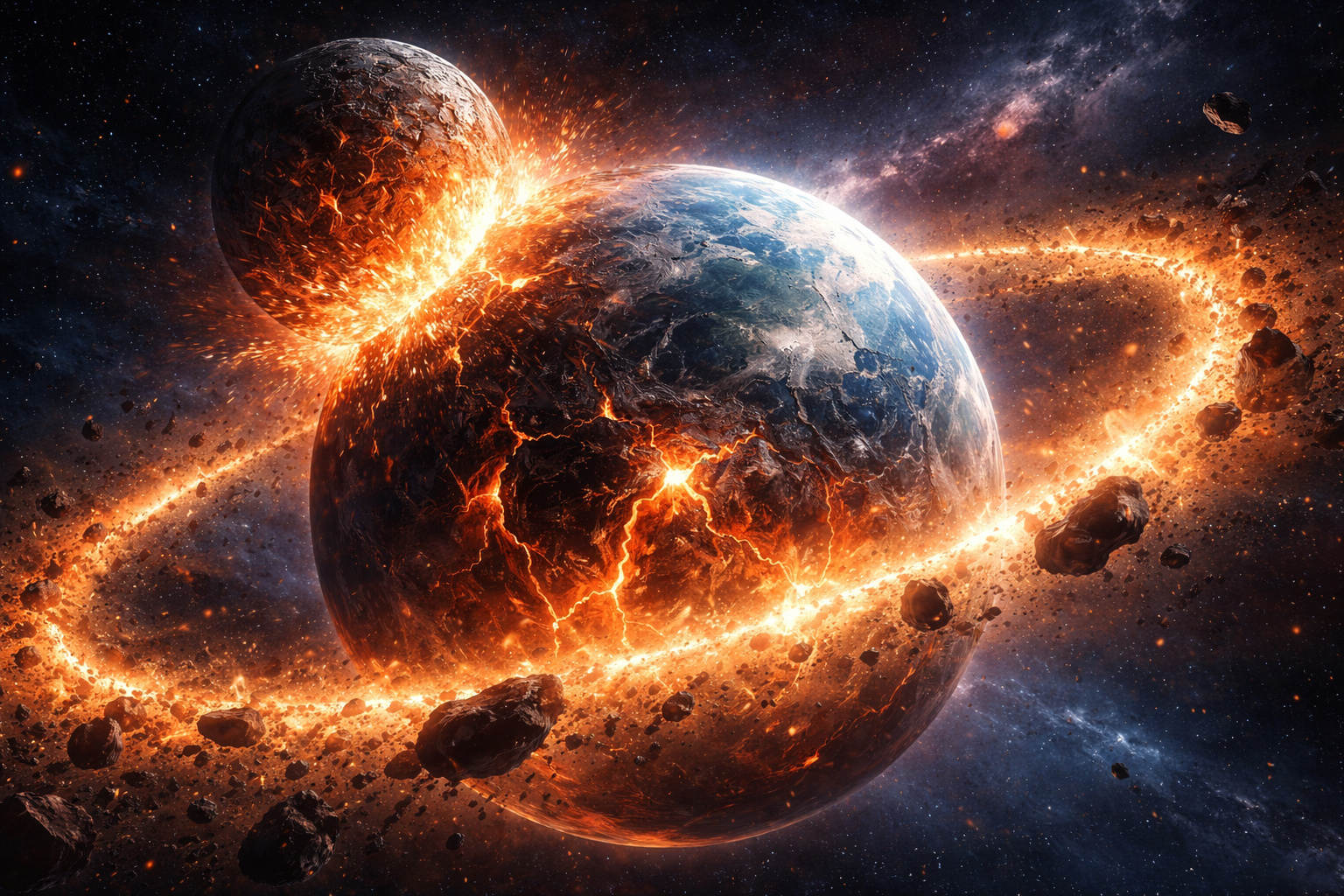
MIT Study Reveals That Fragments of the Proto-Earth 4.5 Billion Years Old Survived the Impact That Formed the Moon and Are Still Preserved in the Earth’s Deep Mantle.
About 4.5 billion years ago, Earth looked nothing like the planet we know today. During that early period in the history of the Solar System, the planet was still forming and essentially consisted of a huge incandescent mass of magma and molten rock. There were no oceans, no breathable atmosphere, and the surface was dominated by extreme temperatures and constant impacts from space debris. Scientists refer to this early stage as the proto-Earth, the embryo of the present planet. During this period, which lasted approximately 100 million years, rocky material began to slowly organize into layers. It was at this moment that the interior of the planet began to differentiate, forming the first structures that would later become the metallic core, the deep mantle, and the primitive crust.
This process, however, was abruptly interrupted by a catastrophic event. An object the size of Mars collided with the proto-Earth in an impact so violent that it completely altered the history of the planet and the Solar System itself.
The Impact of Theia: The Planetary Collision That Gave Birth to the Moon
The celestial body responsible for the collision was named Theia. Astrophysical models indicate that it had between 10% and 40% of the mass of modern Earth, meaning its size was comparable to that of Mars or even half the size of the primitive Earth.
-
A bright yellow mushroom imported from Asia escaped from a cultivation farm in the United States in 2010 and is now aggressively spreading across 25 states, destroying entire communities of native fungi in American forests.

-
Buried under China, a colossal machine weighing 20,000 tons began operating as the largest neutrino detector on the planet and, in just 59 days, surpassed results that science took half a century to achieve.

-
Iran enters the center of a climate alert after the war emitted 5.6 million tons of CO2 in two weeks, surpassing the annual pollution of entire countries.

-
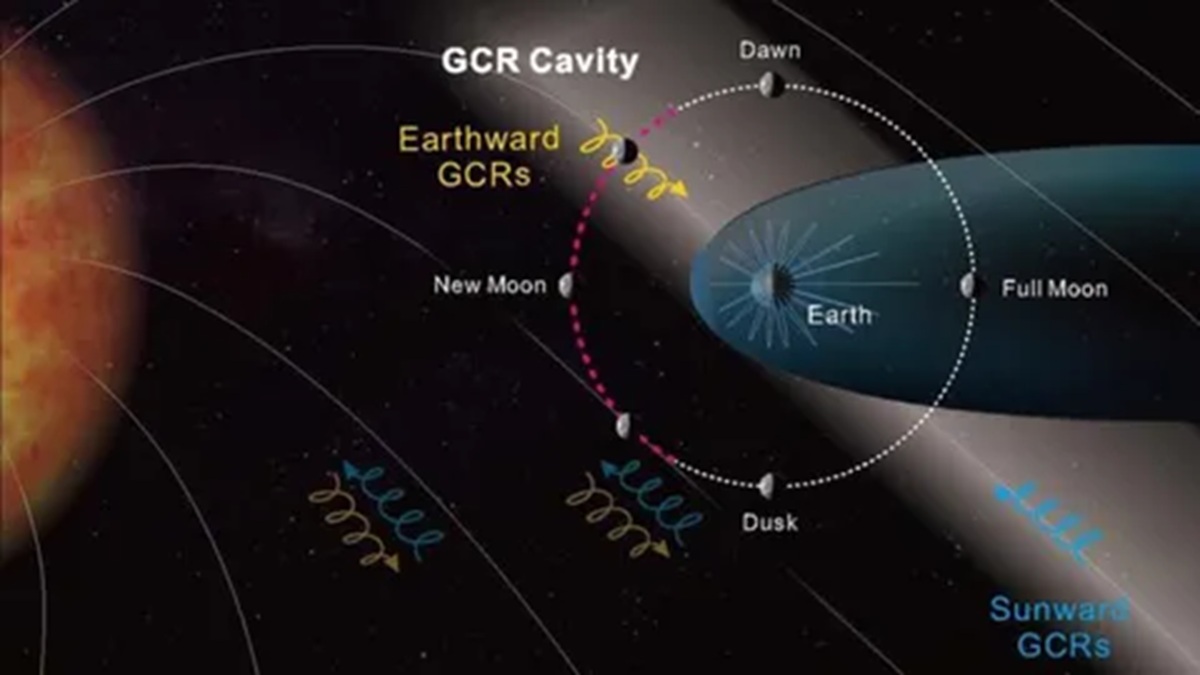
Lunar exploration may change after a Chinese probe finds a “cavity” of radiation that reduces the impact on astronauts by up to 20% at certain times on the Moon.

When the impact occurred, the energy released was enormous. The collision was powerful enough to melt and vaporize large parts of the interiors of both planets. Some of this material was thrown into space and remained in orbit around the forming Earth. Over time, the ejected fragments came together and formed the Moon, the only natural satellite of our planet.


The remainder of the material resulting from the impact eventually fused again, forming the planet we know today. For decades, geologists believed that this impact would have been so intense that any chemical vestige of the original proto-Earth would have been completely destroyed or mixed with the material brought by Theia.
This interpretation dominated planetary science for many years. According to this classic model, the collision would have wiped out any chemical signature preceding the impact, making it impossible to reconstruct the composition of Earth before the formation of the Moon.
Study Published in Nature Geoscience Reveals Preserved Signs of the Proto-Earth
This conclusion began to be questioned in October 2025, when a team led by professor Nicole Nie from the Department of Earth, Atmospheric, and Planetary Sciences at MIT published a study in the scientific journal Nature Geoscience.
The research revealed something unexpected: fragments of the original proto-Earth still seem to exist inside the planet, preserved in the deep mantle. This evidence was not found in recent surface rocks or in geological sediments exposed in the Earth’s crust.
The discovery arose from an extremely small difference in the proportion of a specific potassium isotope present in certain ancient rocks. This isotope is potassium-40, one of the three naturally occurring isotopes of the element potassium found on Earth.
Potassium Isotopes Reveal a Chemical Signature of Billions of Years
Potassium has three main natural isotopes: potassium-39, potassium-40, and potassium-41. In almost all rocks on the planet, the ratio between these three isotopes remains practically constant. After billions of years of geological processes, such as plate tectonics, mantle convection, and meteoritic impacts, the interior of Earth has become chemically very homogeneous.
This means that, in most cases, any terrestrial rock presents virtually the same isotopic composition. However, some very old rocks exhibit slight differences in this ratio, which caught the researchers’ attention.
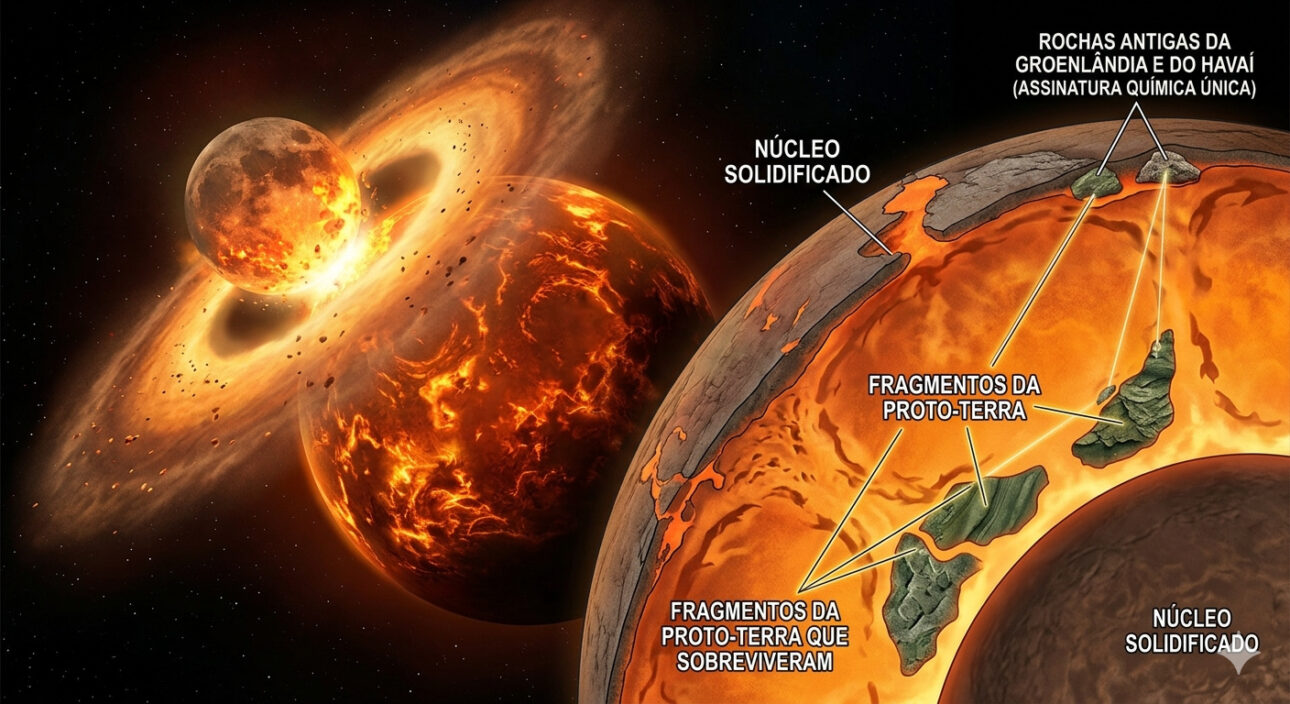
To investigate this phenomenon, the MIT team collected geological samples from extremely ancient regions of the planet. Among them were rocky outcrops in Greenland and Canada, where some of the oldest continental formations of Earth can be found, with an age of nearly 4 billion years.
In addition to these ancient rocks of the continental crust, scientists also analyzed volcanic lavas from Hawaii, which are fed by deep plumes from the Earth’s mantle.
Analysis of Rocks from Greenland, Canada, and Hawaii Reveals a Rare Deficit of Potassium-40
Each sample was pulverized, dissolved in acid, and analyzed using high-resolution mass spectrometers, instruments capable of measuring isotopic ratios with extremely high precision.
The result was surprising. All analyzed samples showed a deficit of about 65 parts per million of potassium-40 when compared to the rest of the Earth’s crust and mantle.
Although this number seems small, it is extremely significant in geochemical terms. To understand the scale of this difference, researchers use a simple analogy: it would be like finding a single specific grain of brown sand in a bucket full of yellow sand — and repeating this discovery in samples collected from different parts of the planet.
The fact that this chemical signature appears consistently in distinct locations makes the discovery hard to ignore.
Why the Deficit of Potassium-40 Indicates Material from the Proto-Earth
The explanation proposed by scientists is directly related to the impact of Theia. When the planet collided with the proto-Earth, it brought with it large amounts of rocky material, including potassium-40. This material ended up mixing with the planet resulting from the collision, raising the average level of this isotope in modern Earth.
According to previous models, all of the planet’s material should have undergone complete mixing. Therefore, all rocks should present approximately the same elevated level of potassium-40.
However, the samples analyzed in the study exhibit lower quantities of this isotope. This suggests that part of the material present in these rocks did not fully participate in the mixing caused by the collision.
In other words, these rocks may contain fragments of the original material of the proto-Earth, preserved since before the formation of the Moon.
Computational Simulations Reinforce the Hypothesis of Preserved Proto-Earth
To test this hypothesis, researchers conducted complex computational simulations. The models included data on known meteorites, impacts occurring later in Earth’s history, cooling processes of the planet, mantle circulation, and plate tectonics.
Even considering all these processes, no scenario was able to reproduce the potassium-40 deficit observed in the samples. The only explanation compatible with the data was the presence of material that existed before the collision with Theia.
According to professor Nicole Nie, this may be the first direct evidence that fragments of the proto-Earth survived the impact that formed the Moon. This is surprising because, until recently, it was believed that any previous chemical signature would have been completely erased by the violence of the collision.
The Deep Mantle of Earth May Function as a Geological Time Capsule
The lava samples from Hawaii are particularly important for this discovery. Unlike many surface rocks, these lavas do not originate in the Earth’s crust. They come from hot rock plumes that rise from the deep mantle, potentially originating from up to 2,900 kilometers deep.
This indicates that fragments of the proto-Earth are not only preserved in very old surface rocks but also circulate within the planet. In some cases, this material ends up being transported to the surface through volcanic activity.
This discovery also connects to recent research on the Earth’s interior. In 2023, studies published in the journal Nature suggested that two enormous structures located in the lower mantle — known as LLSVPs (Large Low Shear Velocity Provinces) — may be fragments of Theia itself, buried thousands of kilometers deep.
Now, the new study indicates that the deep mantle can preserve both fragments of Theia and fragments of the original proto-Earth, functioning as a sort of geological archive of the planet’s formation.
Known Meteorites Do Not Match the Chemical Composition of the Proto-Earth
Another important result of the study emerged when researchers compared the isotopic signature of the analyzed rocks with all known meteorites. Meteorites are considered the primitive building blocks of the Solar System and are often used to reconstruct the original composition of Earth.
However, none of the cataloged meteorites show exactly the same isotopic profile of potassium observed in the rocks associated with the proto-Earth. This suggests that the material that formed the planet may not be represented in known meteorites.
According to Nicole Nie, this indicates that the current inventory of meteorites available for study is still incomplete. In other words, there may be primordial material from the Solar System that has yet to be identified or simply does not reach Earth in the form of meteorites.
Fragments of the Proto-Earth May Be the Only Remnants of the Planet’s Primordial Material
If this interpretation is correct, the rocks preserved in the deep mantle of Earth may represent the only known fragments of the primordial material that formed the planet. This opens a new perspective for studying the origin of Earth and the early evolution of the Solar System.
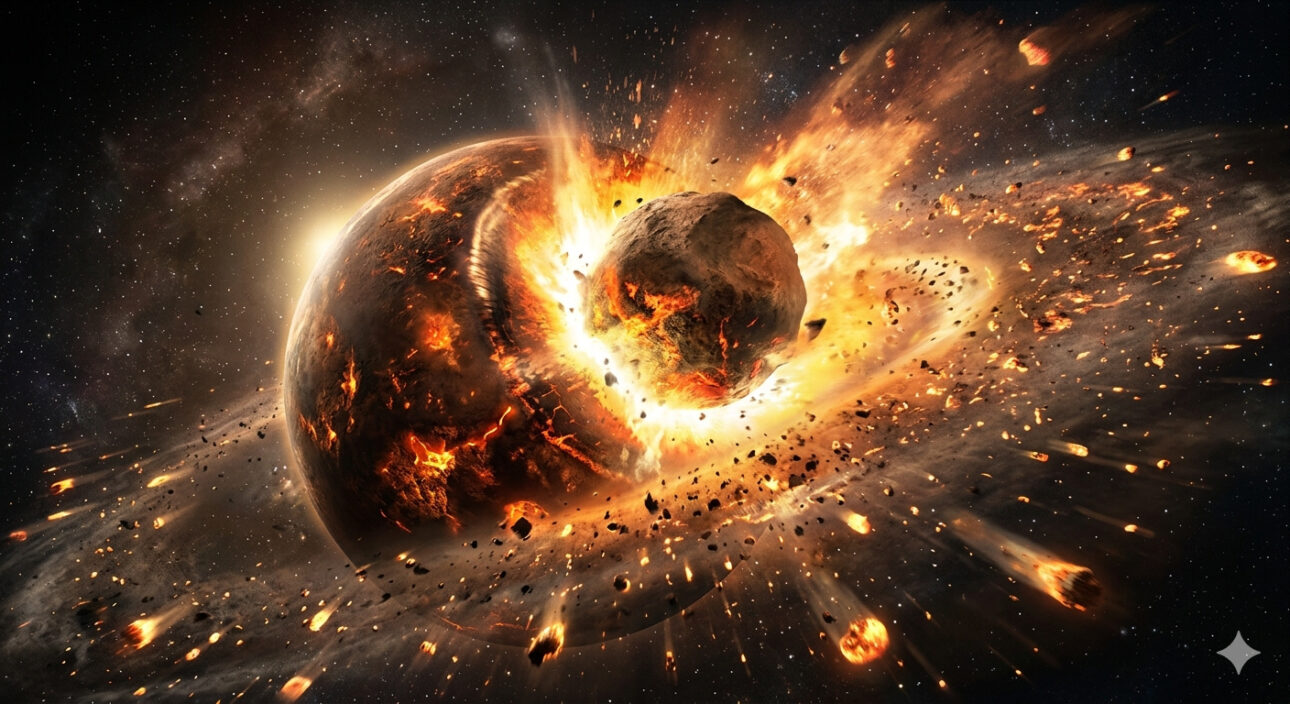
For decades, scientists believed that the impact of Theia had completely erased any chemical record prior to the formation of the Moon. Now, the evidence suggests that this record may have survived in isolated pockets within the planet’s interior.
These fragments act as a kind of geological archive of billions of years, preserving clues about the composition of primitive Earth and the processes that led to the formation of a planet capable of sustaining life.
More than 4.5 billion years after its formation, Earth still holds remnants of a time before the modern planet. These fragments of the proto-Earth represent a rare scientific window into the early history of our world.







-

-

-

-

10 pessoas reagiram a isso.